
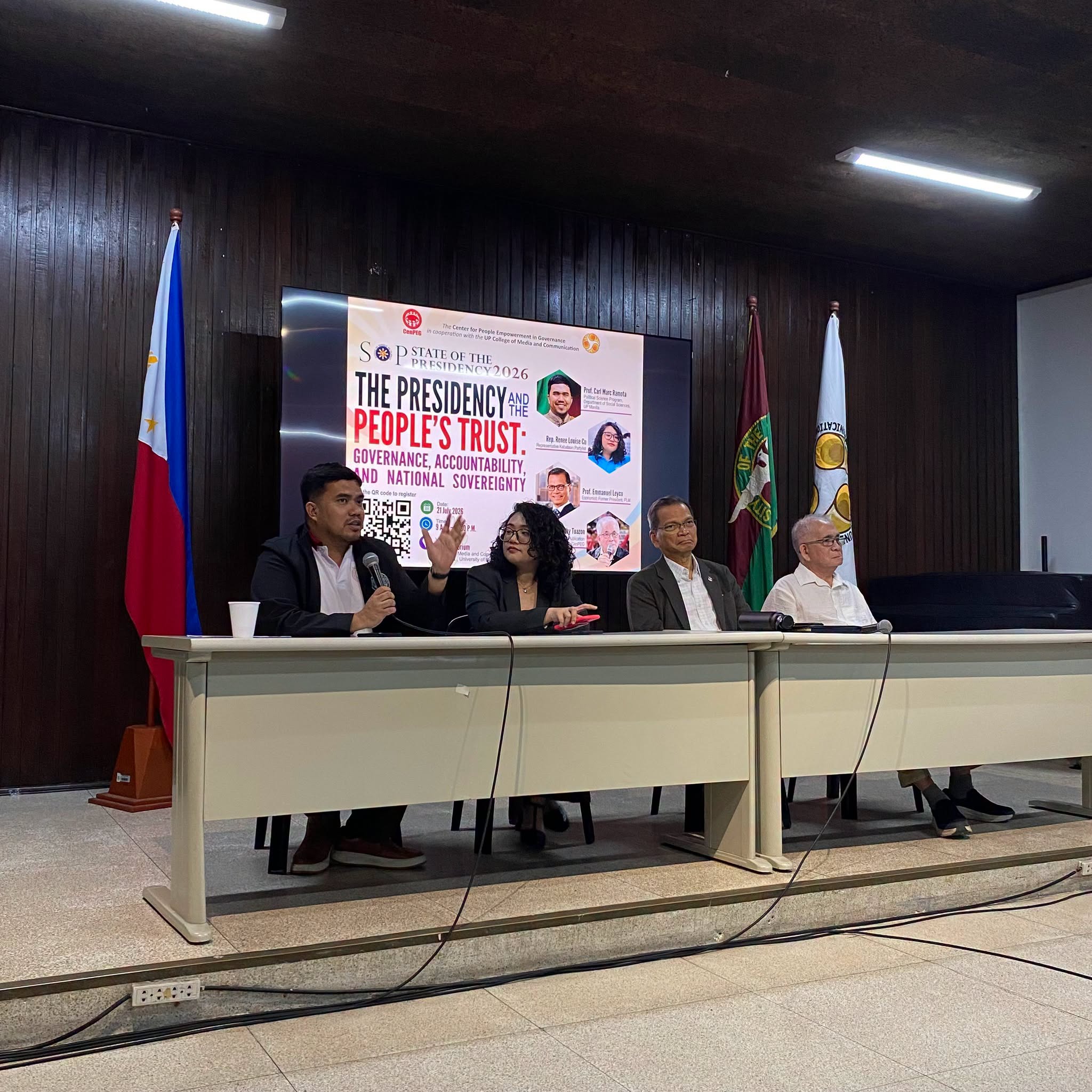
QUEZON CITY, Philippines – Lower-income households bore the brunt of the Philippines’ inflation crises under President Ferdinand Marcos Jr., with experts highlighting that economic classifications mask the harsh realities facing ordinary citizens.
During the State of the Presidency (SOP) 2026 forum held July 20, President and Chief Economist of Credit Rating Investors’ Services Philippines (CRISP) Prof. Emmanuel Leyco presented data showing inflation’s uneven burden.
Headline inflation peaked at 8.7 percent in January 2023 and 7.2 percent in April 2026, but inflation among the poorest households reached even higher levels – 9.7 percent and 8.5 percent respectively.
“A classification is a certificate, not a condition,” Leyco said, cautioning that the country’s recent attainment of upper-middle-income economy status does not fully reflect lived experiences.
“Economic indicators should be weighed alongside people’s actual living conditions.”
Fuel prices climbed to approximately 130 per liter for diesel and 100 per liter for gasoline during the crisis periods. Leyco estimated that 3.1 million Filipinos were at risk of falling into poverty due to the energy shock, noting that the government’s average fuel subsidy for public utility vehicles amounted to only 247 per week.
Beyond household impacts, Leyco questioned the country’s investment trajectory. While the Philippines maintained its investment-grade status, international credit agencies revised their outlooks downward.
“The milestone was earned by the economy’s past; the outlook is being marked down by its present governance,” he said.
He emphasized that public confidence should be treated as an economic measure reflected in borrowing costs, investment flows, and institutional trust, urging the administration to respect accountability processes and ensure official statements are backed by accurate data.
Foreign policy concerns raised
Prof. Bobby Tuazon, Vice Chairperson of Center for People Empowerment in Governance (CenPeg), examined the Marcos administration’s foreign policy direction, particularly its deepening defense cooperation with the United States amid escalating tensions in the West Philippine Sea (WPS).
Tuazon noted the expansion of Enhanced Defense Cooperation Agreement (EDCA) sites from five to nine locations, alongside closer security coordination with Washington. At the same time, he acknowledged efforts to maintain dialogue with Beijing regarding maritime disputes and potential economic cooperation.
However, Tuazon challenged whether the Philippines maintains genuine independence in its diplomatic posture.
“Does the Philippines really have an independent foreign policy? I think many of us here would say right away that there’s no such thing,” he said.
“A foreign policy, in theory, should be dictated by national interests and not the U.S.”
He expressed concern that expanded military cooperation with Washington could increase risks for the Philippines should tensions between the United States and China escalate.
Media’s role in accountability
Kabataan Party-list Rep. Renee Louise Co emphasized the responsibility of media organizations to make complex legal proceedings accessible to ordinary Filipinos through concise reporting, explainer pieces and social media content.
“I think we could be doing more to ensure that the public is continuously engaged and informed with the process,” Co said. She called for translating legal developments into language that citizens can readily understand.
Co stressed that accountability must extend beyond the impeachment trial through sustained civic engagement.
“We have to hold onto the issues that everyone understands, offer solutions coming not from individual people or select groups, but from the people themselves, and then campaign to ensure that these solutions become policy and become our reality,” she said.
The SOP 2026 forum, organized by CenPEG in partnership with the University of the Philippines College of Media and Communication, was held at the UP College of Media and Communication Auditorium.
It served as one of several pre-SONA discussions assessing the Marcos administration’s record on governance, the economy, accountability and foreign policy ahead of President Marcos Jr.’s fifth State of the Nation Address scheduled for July 27. (davaotoday.com)

