
MANILA, Philippines—On Sept. 21, 2026, the Philippines observed the 54th year of signing Proclamation No.1081 that put the country under martial law.
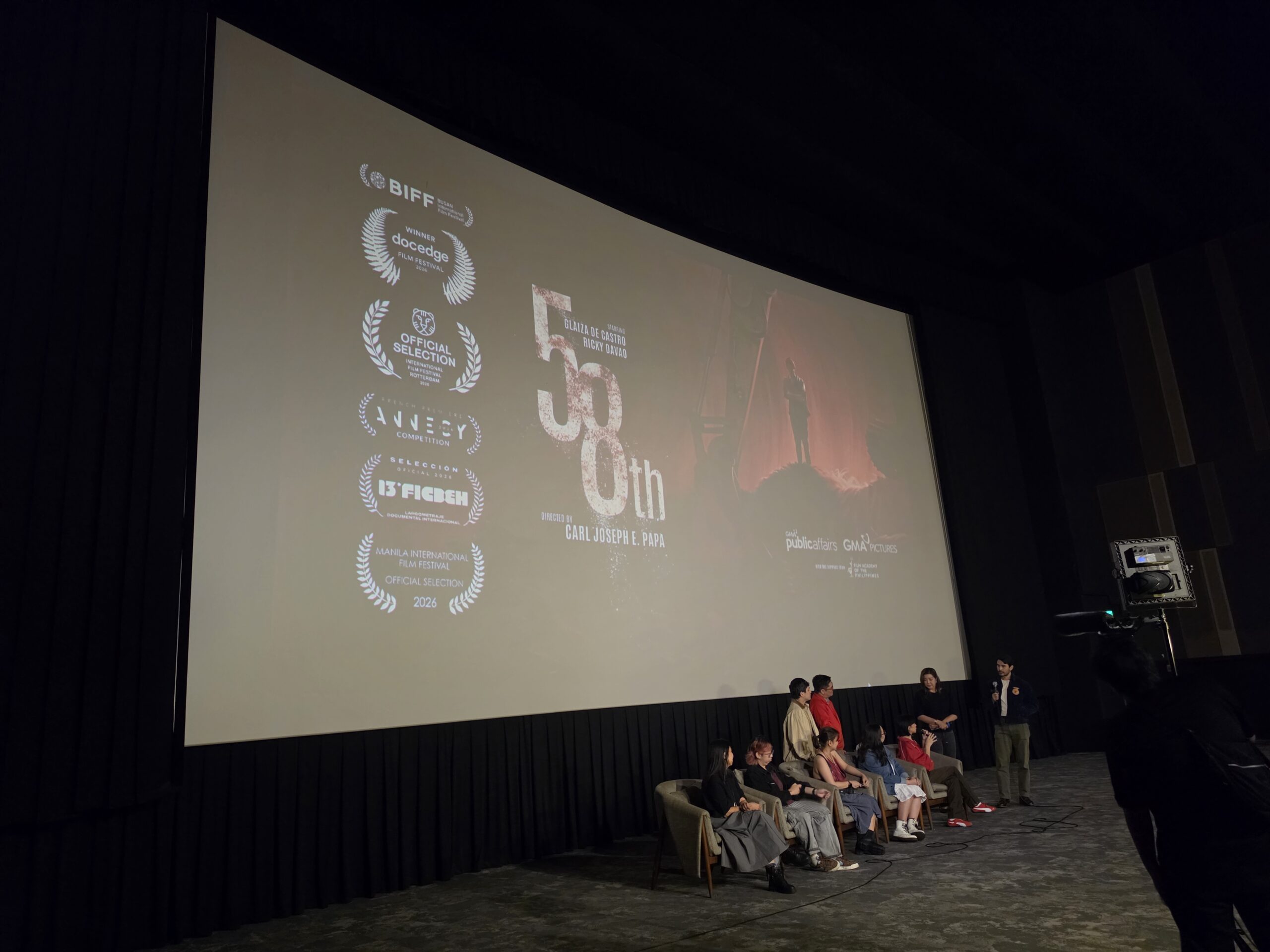
In time of remembering the atrocities under martial law, GMA Public Affairs and GMA Pictures brought to the Philippine theaters 58th—the film that looks back on the 2009 Ampatuan town massacre that killed 58 people including 32 journalists.
The film raises an old question to the new generation: What happens when telling the truth becomes a struggle?
The images in the massacre in Ampatuan town in Maguindanao del Sur have not disappeared 17 years later.
They remain in the memories of families who lost loved ones, in court records, in news archives and no on screen through 58th—an animated documentary.
The film does not merely retells the deadliest attack on journalists in the history but it centers on Reynafe Castillo, daughter of photojournalist Reynaldo “Bebot” Momay whose body was never found and remains excluded from the official count.
Today, the family still continues to seek Momay’s recognition as the 58th victim. Castillo argues the absence of a body does not mean the absence of a victim.
While the film gravitates on Reynafe’s story confronting what happened in 2009, the filmmakers juxtapose how the violence easily disappears from public memory.
Act of remembering
The irony surrounding “58th” is hard to miss: A film made to remember people whose lives were violently cut short struggled to reach audiences.
During the film’s talkback, producer Nessa Valdellon recalled that the project had been in development for years. The filmmakers faced challenges in completing it because of its demanding subject and the difficulty of recreating events for which little visual documentation existed.
The struggle continued after the film was completed. First, it was denied a screening at Cinemalaya. Later, it received a limited permit to exhibit. The filmmakers fought hard to bring the film to audiences that its theatrical performance covered a shorter period than the traditional exhibition run.
She drew a painful parallel between the film’s limited reach and the people whose story it seeks to preserve.
“The 58 were silenced, and now they’re still being silenced because there are so many limitations on having this movie come out and having people be able to watch it,” she said.
The barriers to screening became another layer of the story: A film about journalists silenced by violence was itself struggling to make their story accessible to the public.
“58th” is not only about remembering those who were silenced; it also asks what happens when stories about violence, accountability and justice encounter barriers before reaching the public.
The film eventually screened for Philippine audiences at Shangri-La Plaza from Sept. 16 to 22, 2026. It had previously screened at international festivals, including Rotterdam and Annecy, and received recognition at international film festivals.
For the filmmakers, bringing the film to audiences was about more than completing a cinematic project.
“This is really an act of remembering for us,” Valdellon said during the talkback.
That act of remembering carries particular weight in a country where journalists continue to document violence, corruption, human rights violations and abuses of power.
Reconstructing memory from fragments
For journalists, the massacre is more than a historical event. It is a reminder that reporting from communities controlled by powerful political interests can carry extraordinary risks.
The scale of the Nov. 23, 2009, attack — in which 32 journalists accompanying a convoy covering the filing of a politician’s certificate of candidacy in Maguindanao were ambushed — made the massacre a defining moment for Philippine journalism.
It has been etched in history as the deadliest single-day attack on journalists.
In “58th,” the filmmakers revisit that reality through the story of Momay’s daughter.
The film’s creators deliberately avoided presenting the massacre merely as a sequence of gruesome images. Instead, they used rotoscope animation, combining live-action footage, archival material and animation to reconstruct memories and moments for which no conventional footage exists.
Director Carl Joseph Papa said the visual style was intended to make audiences feel as though they were watching memories being reconstructed from nothing. Some sequences were also built around the 600-page court decision, with black-and-white imagery representing facts established by the court and red signifying violence and anger.
The filmmaking choice mirrors one of journalism’s fundamental tasks: reconstructing what happened from fragments.
A journalist gathers testimonies, documents, photographs, videos and records. A filmmaker does much the same. Both attempt to preserve something that could otherwise be lost to time, denial or silence.
For journalists who survived the massacre, revisiting those images can also mean confronting trauma.
During the talkback, Atom Araullo said he had consciously avoided images of the massacre for years because of the weight they carried.
“The trauma is huge. I remember when the news broke, I was in the newsroom at that time. You really can’t believe that it could happen,” he said.
The press today
That responsibility remains urgent in 2026.
The Philippine press continues to operate in an environment marked by physical attacks, intimidation, online harassment and disinformation.
The Center for Media Freedom and Responsibility recorded 239 cases of attacks and threats against journalists from July 1, 2022, to April 30, 2026. Intimidation was the most common form of attack, with 107 cases. The center also warned that online disinformation has weakened public trust in legitimate media and made it more difficult for audiences to distinguish verified journalism from propaganda.
In July 2026, the National Union of Journalists of the Philippines reported that it had documented 256 attacks against the press since President Ferdinand Marcos Jr. assumed office in 2022. Of these, 58 were allegedly perpetrated by government officials and 54 were attributed to state security forces.
Reporters Without Borders’ 2026 World Press Freedom Index placed the Philippines 114th out of 180 countries. RSF continues to describe the Philippines as one of the world’s most dangerous countries for journalists.
The threats are not limited to physical safety.
Disinformation can undermine the credibility of journalism before a report reaches its audience.
This makes the central conflict of “58th” feel contemporary.
The journalists killed in 2009 were targeted while doing their work: documenting an election-related event and bringing information to the public.
Today, journalists continue to work under different but persistent forms of pressure.
The tools have changed. The threats have evolved. But the fundamental responsibility remains the same: to document what happened and preserve information that others may want forgotten.
Valdellon also acknowledged that violence against journalists cannot simply be treated as something that belongs to the past.“The culture of impunity is recurring in the Philippines. It keeps recurring, keeps happening. The killings keep happening. … We have to find a way to stop this. Don’t let it happen,” she said.
The continued attacks against journalists suggest that the risks surrounding truth-telling did not end with the Ampatuan massacre.
Looking back, looking forward
The timing of 58th is significant.
Sept. 21 marked the 54th anniversary of then-President Ferdinand Marcos Sr.’s signing of Proclamation No. 1081, which placed the Philippines under martial law. Although dated Sept. 21, 1972, the proclamation was publicly announced on television two days later.
The declaration transformed the press. The Philippine News Service, then the country’s first privately owned news agency, stopped operating. Newspapers, radio stations and television networks were shut down and guarded by government troops. The Philippine News Agency was later established as the government’s official news agency and launched in 1973.
The shutdown demonstrated how quickly the flow of information could be disrupted when state power was used to control media institutions.
More than five decades later, the anniversary offers an opportunity not only to remember what happened in 1972 but also to examine the conditions that allow information to survive—or disappear.
That is where 58th finds its contemporary relevance. The filmmakers said they wanted younger audiences to know about the massacre because many were children, babies, or were not yet born when it happened. They said recurring impunity and violence make it important to keep remembering.
For the filmmakers, memory is not simply about looking back. It is also about preventing the same silence from being repeated.
Remembering the 58
The number 58 is easy to understand as a statistic: 58 dead, including 32 journalists, in one convoy and one massacre.
But “58th” refuses to leave the victims as numbers. There was a father named Bebot and a daughter named Reynafe. There were families waiting for answers and journalists who set out that day believing their cameras and press credentials would help them document an election-related story.
During the film’s talkback, the team said it was made partly for younger audiences — those too young to remember the massacre or not yet born when it happened.
Journalist Kara David recalled the words of journalist Joe Burgos, who fought during martial law: “The problem in the Philippines is that our memory is very small. It’s easy to forget.”
The quote reflects the film’s focus on a victim whose identity became a struggle for recognition. Forgetting, the film suggests, can become another form of silence.
Glaiza de Castro, one of the film’s lead actors, expressed her gratitude for the film’s impact and stressed the importance of bringing its story to a global audience.
“I know it’s a big subject and I’m not going to be proud that this is what happened in the Philippines and how we can be identified by people outside the Philippines, but it needs to be told for the new generation,” she said.
De Castro also urged people to speak up for the the truth and what is right.
Remembering can become an act of journalism. Every archived photograph, verified report, recorded testimony, preserved document and difficult question can contribute to the country’s collective memory.
The producers of “58th” want that memory to reach beyond the people who already know the story — including audiences who may know the massacre only as a paragraph in a textbook and a generation that will inherit the responsibility of remembering.
The film’s final message puts that responsibility directly in the public’s hands.
“We are the ones who have the power to not forget these incidents in our country,” David said.
As the country marked another Sept. 21, “58t”h offered a reminder that press freedom is not only about the journalist holding the microphone, camera or pen. It is also about whether the public can hear the story, whether victims can be remembered and whether journalists can continue asking difficult questions.
The story of the 58 does not end with the massacre. It continues every time someone chooses to tell it. Filipinos deserve better.(davaotoday.com)


