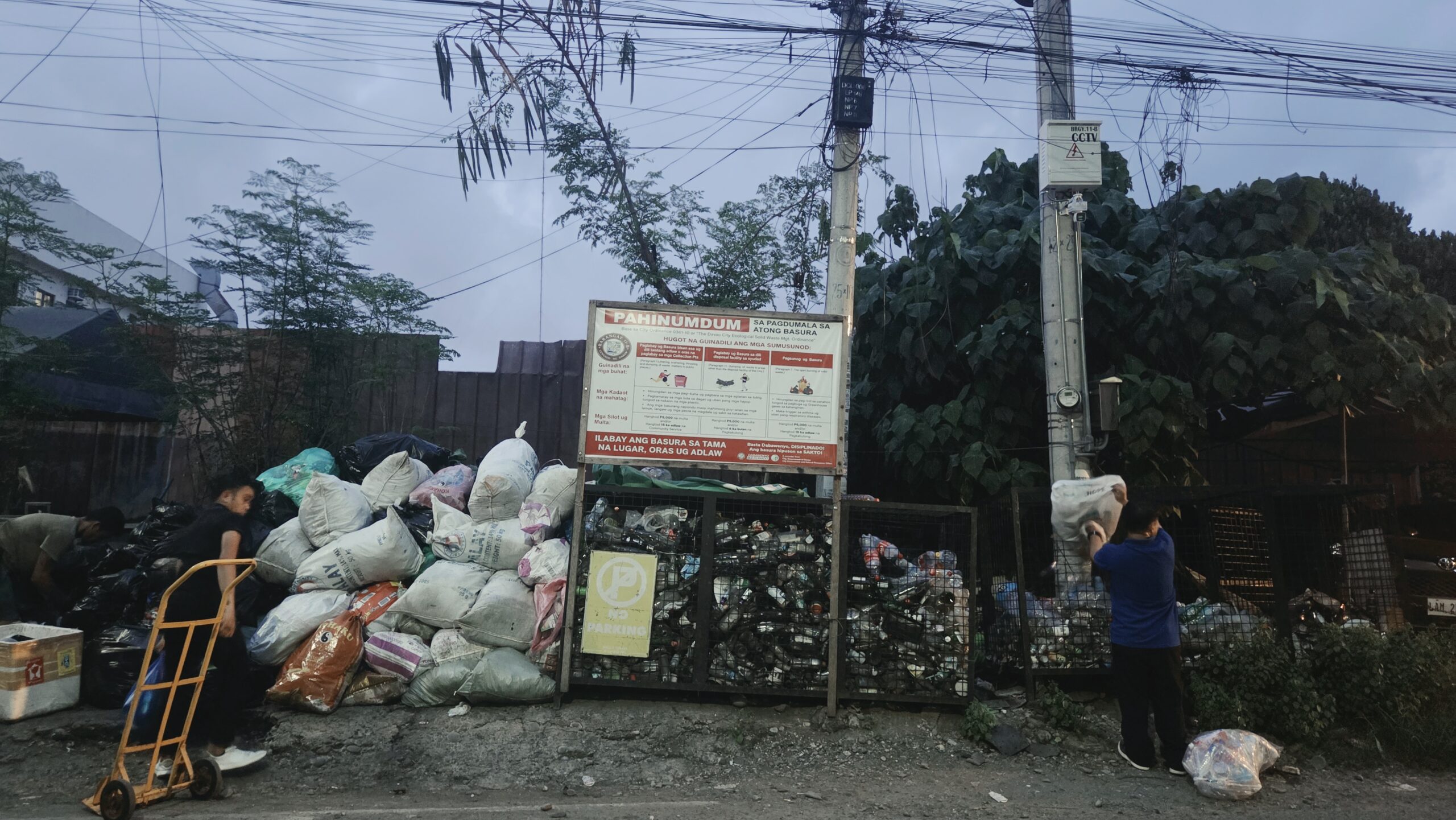
DAVAO CITY, Philippines — Davao City residents complained that their efforts to segregate trash at home were wasted when collectors mixed all trash at collection points, raising questions about the city’s planned incineration project.
Lenette Cambalon, 58, separates food scraps from recyclables at her karinderya (eatery) in Barangay 32-D every Tuesday and Friday. Their efforts became futile, she said, as sorting ends once garbage reaches the neighborhood collection point.
“They are no longer segregated when placed in the sacks,” Cambalon told Davao Today in Cebuano. “It’s still useless for you to segregate it. They’re just going to mix it all up anyway.”
Emelita Sumas, 32, echoed the sentiment in Barangay 11-B. “We don’t segregate because when it reaches the collecting point, it’s still mixed,” she said in Cebuano.
At one point, Sumas said the barangay provided resident IDs to identify those allowed to dispose of waste there, but they are not consistently checked.
“The ID given to us for the trash is still useless,” Sumas said.
She said people from outside the area, including some vendors and establishments, sometimes dump their waste there because of the barangay’s leniency, adding to the mixed garbage.
A March 2026 project document from the Department of Environment and Natural Resources-Environmental Management Bureau Region 11 estimates Davao generates 700 to 800 tons of municipal solid waste daily.
Crown Agents Japan announced Oct. 7 that it opened procurement for the design, construction, operation and maintenance of waste-to-energy (WtE) facilities under a Japanese government grant.
City officials expect the facility to generate approximately 13 megawatts of electricity, with completion targeted for 2028 or 2029.
The proposed facility is being pursued as part of the city’s long-term response to its growing waste problem.
Incineration challenged
But the Interfacing Development Interventions for Sustainability (IDIS) opposes the incineration project. Atty. Mark Peñalver, IDIS executive director, argued the city should strengthen its waste management system first.
“We believe that the introduction of the incineration project is a step backward in terms of city efforts,” Peñalver said at a news conference Oct. 7.
Davao has 182 barangays, but only 53 have Materials Recovery Facilities (MRFs) and 116 have Materials Recovery Stations (MRSs). It has 47 composting facilities and 96 barangays meet waste management compliance standards.
In September 2025, the National Solid Waste Management Commission and EMB-11 validated the city’s 10-year Solid Waste Management Plan, noting improvements but recommending stronger source segregation and expanded composting capacity.
CENRO Environmental Waste Management Division head Engr. Lakandiwa Orcullo acknowledged some barangays maintain MRFs “for compliance” without fully utilizing them.
Segregation remains essential
Proper segregation remains essential for the proposed facility. Councilor Temujin Ocampo, chair of the City Council Committee on Environment and Natural Resources, said waste must have adequate calorific value and relatively dry, combustible composition. Food waste, wet materials and certain medical waste should be treated separately.
“Their understanding is that all the trash is to be burned,” Peñalver said. “The only things that should be burned there are the residuals.”
IDIS advocates for stricter enforcement, including a “no segregation, no collection” policy, and argues that thermal incineration cannot be characterized as green or renewable due to emissions and toxic residues.
The waste-to-energy concept appeared in Davao’s 2018-2027 Ecological Solid Waste Management Plan, approved in December 2019. That plan projected waste diversion rising from 31 percent in 2017 to 92 percent by 2027, with WtE accounting for significant portions of the increase.
“With the waste-to-energy incineration we are just encouraging people to generate more waste, to feed our waste-to-energy facility,” Peñalver said. (davaotoday.com)