
By Ina Alleco R. Silverio
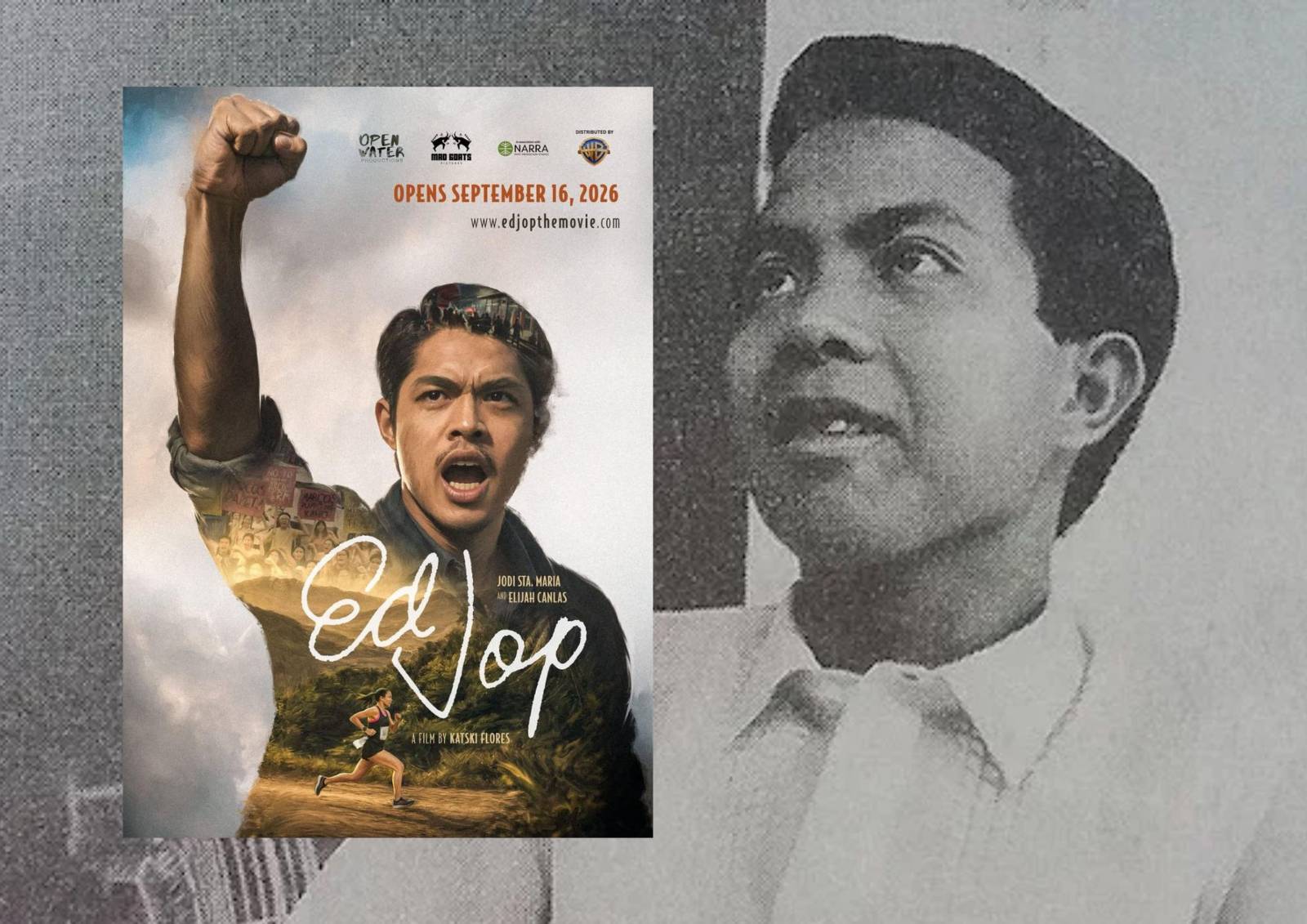
MANILA, Philippines—Long in coming and highly anticipated, Edjop delivered in ways both profound and emotionally resonant, standing as a necessary and urgent film for our times. The life of its titular hero, Edgar “Edjop” Jopson, testifies to the greatness that Filipinos can achieve when they commit their lives to serving the poor.
On cinematography
Visually, the film achieves artistic peaks in the scenes depicting the athletic exploits of Joyette. Jodi Sta. Maria, who played Edjop’s eldest daughter, is shown powerfully swimming in the open seas, or determinedly running across a bare but stunning landscape of snow.
However, it is precisely here that some narrative weaknesses begin to unfold. While the camera work is polished, there are not enough specific markers regarding the places depicted and the people who fell within the ambit of Edjop’s life, sacrifices, and heroism. There are only places like “Manila”, “Mindanao”, “Norway.”
Instead of anchoring the audience in real, identifiable spaces, the film relies on generic shots and fleeting mentions of names. Without tangible markers and signs, audiences unfamiliar with who Edjop was and what his life entailed struggle to connect the historical realities depicted in the film to the actual realities here and now. The visual and historical landscapes are strangely placeless, with the narrative treating geography as a backdrop rather than an active character in the class struggle. It is uncertain if this is all deliberate. If yes, the reasons are unclear given that the film is biographical.
On aesthetics and misleading historical depictions
While the cinematography, set design and the costume design were clearly thought through, they were not executed well enough to make the historical era more recognizable and to younger audiences unfamiliar with the visual and cultural markers of the period. There is much to appreciate about the visual quality of these elements as they were utilized in the film, but they failed to ground the narrative geographically, turning the specific terrain of Edjop’s fieldwork into a guessing game where it is impossible to determine where the rice fields he worked alongside farmers were located, where he worked as a union organizer and what he accomplished in Mindanao where he really wanted to serve his revolutionary duties. There was no mention of where the Jopson supermarket was located or where the La Tondeña strike took place.
Then there’s the depiction of the rallies. The political demonstrations were shown looking like current-day mobilizations, but there were inaccuracies regarding activist conduct. Activists in the film were shown marching while wielding rocks, doing nothing but yelling, screaming and raising their fists—a portrayal that fundamentally misunderstands the reality of collective street actions or does them a disservice.
(To be sure, the rock-throwing is not standard behavior. Protestors do not carry rocks as they march the streets because they do not seek violence. The mad scramble for rocks and throwing them at state forces or goons happens strictly and exclusively as an act of self-defense when protesters are attacked. Also, this happens mostly in picket line areas where workers and their supporters have to protect and defend themselves when security guards or other armed forces sent by companies attack strikes.)
Another misstep in the film’s visual and historical narrative occurs in a scene depicting the former priest Luis Jalandoni—one of the founders of the National Democratic Front and the Christians for National Liberation—running across a cornfield alongside Edjop while being chased by armed men. This is a severe historical inaccuracy. Jalandoni, when he was still an active priest, was a veteran organizer and steadfast supporter of the sugar farm workers of Negros Occidental. The actual historical episodes of extreme danger he faced, including running for his life while being shot, involved private goons and warlord militias hired by sugar barons—and the fields through which they ran were vast, dense sugarcane fields, not cornfields.
But the bigger error and, let it be said, insult, concerns the depiction of Jalandoni. In the film, he is portrayed as an overweight man who talks roughly and downs lambanog like your neighborhood lasenggo. Nothing could have been further from the truth. Jalandoni, who hailed from Bacolod, graduated with Latin honors and was a former collegiate basketball star from De La Salle University in Manila. He had an athletic figure, always dressed well, and spoke softly like the typical Ilonggo. He worked alongside Edjop in the La Tondeña strike, and always spoke highly of Edjop with affection. Had Jalandoni really been like how he was portrayed in the film, there would have been no issue. But Jalandoni – who died earlier this year – is still very much alive in the memory of so many because up to the end of his life he was a spokesperson for the revolutionary movement’s peace negotiation efforts and international work. They know Jalandoni was quite unlike how he was represented in the film.
When it comes to characterization, the film struggles with depth due to its pacing and treatment of peripheral figures. Throughout the movie, real people are mentioned in passing, yet their importance or notoriety is not given the emphasis they deserve. Key comrades, historical figures and adversaries flit across the screen as mere names rather than fully realized forces that challenged or shaped Edjop’s worldview. While the central portrayal of Edjop captures his earnestness, intelligence and quiet but determined courage, the supporting cast often feels underwritten.
The film was based on real events, and while there is no certainty that the producers intended the movie to be more than just a straightforward narration of the life of one of the more well-known among thousands of national democratic cadres who fought the Marcos dictatorship, at least laying down more specific markers would have immensely added to the texture and quality of the narrative, contributing to its value as a film that depicts the dark years of martial law and the role of the democratic mass movement in fighting the dictatorship.
The portrayals of Edjop’s comrades—representations of leaders of the Communist Party of the Philippines and the New People’s Army—are puzzling and disconcerting. A man of Edjop’s intelligence and capacity for compassion surely would not have wanted to be a member of either the CPP or the NPA if the leaders were all like the men in the film.
These supposed representatives of the CPP and/or the NPA were sinister-looking, arrogant and practically stupid, reducing the revolution against the dictatorship as mostly military in nature. One specific character—one theory is that it was the former head of the CPP branch or office in the NCR, Filemon Lagman—who portrayed Edjop’s “political officer” or “commanding officer” when he first became a cadre of the CPP was particularly repelling: boorish, physically unattractive and on the whole a strong contrast to Edjop’s gentle handsomeness and intelligence.
Some say the man who confronted Edjop was the founder of the CPP and the first chairperson of the older organization, the Kabataan Makabayan (KM), Jose Ma. Sison. Again, the portrayal was negative.
Choosing to unsympathetically depict representatives—or representations of representatives—of the revolutionary organizations that Edjop pledged his life to appeared to be deliberate: perhaps a way to show that Edjop was so much better than the people he called comrades? If so, it is another misstep because it begs the question: why did Edjop remain steadfastly loyal and committed up to the very end to these revolutionary groups if all their leaders were quite unlike him, possessing none of the values he surely considered important?
In broad strokes, Edjop was vague when it came to establishing a timeline of Edgar Jopson’s martyrdom—his transition from the moderates of the National Union of Students of the Philippines (NUSP) to the ranks of the national democratic underground, his work among workers and peasants, and his eventual death. The film’s historical accuracy is undermined by its generalized presentation. By stripping away concrete geographical markers, specific dates following martial law and the dense political debates of the era, the film risks sanitizing history into a generalized myth.
True historical accuracy in revolutionary biographies requires revealing the specific names, concrete policies and the raw political economy of oppression—elements that are unfortunately muted in favor of a streamlined but somewhat muddled narrative.
Narrative focus and misplaced subplots
While the film bears the title Edjop, a surprisingly large chunk of its running time is devoted to the life of Joyette, the middle child and first daughter. Unfortunately, this creative choice introduces significant narrative clutter, and the possibly intended way of bridging past and present was not realized.
Extended sequences follow Joyette’s personal life, including a failed relationship featuring scenes that feel entirely unnecessary to a political biography—specifically, an unneeded sex scene and a sequence where her former boyfriend borders on becoming physically violent. Rather than illuminating Edgar Jopson’s legacy, these cinematic tangents dilute the historical and political urgency of the film, leaving viewers wondering why precious screen time was diverted away from Edjop’s actual revolutionary work and underground organizing.
Even the closing scenes were devoted to Joyette and her current circumstances. No mention of what has become of the revolution Edjop lived for, or of the social circumstances that make Edjop and his activism still very relevant. The film could have ended on that note given that it was meant to a tribute to the man. The film already made it that Edjop believed in fighting for the poor was a duty that everyone must undertake; it’s unfortunate that this was not reiterated in the ending, because this would have driven home the message that Edjop’s decisions in life—as hard and difficult as they were—were worth it. That more than ever, defending the welfare of farmers and workers—like he did with his comrades—is urgent because the country remains more or less the same as when it was under martial law.
It is understandable that Joyette was intended to serve as the narrative lens or framing device for the film, but she ultimately proves to be ineffective in this role. Throughout much of the story, she is depicted as largely indifferent to her father’s revolutionary history. This comes into sharp focus when she interacts with her siblings.
While Joyette comes off as clueless, flippant, or dismissive, her siblings demonstrate a profound, lived connection to their father’s legacy: Noy carries the heavy, trauma-filled memory of being abducted by state forces alongside Edjop and witnessing his father being brutally tortured. Risa, who was just a baby when Edjop was martyred and therefore has no direct personal memory of him, is deeply invested in preserving his legacy as a towering figure of the Filipino people’s struggle against the dictatorship. In a brilliant touch, Risa even makes a cameo in the film as a worker at La Tondeña during preparations for their historic strike, defying Marcos’s draconian bans against protests and collective action.
In stark contrast, Joyette spends most of the film focused inward—seeking herself through sports.
The domestic reduction of a revolutionary life
When Joyette finally comes to accept her father and honor his memory toward the end of the film, she processes his life as an exclusively personal and familial revelation. She cannot see beyond the domestic sphere, compressing the vast, historic meaning of Edjop’s life and work simply into a “love of family.”
While family love was undeniably real and deeply felt—Edjop deeply loved his parents, his sisters, his wife Joy, and his children whom he barely saw—reducing his life to domestic sentimentality fundamentally misrepresents a revolutionary. Edjop’s love for his family was fierce and genuine, but inevitably it had to come second to his overarching commitment to the cause of freedom, the defense of the oppressed and the collective struggle for social justice. By framing his martyrdom through Joyette’s narrow, depoliticized lens, the film domesticates a revolutionary, stripping his sacrifice of its wider systemic and historical meaning.
A faultless cast: Elijah Canlas and Kakie Pangilinan
On the acting front, Elijah Canlas as Edjop and Kakie Pangilinan (as Edjop’s wife, Joy) deliver brilliant performances. Canlas’s portrayal is grounded, deeply sincere and emotionally resonant. While he handles the harrowing scenes of interrogation and brutal torture with gravity beyond his years and previous acting experience, his acting skills truly shine in the quiet, intimate moments with Joy, his sisters, and his parents.
These scenes represent one of the film’s greatest strengths, illustrating a revolutionary’s personal relationships and the vital, grounding role of family support in the life of any activist. Among the most moving moments is the scene where Edjop apologizes to his father for “not being the son he should have been,” prompting a heartbreaking, prophetic joke from his father that he would outlive his only son. The father later declares his profound pride in Edjop, expressing gratitude that the latter did not listen to him when he originally tried to dissuade him from continuing his activism.
Another affecting scene is the somewhat desperate and wordless embrace between Edjop and Joy when they are finally reunited after Edjop’s escape from his military escort. Pangilinan is exceptionally effective here, conveying immense emotional weight through her silence and tears—encapsulating the raw worry and unspeakable fear that every activist’s family carries: the terror that a loved one might not return alive the next time they walk out the door.
These domestic and marital scenes strike a deeply resonant chord among activists in the audience. They serve as a powerful reminder that we still live in dangerous times where fighting injustice means facing grave threats at the hands of state forces—abduction, torture, death and enforced disappearance. The film highlights that activists are bound not only by rigorous ideological ties, but also by deep, human love. At the same time, it underscores that the strongest revolutionary bonds are always built on the foundation of shared political histories and collective experiences.
On the whole, there is zero room to criticize the cast and their performances: Edjop’s sisters, and parents; the actors who portrayed people Edjop interacted and worked with; even the actors portraying the film’s antagonists—such as the notorious military general Aguinaldo and the head of the Metrocom team who relentlessly hunted Edjop up until that fateful day in Skyline—played their despicable roles with chilling effectiveness.
In the meantime, praises heaped upon Jodi Sta. Maria are entirely justified. While calling her one of the best actors of her generation is accurate, it is perhaps even truer to say she is already among the finest actors across any generation in the history of Philippine cinema.
Finally, one of the most notable achievements of the film’s screenplay is its handling of political discourse. Too often, radical political cinema falls into the trap of “tibakspeak”—the stilted, dogmatic jargon that can sometimes sound off-putting or “cringe,” even to seasoned activists when translated to the screen. Edjop gracefully avoids this failing.
The dialogue throughout the film is real, organic and grounded. Even when Edjop delivers lines that could easily be considered as traditional movement rhetoric—speeches centering on the absolute necessity of mass organizing, ideological grounding, and empowering the poor to take their destiny into their own hands—they never sound like hollow slogans delivered mechanically. Because Canlas delivers them with profound emotional and intellectual conviction, these moments feel entirely sincere, capturing the authentic cadence of a young leader whose revolutionary practice was guided by his own innate goodness.
Ultimately, Edjop serves as an introduction to an important figure of the Philippine struggle for genuine freedom and social justice, but it leaves viewers yearning for a bolder, sharper cinematic commitment to the concrete historical truths he died defending. Edgar Jopson, the national democrat, will continue to represent the best of the Revolution he embraced and serve. #


