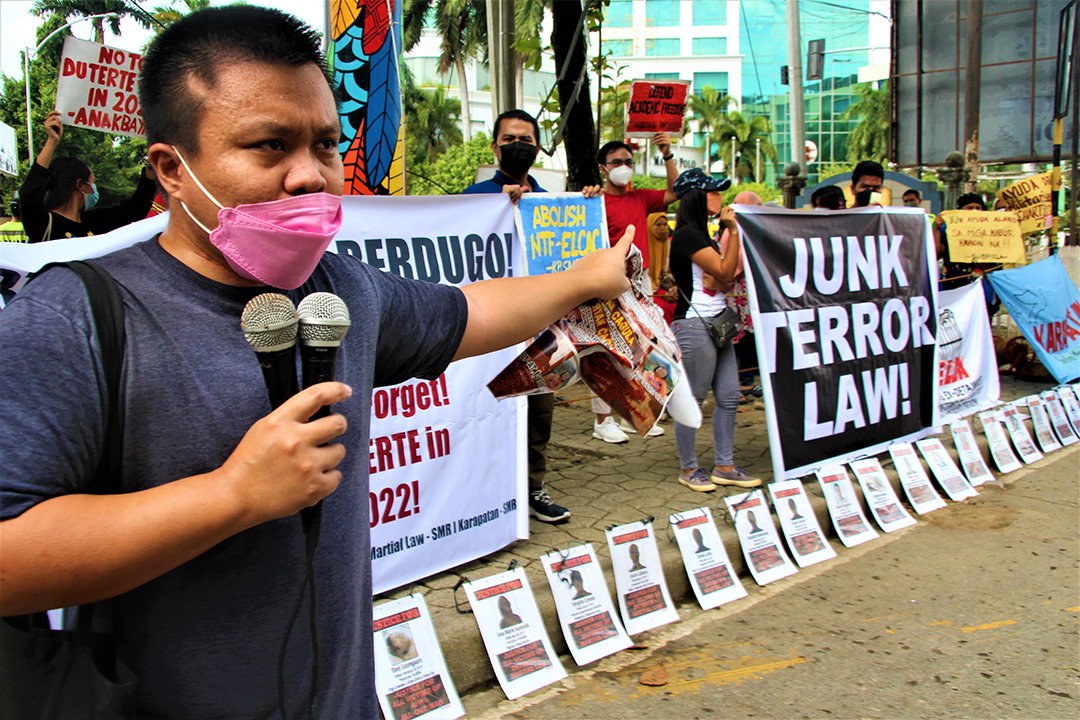
This July marks six years since the Anti-Terrorism Act of 2020 (ATA) was signed by then-President Rodrigo Duterte during one of the country’s longest pandemic lockdowns. On this anniversary, human rights advocates and lawyers continue calling for its repeal.
For a law touting its ability to protect Filipinos from terrorism — crafted during a period when Martial Law in Mindanao and the Marawi Siege normalized military authority and security-centered governance — its enactment enhanced the Anti-Terror Financing Act of 2012. Both laws boast a list of questionable accomplishments.
The first ATA case filed in court in August 2020 was not against a known terrorist group, but against two Aeta farmers in Zambales. Soldiers claimed the two fired guns at them, but charges were dropped for lack of evidence.
In August 2022, 16 people working on a Rural Missionaries of the Philippines Northern Mindanao Region (RMP-NMR) project were charged with financing terrorism. Prosecutors alleged their projects supported Mindanao Lumad’s advocacy for ancestral domain funded people linked to the Communist Party.
Among those charged are Catholic missionary nuns managing the group, their lawyer and staff. One staff member, Aileen Villarosa, was arrested in 2023. Also detained is church deacon Aldeem Yañez, of the Iglesia Filipina Independiente, who faced another fabricated charge. The case has lingered for years as lawyers argue it relied on testimonies from alleged former rebels extracted under duress.
Community journalist Frenchie Mae Cumpio and another RMP worker, Mariel Domequil, were arrested in 2020 on rebellion and terrorism financing charges. Their case was heard only in 2024. International human rights bodies and journalists question the recent decision convicting them of terrorism financing. How can the two be cleared of one charge and found guilty of another based on the same body of evidence?
These cases reveal a disturbing pattern: the accused are Indigenous people protecting and cultivating ancestral lands, humanitarian workers and environmental advocates serving marginalized communities and community journalists speaking for the voiceless. How are these people considered threats to national security?
It is not just these cases. Karapatan documented 222 persons charged with the ATA or terrorism financing over six years. Yet 138 of these accused have been cleared in court, where evidence proved weak.
This led the National Union of Peoples’ Lawyers (NUPL) to say what is happening is “political persecution masquerading as national security.” What is presented as counterterrorism has, in practice, become an extension of counterinsurgency. Such is the trademark of the previous Duterte administration, which red-tagged not just activists, but journalists, church workers and celebrities who expressed criticism or solidarity with the marginalized.
The danger continues as billions of pesos are still allocated to the National Task Force to End Local Communist Armed Conflict (NTF-ELCAC), an agency that has led red-tagging and forced surrender activities throughout the country.
Recently, 15 activists in Davao City raised alarm when branded as “most wanted” by the police station in Cateel, Davao Oriental, which lacks jurisdiction over them. The last time “wanted” posters circulated in Davao City in 2020, the former secretary-general of Karapatan Southern Mindanao was later arrested on alleged attempted murder cases in three different courts.
Karapatan and NUPL are among signatories of 37 petitions urging the Supreme Court to repeal the law. The petitions warned of abuse and vague provisions of the law bordering on repression.
The state contends that this law ensures security. But far from making Filipinos safe, critics argue that the law itself has become a source of fear, expanding military authority and paranoia at the expense of due process and democratic rights.
Filipinos also live in a different state of terror — one where floods wreck their homes as flood control projects are corrupted, where mountains and farms are denuded by mining and plantations, and where homes are being demolished. This insecurity is enforced by the government with impunity.
But the story of the Anti-Terrorism Act is not just about fear. Journalists continue reporting despite intimidation. Lawyers challenge abuse in the justice system. Human rights groups continue documenting cases. Communities continue organizing and defending their rights.
These efforts have produced hard-won victories, from dismissed cases to judicial recognition that red-tagging itself endangers constitutional rights. Some are considering filing cases against the state for abuse.
History shows that harsh measures may silence people for a time, but they never end the fight for justice. Real national security comes from protecting the rule of law, due process and democratic freedoms. Repealing the Anti-Terrorism Act would be an important step toward preventing its abuse.(davaotoday.com)