
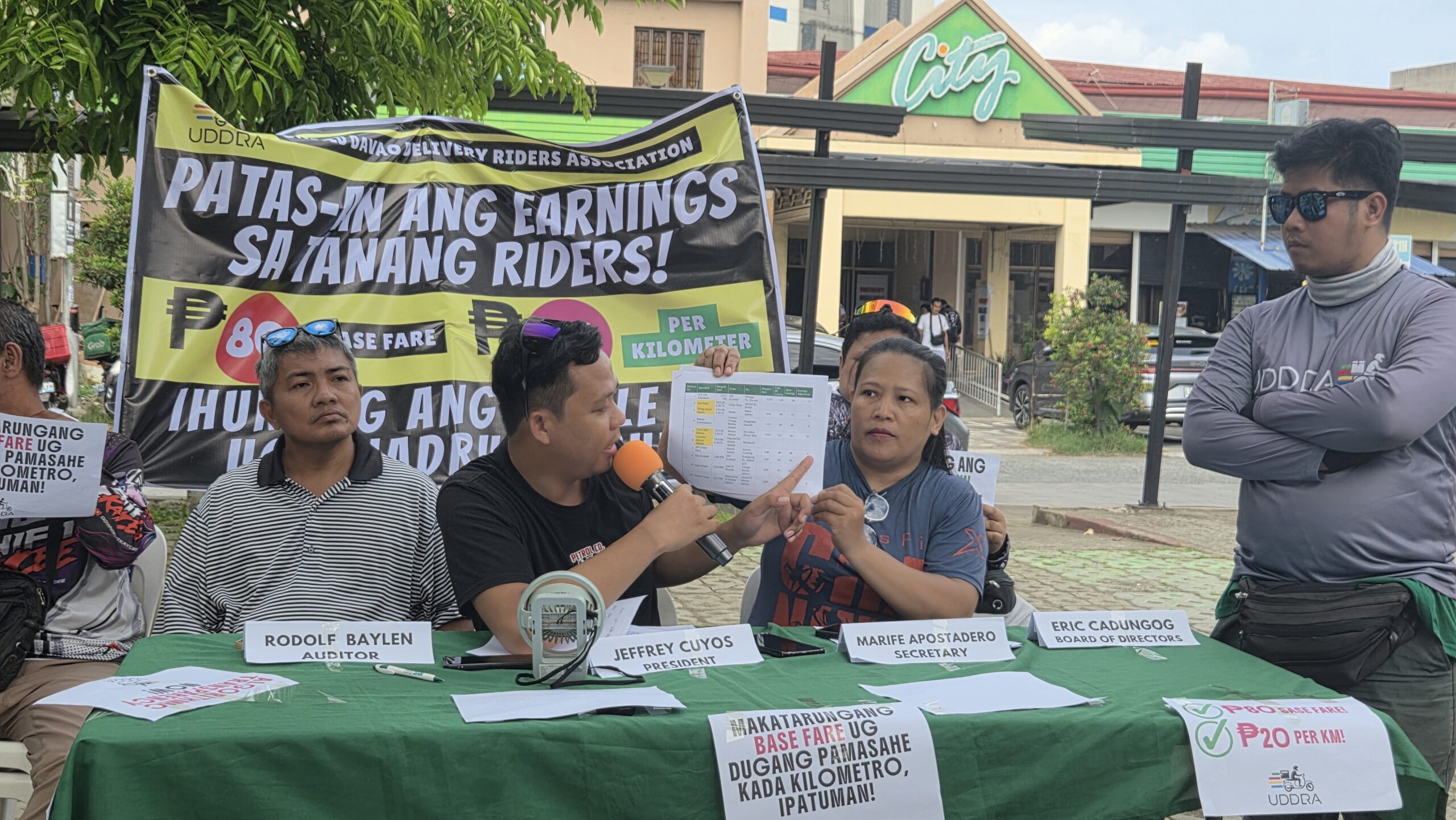
DAVAO CITY, Philippines—Delivery riders in Davao City seek an increase of P80 base fare and an additional of P20 per kilometer from delivery platforms amid rising living and operating costs.
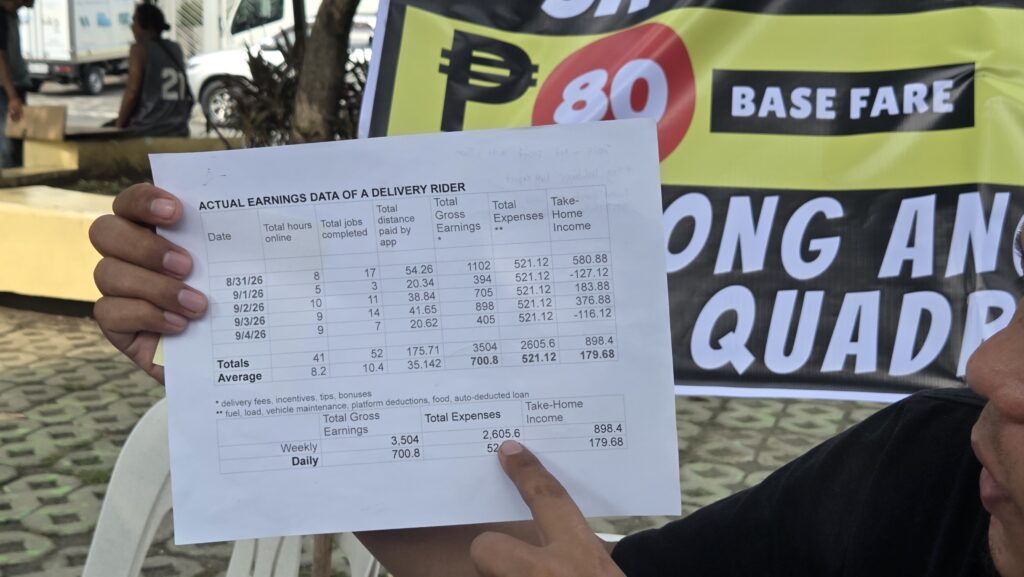
A delivery rider in Davao City takes home an average of just P179.68 per day after spending on fuel, food and motorcycle maintenance, the United Davao Delivery Riders Association (UDDRA) said.
In UDDRA’s calculations, a rider completing 52 jobs over 41 hours online in five days, earns P3,504 in gross income. But after P2,605.60 in expenses, only P898.40 remains for the week.
UDDRA president Jeffrey Cuyos said the figures only show the difficulties they face as fuel and other commodities become more expensive while their earnings remain unchanged.
“The crisis continues, and prices of basic goods and gasoline are constantly rising. Yet our fares and earnings remain the same,” Cuyos said in Cebuano.
The delivery riders, he said, only want to be heard and be given fair fares and proper compensation for their services.
Unfair bundled delivery payouts
UDDRA is also calling for the removal of triple-run (3Run) and quadruple-run (4Run) schemes, which allow riders to deliver multiple orders under a single booking. These were introduced without rider consultation.
Cuyos cited a three-delivery booking paying P127 versus P67 per single delivery under earlier arrangement. At P67 per order, three separate deliveries would amount to P201—P74 more than the bundled booking
“Back in 2021 and 2022, there was only one delivery per booking. Now, there are three deliveries, so why would a sample total be only P127? Where does the money go?” Cuyos said.
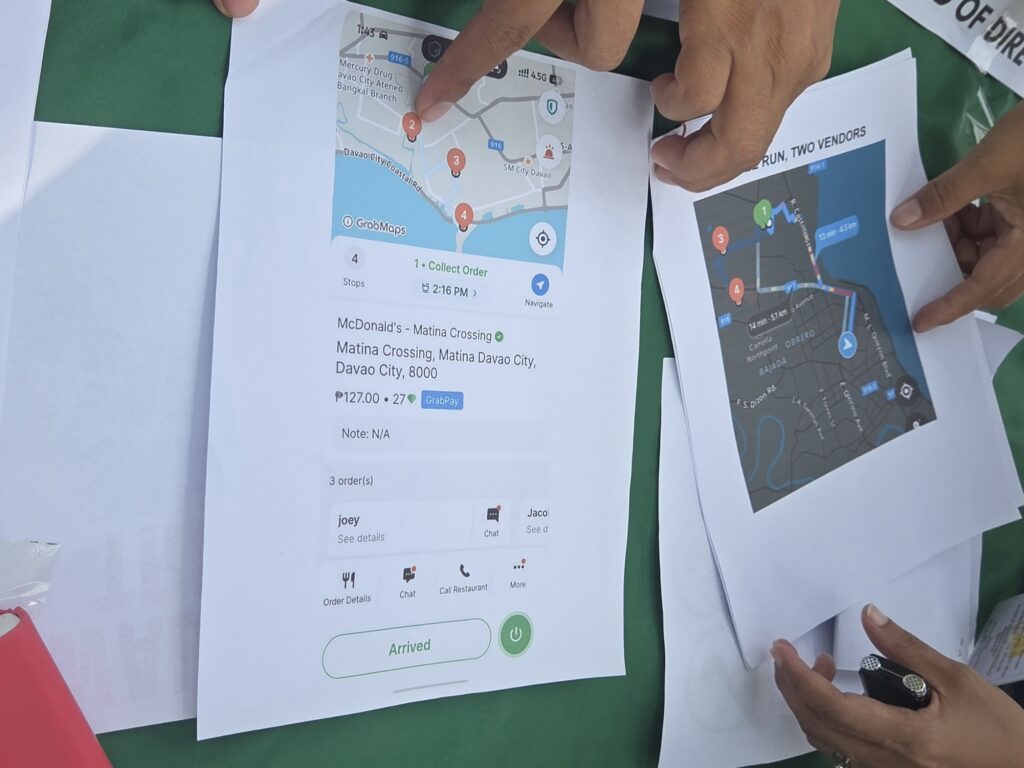
Another example showed two customers paying P125 and P187 in delivery fees while the rider received P114. The P198 difference between customer charges and rider pay lacks adequate explanation, he said.
Cuyos said riders also absorb fuel costs traveling to merchants before collecting orders, citing a pickup location 4.5 kilometers away as adding to operating expenses before the first delivery begins.
The association has repeatedly sought explanations about fare-setting algorithms, including how distance, stops and other factors affect the final rider payments, but has not received satisfactory answers.
“This is a partnership. Since we are partners, we should have a voice in asking for fair payment for our work,” Cuyos said.
However, Grab and foodpanda terms classify riders as independent contractors or third-party service providers rather than employees or legal partners.
The Department of Labor and Employment (DOLE) said rider status depends on the actual working relationship, including platform control levels.
Cuyos questioned claims of limited capacity to improve compensation, noting Grab Holdings reported P214 billion (US$3.37 billion) in revenue and P12.7 billion (US$200 million) in net profit for 2025, its full year of profitability.
Operating expenses reduce take-home pay
UDDRA auditor Marife Apostadero said gross earnings figures create misleading impressions about delivery work compensation.
“For example, we earn P1,000 a day, but we still have to deduct all our daily expenses, including gasoline. Out of that P1,000, we spend around P300 to P350 on fuel because prices are high,” she said in Cebuano.
Apostadero said riders could only take home only about P200 to P300. “And that is already considered a lot,” she added.
The gap between gross earnings and take-home pay has made it increasingly difficult for riders to support their families as expenses climb.
An anonymous Grab rider reported earnings declining from roughly P1,500 for an eight-hour shift in 2023 to about P800 for a comparable shift now.
“I still have to spend P300 on gasoline and pay for food and motorcycle expenses. How much is really left? Only around P400.”
Motorcycle maintenance costs are significant, with oil changes needed nearly weekly due to constant operation.
“We have to change our engine oil almost every week because our motorcycles are constantly running and could overheat,” the rider said in Cebuano.
The rider also questioned why compensation remains low despite the risks involved in delivery work, including exposure to traffic, rain, and heat.
Benefits and protection gaps
Rider Eric Cadungog said insurance and accident assistance remain a concern.
“Sometimes, accidents or other incidents happen to us on the road, but the companies do not always provide assistance,” Cadungog said in Cebuano.
The anonymous Grab rider noted riders lack social security and health insurance benefits associated with regular employment, questioning how compensation accounts for risks faced during long shifts without protection.
“We do not receive the same benefits as other workers. So how did they calculate our fares when we are doing such risky work?” he said.
UDDRA said it will continue pressing platforms to address earnings and working conditions. (davaotoday.com)


