

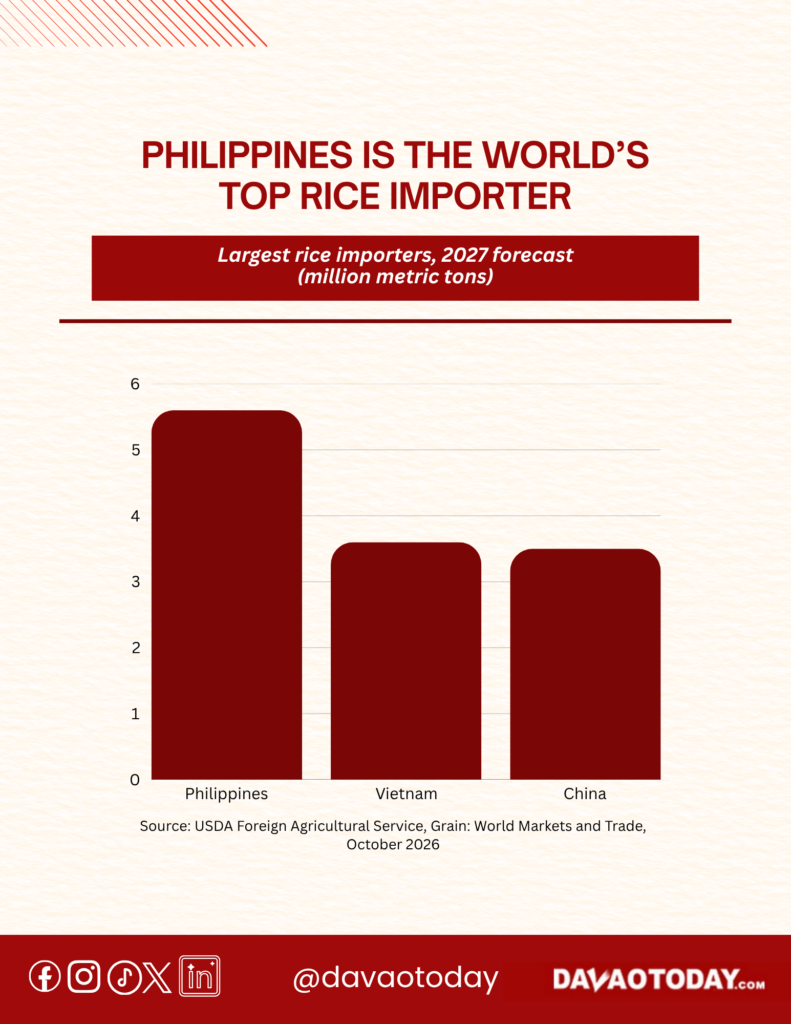
DAVAO CITY, Philippines— The Philippines will remain the world’s top rice importer in 2027, according to the US Department of Agriculture (USDA), with imports forecast at 5.6 million metric tons—larger than Vietnam’s 3.6 million and China’s 3.5 million.
This year, USDA estimates the country will import 5.5 million metric tons, up from 3.65 million in 2025. The surge covers a domestic shortfall: Filipino farmers are projected to harvest 12.1 million metric tons of milled rice while consumption reaches 17.8 million, leaving a 5.7-million-ton gap. Local producers would supply roughly 68 percent of national demand.
USDA lowered its harvest forecast from 12.4 million metric tons a month earlier and expects Philippine rice stocks to decline by about 2.6 million tons. The agency also noted Vietnamese export prices dropped $8 to $415 per ton, partly reflecting weakened demand from the Philippines, Vietnam’s leading market.
Government data diverges
USDA reports milled rice figures, while Philippine agencies track palay (unmilled rice), making direct comparisons difficult.
The Philippine Statistics Authority (PSA) said April to June palay output reached 4.63 million metric tons, up 5.7 percent from a year earlier—the highest for that quarter since 1987. It projects July-September output at 3.25 million metric tons, down 13.3 percent.
The Department of Agriculture (DA) warned in an Aug. 4 statement that El Ñino could cut palay output by 750,000 metric tons. The agency said it would not suspend rice imports this year to build buffer stocks, after halting shipments from September through December last year to support farmgate prices. More than 3 million metric tons had arrived by early August.
The DA also said that the National Food Authority (NFA) has been told to buy about 500,000 metric tons of palay this wet season, at a minimum of P21 per kilo for wet palay and P25 to P27 for dry. The NFA’s procurement budget rose to P14 billion from P9 billion in 2025.
Calls for repeal, not amendment
Leo XL Fuentes, regional coordinator of Magsasaka at Siyentipiko para sa Pag-unlad ng Agrikultura (MASIPAG) Mindanao, attributed the import dependence to structural failures in agricultural policy.
“The main reasons are farmers’ lack of access to and ownership of land, seeds, among other resources, rapid crop and land use conversion, and the rice liberalization law that furthers our import dependence,” Fuentes told Davao Today.
The Department of Finance defends the law, noting that rice’s contribution to inflation fell after it took effect and that import tariffs fund RCEF.
The Rice Tariffication Law, or Republic Act 11203, lifted quantitative limits on rice imports, replaced them with tariffs, and created the Rice Competitiveness Enhancement Fund (RCEF) for machinery, seeds, credit and training.
MASIPAG Mindanao is calling for the law’s repeal rather than amendment.
“First, the government must scrap the Rice Tariffication or liberalization Law,” Fuentes said. “Second, the government must enact the Rice Industry Development Act (RIDA) that aims to strengthen our rice industry, anchored on the principles of self-reliance rather than import dependence.”
He said RIDA would require land tenure through genuine agrarian reform and promotion of sustainable agriculture—a combination the network calls Garsa (Genuine Agrarian Reform and Sustainable Agriculture).
Land availability
Fuentes said the land needed to close the gap is minimal. MASIPAG calculated in 2018, using the most complete data available from 2014, that approximately 110,000 hectares would suffice to cover the country’s rice shortfall.
“That is roughly 30 percent of agribusiness plantation area in Mindanao at the time, or about 11 percent of the target area under the government’s palm oil industry roadmap,” he said.
“In short, it is possible for the Philippines to become self-reliant in terms of rice.” (davaotoday.com)


