Thinking Out Loud: Again, Murder
Again, Murder Last night, as I was commuting home, I saw a crowd on R. Castillo Street in Agdao. Three patrol cars and a 911 ambulance stood by. The driver…

Again, Murder Last night, as I was commuting home, I saw a crowd on R. Castillo Street in Agdao. Three patrol cars and a 911 ambulance stood by. The driver…
By Cheryll D. Fiel
davaotoday.com
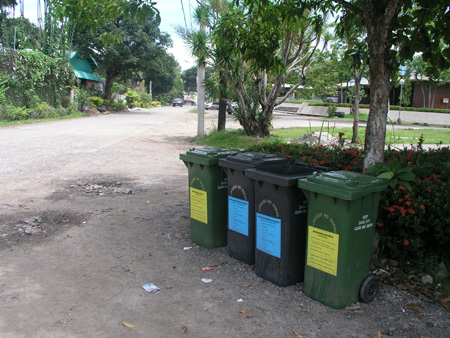
DAVAO CITY ? The trash bins look expensive. These are placed strategically in practically every street corner in several ?pilot? areas in the city, as if telling the public that there?s no excuse for littering and — this is important — segregating garbage.
To put it bluntly, you could go to jail for ignoring what the bins are for. And City Hall says it is serious in implementing this waste-segregation scheme.
MANILA ? The labor group Kilusang Mayo Uno (KMU) has accused the government of again fabricating national statistics to make it appear that the poverty level is declining. The National…
DAVAO CITY — Latest laboratory analysis of the Bureau of Fisheries and Aquatic Resources (BFAR) have established that some areas in Mindanao, including Davao Oriental, are still positive of “red tide” toxins and have thus been put under a so-called ?shellfish ban.?
The coastal waters of Dumaguillas Bay in Zamboanga del Sur, Balite Bay in Mati, Davao Oriental, and Bislig Bay in Bislig City, Surigao del Sur have been found positive of red tide toxins.
The military, police, barangay officials from Davao all agree: They are not members of the New People?s Army (NPA).
By Ace Alegre
Bulatlat
La Trinidad, Benguet ? The Davao City-based military command, local police and barangay officials cleared the three backpackers who live in Davao from any link with the NPA.
The Regional Trial Court in Benguet declared two weeks ago the arrest by Benguet police officers of 11 Sagada-bound backpackers as illegal. Two of the 11 were released on recognizance immediately after.
(more…)