
MANILA, Philippines—The Truth Commission called on the Professional Regulation Commission (PRC) and the Philippine Medical Association (PMA) to investigate five doctors who certified that at least 13 drug war victims died of natural causes, even though forensic examinations found they had been shot.
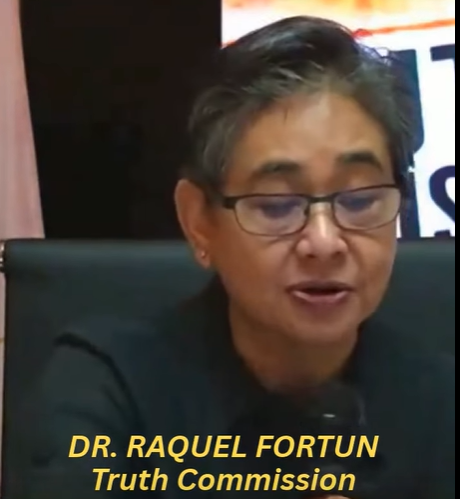
In a news conference on Oct. 30, the Truth Commission said death certificates listed pneumonia, heart attack, sepsis, high blood pressure, and stroke as causes of death, contradicting forensic examinations conducted by commission member and forensic pathologist Dr. Raquel Fortun.
The commission reviewed 13 cases from Caloocan and Quezon cities. Eleven victims were killed in 2016 and two in 2018. Forensic examinations in all 13 cases found gunshot wounds to the head or torso.
Six listed pneumonia, four heart attack, one sepsis, one high blood pressure, and one stroke with bleeding and high blood pressure.
Fortun said the discrepancies raised questions about how the deaths were documented and if the certificates accurately reflected the circumstances.
She said the cases exposed broader weaknesses in the country’s system for investigating suspicious deaths, particularly the absence of clear procedures for determining causes of death.
“We don’t have a death investigation system. The body is evidence. The scene is evidence,” Fortun said.
Fortun recalled a 2018 autopsy in which a man shot multiple times in the head and chest was recorded as having died of a heart attack.
The commission said the questioned certificates may represent only a fraction of the problem, given the thousands of deaths reported during the drug war under former President Rodrigo Duterte.
“The death certificate is the official record of the cause of death of the victim. It is important that the death certificate reflects the truth about how that person died,” Fortun said during the news conference.
The commission identified five physicians whose signatures appeared on the questioned certificates: Dr. Amadea S. Cruz, a medical officer at the Caloocan Health Department who has since died, in five cases; Dr. Kathleen J. Timogan, listed as a private physician, in five cases; Dr. Arnold B. Montero, in one case; Dr. Ramil Q. Razon, in one case; and Dr. Leonilo M. Aquino, a medical officer at the Torres-Bugallon Health Center, in one case.
Identifying the doctors was not a declaration of guilt, the commission stressed, but a call to investigate the medical basis of their certifications.
The commission also acknowledged that some doctors may have been pressured to issue inaccurate certifications during the drug war, possibly making them victims themselves. Still, it said, the five doctors’ signatures warrant scrutiny and possible disciplinary action, subject to due process.
Accountability, corrections
The commission urged the PRC’s Board of Medicine and the PMA’s ethics committee to determine what medical evidence supported the doctors’ diagnoses and why the certificates did not reflect the gunshot wounds documented in the forensic findings.
It also called on the Philippine Statistics Authority (PSA), local civil registrars, and health authorities to help families correct the death certificates using complete forensic evidence.
Commission Chair Raul Pangalangan, a former judge at the International Criminal Court, said inaccurate death records could conceal the violence suffered by victims and obstruct their families’ pursuit of justice.
“Honoring the dead this All Souls’ Day means more than remembering them. It means setting their records straight and holding those responsible to account,” Pangalangan said.
Lawyer Ted Te, chairman of the Free Legal Assistance Group and a faculty member of the University of the Philippines College of Law, said correcting death certificates may require legal proceedings, making the process difficult for grieving families.
He said the justice system involves not only court proceedings but also proper investigation, evidence gathering and documentation of deaths.
“If you can’t get the facts, then you can’t even get to court,” Te said, stressing that inadequate documentation could prevent courts from establishing the truth behind the killings.
The commission also called for the preservation of original death certificates, medical records, and autopsy reports, as well as an investigation into other drug war deaths that may have been similarly documented.
The International Criminal Court will open trial proceedings against Duterte on Nov. 30 for crimes against humanity related to the country’s drug war, which prosecutors allege resulted in thousands of deaths between November 2011 and March 2019. (davaotoday.com)

