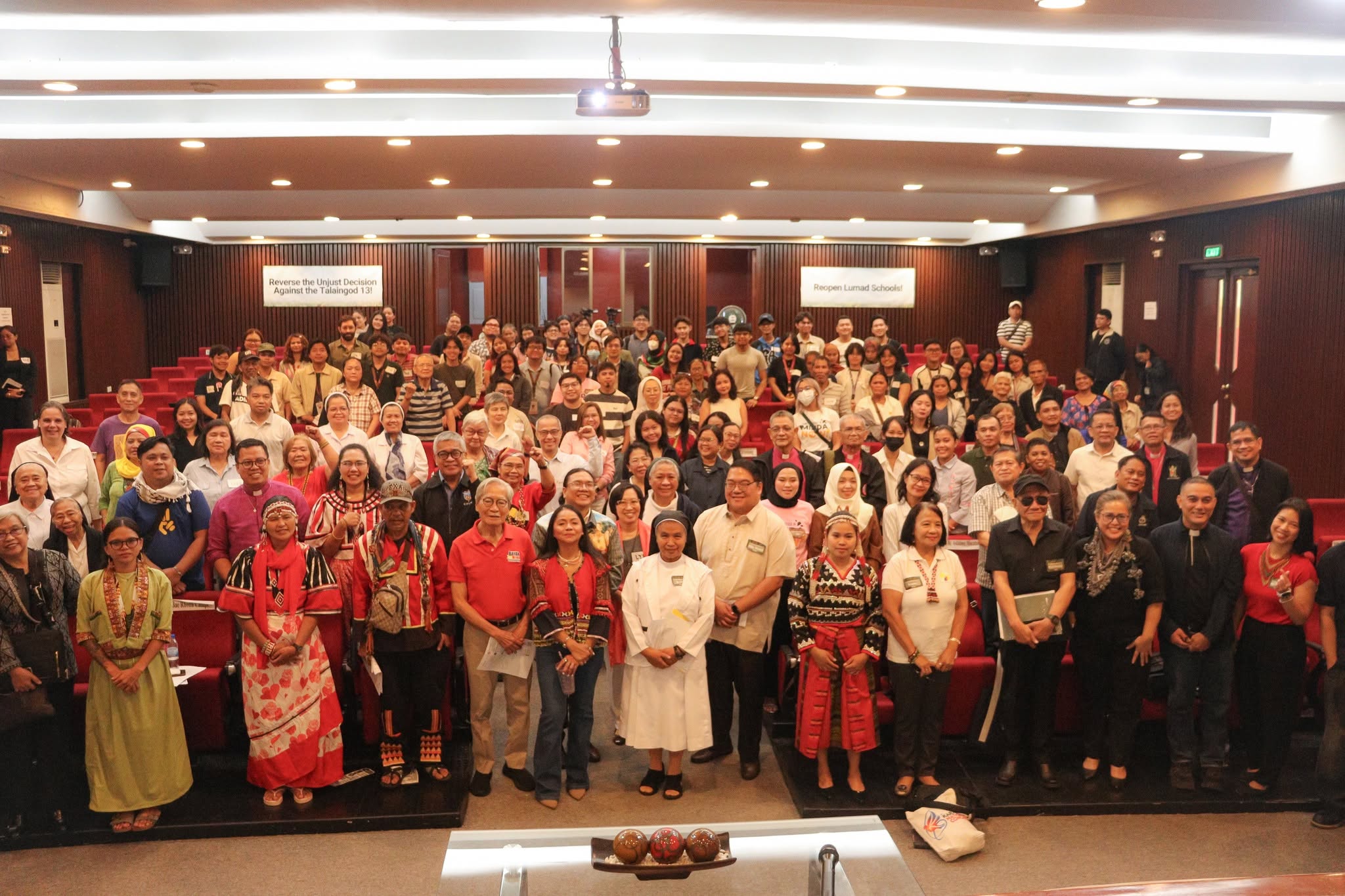
MANILA, Philippines — Human rights advocates and Indigenous leaders renewed calls to reverse the Talaingod 13 conviction during the KATUNGOD Conference 2026 at the University of the Philippines College of Law July 15.
They said the case has become a broader fight for indigenous rights, education, humanitarian action and democratic freedoms.
More than 300 delegates from Mindanao and other parts of the country attended the gathering on the second anniversary of the Talaingod 13 conviction. Held under the theme “Justice for the Talaingod 13 and the State of Mindanao,” the conference brought together Lumad and Moro leaders, church workers, youth advocates, journalists, student and human rights defenders to examine the legal case alongside issues affecting Mindanao, including ancestral domain conflicts, displacement, climate justice and protection of Indigenous communities.
Continuing legal battle
The current legal framework for dispute resolution in the Philippines is overly complex, often generating additional conflicts rather than solving them, and has led to corruption in various government agencies, according to Atty. Raymond Marvic “Ice” Baguilat.
Baguilat, head legal officer of the UP Law Center Institute of Human Rights, spoke July 15 at the KATUNGOD Conference 2026 at the University of the Philippines College of Law.
He said the Talaingod 13 case reflects broader issues confronting Mindanao, including ancestral domain conflicts, Indigenous education, climate justice, displacement and democratic participation.
“The current legal framework for dispute resolution is overly complex. In many cases, we would see that this only generates additional disputes rather than resolving them. Unfortunately, this also leads to some form of corruption in various government agencies, particularly due to overlapping land titles,” Baguilat said.
Law weaponized to enforce terror
Atty. Carol Kay Paquera, secretary general of the Union of People’s Lawyers in Mindanao and a member of the Talaingod 13 legal team, said the case has evolved beyond a criminal proceeding and now represents broader concerns over Indigenous education, ancestral domains and the criminalization of humanitarian work.
“Their crime was responding to a distress call,” she said, referring to volunteers who assisted displaced Lumad children in 2018.
“When the state treats the act of feeding, sheltering and protecting the vulnerable as a criminal enterprise, the law is no longer serving justice. It is being weaponized to enforce terror,” she added.
Witnesses recount humanitarian mission
Former ACT Teachers Party-list Representative France Castro and Talaingod 13 witness Angelika Moral shared testimonies on the 2018 evacuation of Lumad students from Talaingod, Davao del Norte.
Castro said humanitarian workers should not be punished for helping vulnerable communities.
“It was not a crime to help our fellow countrymen. But the state used these laws to criminalize our fellow countrymen,” she said.
Moral also rejected allegations that volunteers kidnapped Lumad students during the evacuation. She also renewed calls to reopen Lumad schools.
“We also called for our schools to be reopened because more than 218 Lumad schools were closed and 10,000 students lost their education,” she said.
Fire: A vision for alternatives
Fr. Raymond Ambay, convenor of the Save Our Schools Network, urged the public not to treat the Talaingod 13 case as a temporary issue but as part of the continuing struggle for Indigenous rights, education and justice.
“Will the Talaingod 13 be a burning issue today and forgotten tomorrow? We must consider the people’s burning issues as burning bushes. They are fires sparked from the ground. The fire comes from unresolved contradictions. The fire is inflamed by continuing injustices and repressed aspirations. The fire is also a vision for alternatives,” he said.
Dr. Aslainee Macatanong, faculty of Mindanao State University, said the Talaingod 13 case has grown beyond a legal battle involving 13 individuals, reflecting broader concerns over Indigenous education, humanitarian action, democratic freedoms and the right of communities to stand together in times of crisis.
She spoke during the reading of the KATUNGOD Conference 2026 People’s Declaration.
“The final resolution of this case will do more than settle a legal controversy. It will become a judgment on who we are as a people and what kind of nation we choose to become,” Macatanong said.
Participants renewed their call to reverse the Talaingod 13 conviction and protect Indigenous rights. (davaotoday.com)