MANILA, Philippines – At around 6 in the morning, while much of Metro Manila is only beginning to stir, Carlo Palajos, 41, is already preparing for another day of work.
As a saucemaker at a sardines company, his work is tied to production schedules—long hours, daily demands and, when required, overtime.
For most workers like Palajos, the day begins with work. But before the first task is done, another calculation is already running in the back: How far will today’s wage go?
The answer has become harder to stretch as the prices of food and other necessities continue to rise.
“Mahal masyado ang bilihin dito sa Manila, ang ating minimum wage ngayon na 695, parang 300 pesos nalang,” Palajos said, describing the cost of goods in the capital.
For him, the proposed wage increase is not simply a figure announced through a wage order. It is money that could be converted into something tangible at home—food on the table, transportation to work, or another household expense paid on time.
“Nakakadismaya kasi, kahit P55 pesos, makabili ka ng isang kilong bigas,” he said, illustrating what even a small increase could mean to a worker’s daily budget.
But the additional income workers were expecting has been put on hold.
The ?85 increase under the National Capital Region (NCR) wage order was supposed to provide workers with additional income in two tranches. Its implementation, however, was suspended following a court order, leaving workers like Palajos waiting for relief they had hoped would help ease the pressure of everyday expenses.
For most workers who live on a tight budget, the suspension is more than a legal development. It is a delay in money they had been counting on.
Palajos described the difficulty of covering expenses from his existing income, including transportation and other daily necessities. Depending on production, workers may also have to work overtime to supplement their earnings.
The value of the increase becomes clearer when translated into the language of a worker’s household budget.
?85 is not simply ?85. It is food. Fare. Bills. A little breathing room.
A wage increase caught in court
The expected increase, however, is now at the center of a legal dispute.
Lawyer Arman Hernandez, Legal Affairs Officer of the Center for Trade and Human Rights, said construction companies Rebicon Trading and Construction Corporation and R2 Builders filed a petition for declaratory relief before the Regional Trial Court in Pasig.
The companies argued that implementing the wage order could cause irreparable damage to their businesses and affect their right to a fair return on investment.
The court subsequently issued an order suspending the implementation of the wage order.
But Hernandez questioned whether a regular trial court has jurisdiction to suspend a wage order issued by the Regional Tripartite Wages and Productivity Board (RTWPB).
“The courts have no role in implementing wage orders,” Hernandez said, pointing to provisions of the Labor Code concerning the authority of regional wage boards and the National Wage and Productivity Commission (NWPC).
For workers, the legal dispute has a direct consequence: they cannot yet enjoy the additional wages provided under the wage order while the restraining order remains in effect.
Whether workers will receive the increase retroactively if the temporary restraining order (TRO) is lifted remains subject to guidelines from the wage board.
He also said that workers should receive the increase retroactively.
“The RTWPB needs to issue guidelines. In our stand as lawyers and workers. We want to have a retroactive effect because it’s long overdue,” he said.
‘Manggagawang Pilipino’ were robbed
For labor advocates, the dispute is rooted in a larger problem: workers’ purchasing power is being squeezed by rising prices.
Jerome Adonis, Kilusang Mayo Uno Chairperson, said workers had pushed for the wage increase amid rising prices and declining purchasing power. The approved increase was supposed to provide ?60 beginning July 25, followed by another ?25 in January.
The suspension, he said, has frustrated workers who had already been waiting for the increase.
“That’s why the workers are angry,” Jerome said.
He also warned that the dispute could have implications beyond the current wage order, particularly for future wage increases and the regional wage-setting mechanism.
Here the issue cannot be separated from the broader demand for a living wage.
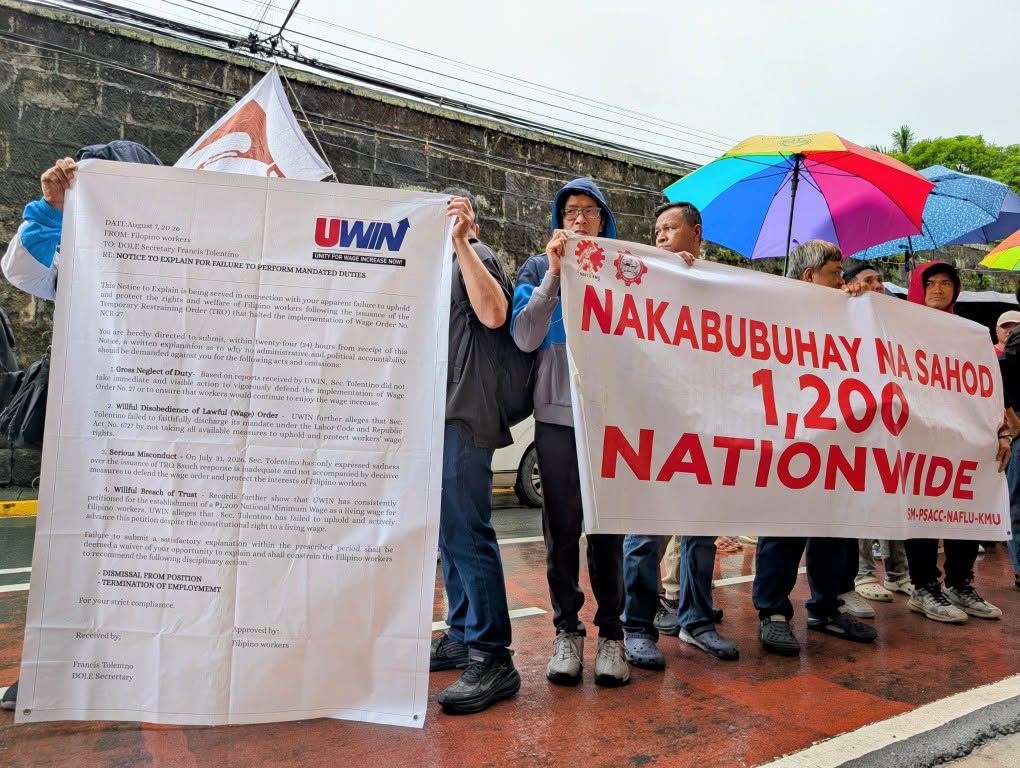
He said workers and labor groups are calling for a substantial wage increase, citing a proposed ?1,200 national living wage.
He also invoked Article 13, Section 3 of the Constitution, which provides for the protection of labor rights and the promotion of a living wage and just and humane conditions of work.
Adonis, likewise said the labor movement is pushing for a ?1,200 legislative wage increase.
“We want an equal salary for all the workers in the country, because that is the right salary that every family needs so that we can survive on the daily expenses,” Adonis said.
He also added that KMU did their best to push for the lifting of the TRO for all Filipino workers’ sake.
“Our local federations under KMU and the alliance where KMU is a member already had legal moves that were done. We filed a motion to immediately lift the TRO.”
But for Palajos, the debate ultimately returns to something much simpler: making a day’s wage last through a day’s needs.
When work begins in the morning, so does the calculation of how much can be spent, how much must be saved and what can wait until the next payday.
The court may decide when the wage increase can take effect. But for Palajos, the cost of living does not wait. (davaotoday.com)