DAVAO CITY, Philippines—A United Methodist pastor says he will continue his church work despite facing terrorism-financing charges over allegations that he helped people seek refuge from conflict zones.
Pastor Julius Neri Camannong and fellow United Methodist Pastor Joel Ordaneza, plus driver Romeo Russel, faced a terrorism-financing complaint after the Criminal Investigation and Detection Group (CIDG) filed allegations against them in 2024.
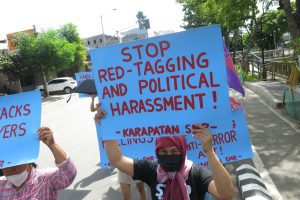
Rauf Sissay of Bagong Alyansang Makabayan-Southern Mindanao Region (BAYAN-SMR), also recalled being among at least 14 activists whose names and photographs were posted by the Cateel Municipal Police Station in Davao Oriental in May as “active wanted persons,” even though they had no pending arrest warrants.
“They say we’re wanted, but there’s no case filed. What does this mean for our struggle or for democracy in our country?” Sissay said in Cebuano.
The cases were discussed during a Sept. 29 forum in Davao City examining how counterterrorism measures affect church workers, activists and civil society groups.
Forum examines UN strategy implications
The forum, organized by the Union of Peoples’ Lawyers in Mindanao (UPLM) in partnership with PANAW Mindanaw and Brokenshire College Inc., focused on the United Nations Global Counter-Terrorism Strategy and its implications for marginalized communities.
According to a 2024 Karapatan report, the complaint stemmed from allegations that Cammanong, Organza and Russel provided sanctuary to two people seeking refuge at a United Methodist Church in Zamboanga Sibugay. The three denied wrongdoing and filed counter-affidavits in January 2025.
Speaking at the forum, Camannong said the complaint hadn’t changed his commitment to his ministry.
“We follow the Bible, the Lord’s command. But sadly, in the present time, it’s forbidden to do good. But we as church people will continue,” Camannong said in Filipino.
Sissay said the May incident in Cateel showed how labeling activists affects not only those directly named but also their families and organizations. He described it as red-tagging and other forms of profiling enabled by technology used for counterterrorism at the expense of civil liberties.
Process is already punishment
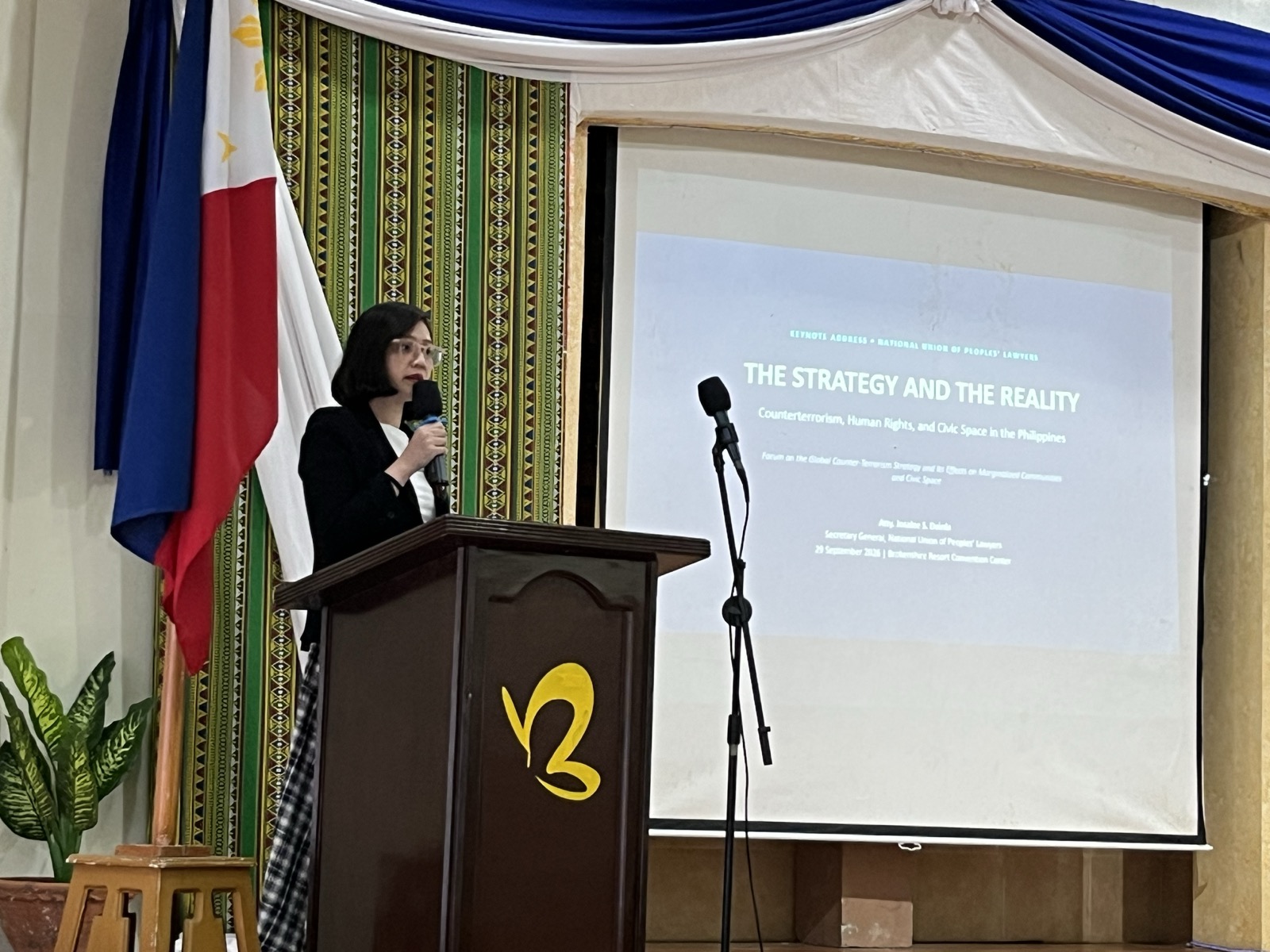
Lawyer Josalee Deinla, secretary-general of the National Union of Peoples’ Lawyers (NUPL) the experiences raised at the forum should be viewed alongside the broader international framework governing counterterrorism efforts.
The framework is presented as a balance between preventing terrorism and protecting human rights, its implementation has placed greater emphasis on operational mechanisms such as financial intelligence, surveillance and data systems.
Deinla said counterterrorism measures can begin punishing individuals even before conviction in court.
She described a progression where an individual may first be publicly accused, followed by intelligence referrals, financial inquiries and asset freezes. Under the Anti-Terrorism Act of 2020, the Anti-Terrorism Council may designate individuals upon a finding of probable cause, while assets are subject to the Anti-Money Laundering Council, or AMLC, for freezing.
“The accusation has traveled much farther than the remedy. The process is already punishment,” Deinla said. “There are remedies, sure, we can file cases in court, but by the time that we do, damage is already done.”
Deinla cited a civil society analysis finding that only 2% of the budget used for the UN strategy went to human rights. She said the UN General Assembly conducted its ninth review of the strategy in July 2026, 20 years after its adoption.
She called for stronger safeguards and greater civil society participation in counterterrorism policy discussions.
“Those who provide evidence must be protected against reprisals. We also ask that victims of unlawful state counterterrorism measures receive attention in policy meetings,” she said. (davaotoday.com)