
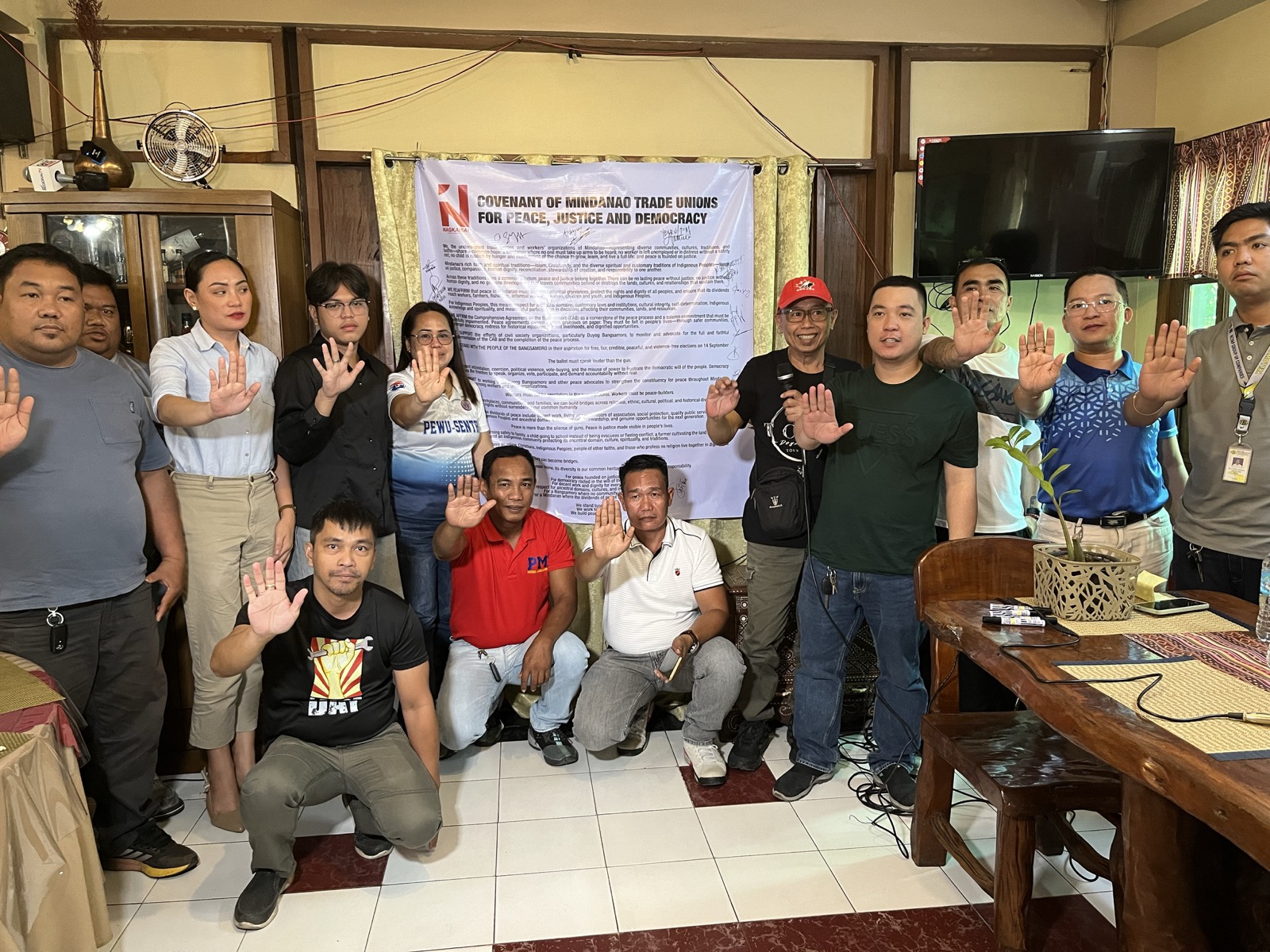
DAVAO CITY, Philippines — As the Bangsamoro parliamentary elections is held today, Sept. 14, Mindanao labor groups urged the government to stay neutral and ensure violence-free elections prevail because lasting peace depends on whether the peace process improves livelihoods and living conditions.
The call was made during the signing of the Covenant of Mindanao Trade Unions in Davao City on Sept. 10, four days before the region’s first regular parliamentary elections.
The Sept. 14 polls mark a major step in the Bangsamoro Autonomous Region in Muslim Mindanao’s (BARMM) transition to a regular parliamentary government. The elections, originally scheduled for May 2022, were postponed several times before being reset to 2026 under Republic Act 12317.
Mercy Abucayon of Sentro Davao said Malacañang should ensure that government forces remain neutral and that voters are protected from intimidation, coercion and violence.
“That’s why we are very particular in telling Malacañang to keep its hands off. They should maintain the peace and be fair,” Abucayon said.
The coalition was concerned about the possibility of election-related violence given Mindanao’s history, but stressed that the national government must create conditions for safe and free voting.
Partido Manggagawa representative Jong Pacanot said the government and candidates must follow Commission on Elections rules and ensure voters do not feel threatened when going to polling places. Armed groups, he added, should stay out of the electoral process.
“Only the AFP and PNP should be used as the security apparatus. All MILF forces, regardless of the group, should stay on the sidelines. They are not part of it,” Pacanot said in mixed English and Tagalog.
From arms to livelihoods
Helping former Moro Islamic Liberation Front (MILF) fighters transition to civilian life is one of the government’s unfinished commitments under the Comprehensive Agreement on the Bangsamoro. This goes beyond the elections.
The agreement’s Annex on Normalization provides for the decommissioning of members of the MILF’s Bangsamoro Islamic Armed Forces (BIAF), including needs assessments and a comprehensive socioeconomic development program. It also covers the disbandment of private armed groups and development assistance for conflict-affected communities.
Pacanot said former combatants cannot be expected to surrender their weapons without a viable path to civilian life, including livelihood assistance, skills training and support for their return to communities.
“The socioeconomic aspect is about how they will return to civilian life. There are capability-building programs to help them find work or pursue other paths,” he said.
The government reported in 2025 that 26,145 MILF combatants had been decommissioned since 2015. It said the assistance included P100,000 in transitional cash aid per combatant, skills training and emergency employment.
However, the normalization process remains unfinished.
In August 2026, the government and the MILF resumed the joint work on the normalization track and acknowledged that important commitments remained.
Third Party Monitoring Team Chair Heino Marius also said much work remained to complete the process.
Pacanot said unresolved socioeconomic issues could make the transition more difficult for former combatants who still need jobs, land and skills to support themselves and their families.
Land and recovery
Pacanot also identified land ownership as a contentious issue in the transformation of former MILF camps. Some lands associated with the camps are also claimed by Indigenous Peoples, creating potential disputes over where former combatants can settle, farm and build homes.
The Department of Agrarian Reform completed in June an inventory of land parcels in priority areas within six acknowledged MILF camps. The government said the data would guide reintegration and peacebuilding programs for decommissioned combatants and their communities.
Pacanot said the issue ultimately centers on whether former combatants and conflict-affected communities can build sustainable civilian lives.
“The problem is that they will struggle to find work there. Marawi has yet to recover, and this has affected the livelihoods of people who lost their jobs and means of earning a living,” he said.
He said the government should restore livelihoods and create conditions for people to work safely, including farmers who may still fear going to their farms because of insecurity.
Peace dividend
Abucayon said the economic benefits of peace should extend to all workers in BARMM through decent jobs and improved living conditions.
“What BARMM needs is decent work. People should feel the peace dividend. Peace should be maintained, jobs should be decent and the lives of people in BARMM should improve,” she said.
Pacanot said the coalition would monitor the elections as far as it could, particularly for violations that could affect the credibility of the vote.
“There would be no peace without justice,” he said. “That is what the people of BARMM are asking for.” (davaotoday.com)

