
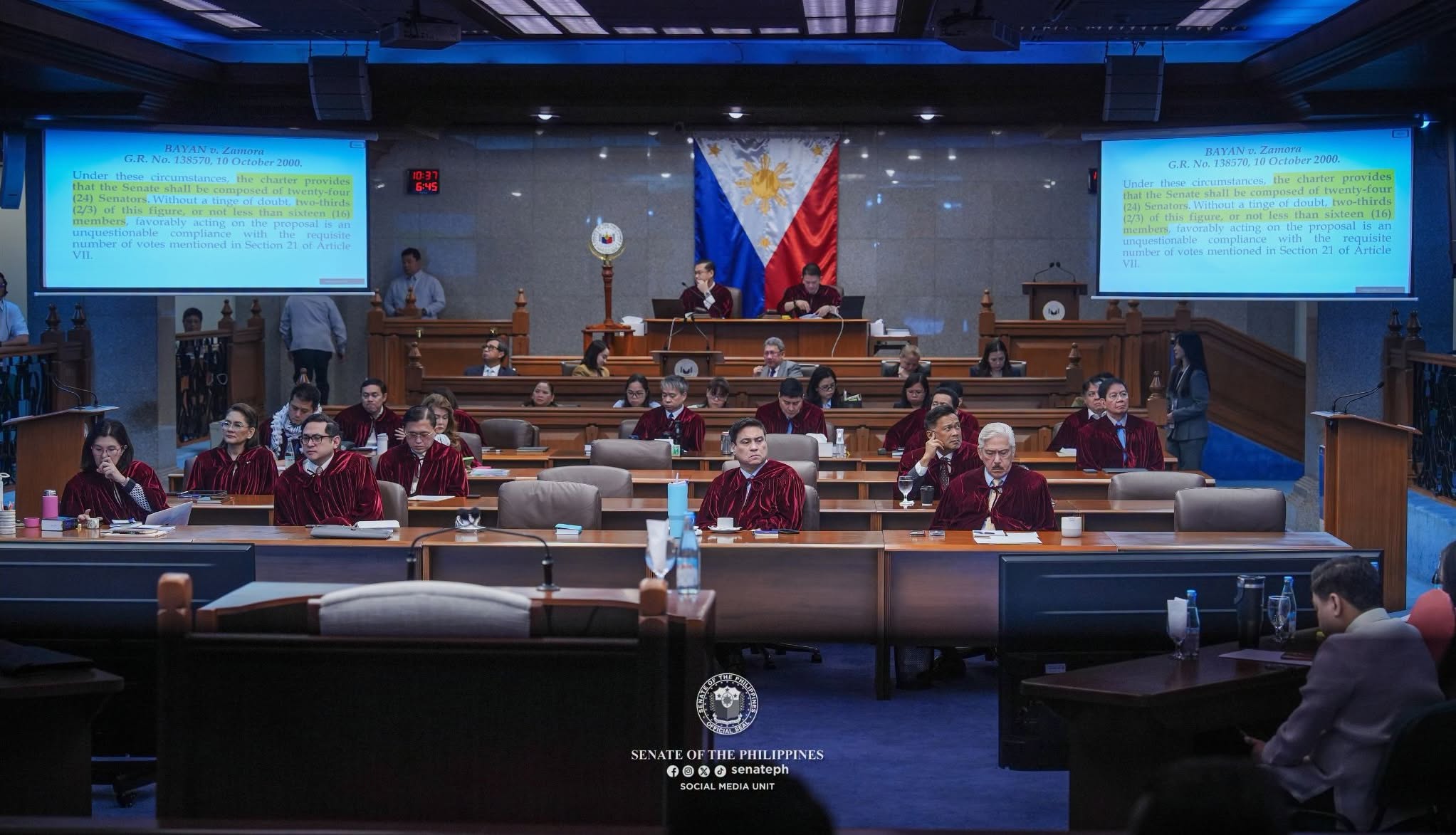
DAVAO CITY, Philippines—The Senate impeachment court voted Sept. 23 to lower the number of votes needed to convict Vice President Sara Duterte from 16 to 14.
The decision has raised questions from Duterte’s lawyers and supporters, who said they would appeal to the Supreme Court. The ruling is supported by former chief justices and constitutional scholars.
Two-thirds of participating senators
The Philippine Constitution states an official shall be convicted of impeachment charges with a majority vote of two-thirds of the Senate sitting as an impeachment court.
The Senate voted to lower the two-thirds threshold, or denominator, to 14, as 20 senators have consistently attended the trial since July 6.
Three other senators have not attended a single trial. Sen. Loren Legarda attended only 10 trial days before going on medical leave out of the country Aug. 3.
The three absent senators cited various reasons. Sens. Jinggoy Estrada and Rodante Marcoleta were detained since June 2 and July 6, respectively, facing plunder and graft charges. Sen. Bato dela Rosa has been in hiding since his last Senate appearance on May 13 due to a pending arrest warrant from the International Criminal Court (ICC).
Given the situation, the 20 remaining senators deliberated on adjusting the voting denominator. A special session with amici curiaeorfriends of the court on Sept. 16 heard legal views from retired Supreme Court chief justices Hilario Davide Jr., Artemio Panganiban and Reynato Puno, and retired Associate Justice Adolfo Azcuna on how to interpret the two-thirds rule set in the Constitution.
The three chief justices noted the need for contextual interpretation, while Puno put it bluntly: The law stated two-thirds, not 16.
“By using two-thirds, the number of votes to convict will have to move depending on certain factors,” Puno said.
Only Azcuna said the 16-vote threshold is fixed, interpreting that the law states “all of the Senate.”
How the Senate voted
The 20 remaining senators voted 13-1-6 to lower the threshold. Senate impeachment Presiding Officer Francis Escudero was the lone dissenting vote, standing by his ruling at the start of the trial that the conviction count is 16.
Six senators belonging to the minority aligned with Duterte did not vote. Minority Leader Alan Peter Cayetano proposed before the vote not to participate and leave the issue to the Supreme Court, fearing a mistrial and abuse of law.
But Puno noted in his Sept. 16 interpretation that the Constitution gives the Senate “sole power” to decide on impeachment matters, including its rules, as long as it abides with the two-third threshold.
Cayetano’s motion was put to a vote and failed, leading the minority to skip the afternoon session. Other senators who abstained were Sens. Pia Cayetano, Christopher “Bong” Go, Imee Marcos, Robin Padilla, and Camille Villar.
The only minority member who cast a vote was Mark Villar, who supported the lowering of the vote.
Constitutionalists’ view
Duterte’s defense lawyer Sheila Sison said after the vote they would proceed with the trial with reservation on this ruling.
Meanwhile, a Duterte ally, lawyer Vic Rodriguez, has filed a petition for certiorari with the Supreme Court to review the Senate’s decision, alleging abuse of discretion.
But some members of the 1987 Constitutional Convention support the Senate’s ruling.
In media interviews, lawyer Christian Monsod said the Senate’s interpretation did not violate the Constitution.
“The denominator can be changed and therefore, the numerator can also change. The one that cannot be changed is the two-thirds,” Monsod said.
He said he consulted other living members of the convention, including Ed Garcia, Felicitas Arroyo, Florangel Braid and Rene Sarmiento, who agreed with this position.
“That makes five of us so if you add [former Chief Justice Hilario] Davide [Jr.], who also agrees that it could be changed, that is already six and there are only 11 surviving members of the framers of the Constitution,” Monsod said.
Questions remain on how the defense and the Senate minority members will move forward. Minority members have said there is political pressure against them, including graft charges, which may disrupt attendance.
Lawyer Dexter Lopoz, spokesperson of Union of Peoples’ Lawyers in Mindanao, favors the Living Constitutionalism method of interpreting the Constitution.
“The interpretation and application of its provisions cannot be limited to a strict reading of its provisions,” Lopoz said. “Proponents of this school of thought argue that this flexibility is essential for the Constitution to remain relevant and functional across generations and decades or even centuries of a nation’s political life.”
“it is high time that we interpret and apply the Constitution based on evolving standards of justice and modern societal norms—to uphold fairness and common sense,” he added.
Bayan Muna vice-chairperson for Mindanao lawyer Carlos Zarate said what matters is safeguarding institutions to function in this political situation.
“The Constitution is not merely a collection of words to be guarded in amber. It is a framework meant to govern real institutions, real crises and real exercises of public power. Its safeguards must work. Its accountability mechanisms must remain capable of holding even the highest officials to account,” Zarate said.
“The Senate, therefore, carries a burden beyond simply defending its arithmetic,” he added. “Having exercised its constitutional authority to determine the denominator, it must show that the contextual rule is being applied to preserve—not manipulate—the integrity of impeachment.” (davaotoday.com)

