As the country marks 54 years since the declaration of martial law, former journalist Myles Albasin is still learning what freedom means—and remembering why the fight for justice is never finished.
DAVAO CITY, Philippines—Fifty-four years after the dictator Ferdinand Marcos Sr. declared martial law, the country continues to remember the arrests, disappearances, torture, killings and other abuses committed in the name of security and order.
But for Myles Albasin, that history is not something found only in textbooks or museums.
She lived through her own version of it.
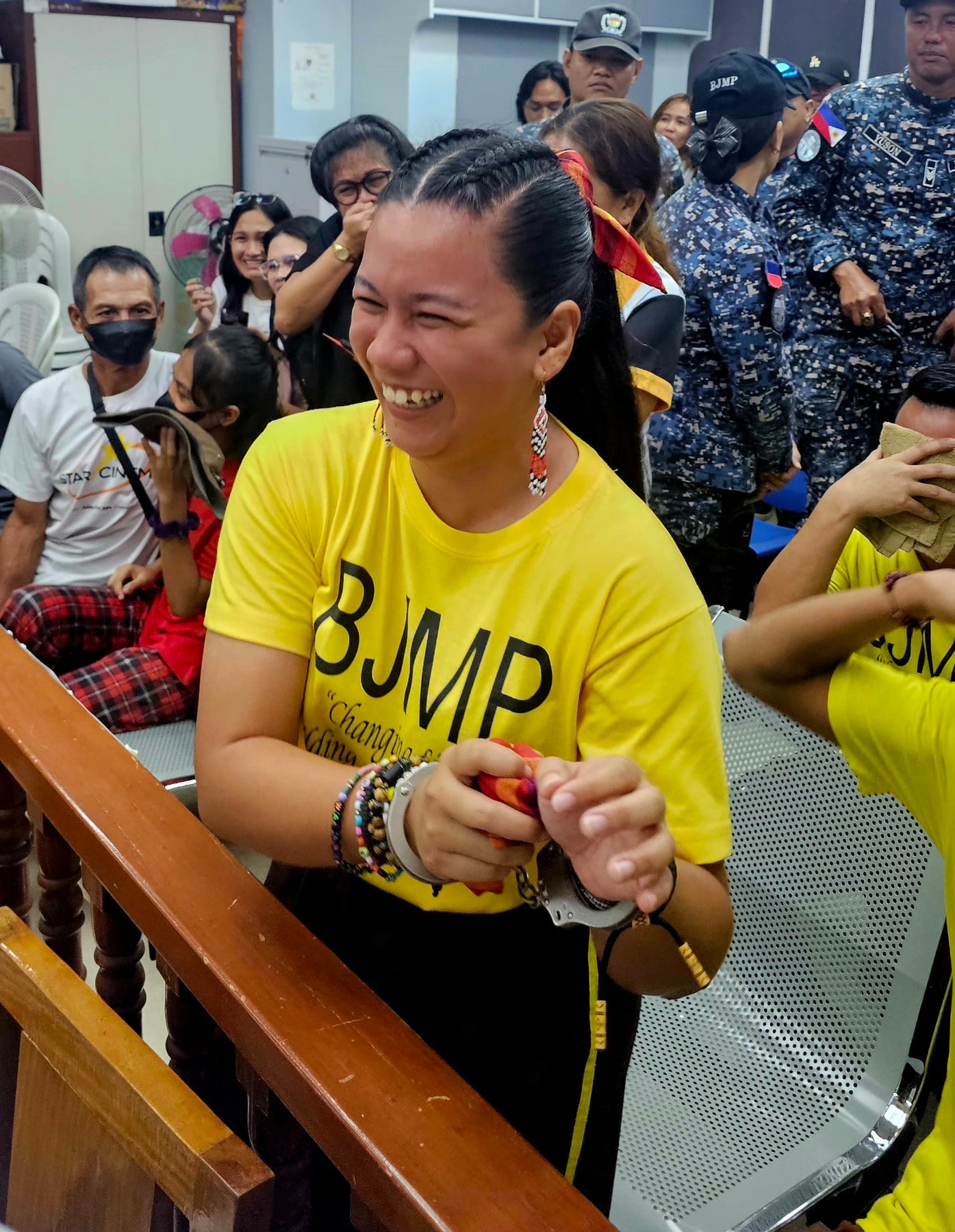
A year ago, on September 22, 2025, Myles heard the word she had waited more than seven years to hear: ACQUITTED.
It was supposed to be the end of a nightmare. Instead, she discovered that freedom comes with its own reckoning.
“It was indescribable,” she recalls.
As the Clerk of Court of the Dumaguete Regional Trial Court read the verdict,
Myles pressed her face against the tubaw she had been holding throughout the proceedings. She tried not to break down.
Seven years of holding herself together suddenly gave way. Finally, she said, they had been vindicated.
A year later, the memory remains vivid. But the life she returned to is no longer the life she left behind.
“It now feels like a lifetime ago,” she says.
The six—known throughout their ordeal as the Mabinay Six—spent years behind bars facing charges they maintained were fabricated.
Their ordeal began in the dead of night on March 3, 2018, in Barangay Luyang, Mabinay, Negros Oriental.
Soldiers surrounded the house where they were sleeping. They were given 10 seconds to come out or face a grenade.
Half-awake and terrified, Myles shouted: “Sir manggawas mi! Ayaw ra tawn mi’g unsa-a ninyo, sir. Maluoy mo!” — Sir, we will come out. Please don’t hurt us.
They emerged with their hands raised. Then came the gunfire.
A soldier made Myles squat beside a rock and fired two bursts from his firearm.
She later asked why it had been necessary.
The answer was chilling in its ordinariness: “SOP ra man ni.”
Standard operating procedure.
At the Mabinay police station, Myles recalled seeing officers apparently discussing what charges to file. She saw soldiers bring firearms into a room and later emerge without them. The weapons and other objects were subsequently arranged and photographed.
She repeatedly asked to call her family or a lawyer. Her requests were ignored. That night eventually became seven (7) years.
The years inside
The hardest part, Myles says, was not any single deprivation. It was the uncertainty.
The seemingly endless waiting. The possibility of conviction that never disappeared. The fear that she might lose family members while she remained behind bars—or never again walk freely outside prison.
Then there was the label: “Very High Risk” inmate.
She found it bitterly ironic. She was the one in a high-risk position, she said, at the mercy of uniformed personnel and a system that had taken away her liberty.
But prison did not erase her activism. If anything, it deepened it.
“In my seven and a half years in jail, I have perhaps seen just a fraction of the injustice that many more experience in the different sectors across the country,” she said.
She also came to appreciate something else: the capacity of ordinary people to help and serve wherever they find themselves.
Inside the jail were women whose lives had been shaped by poverty, women separated from their families simply to survive. Myles listened to their stories and lived alongside them for years.
The jail became another community. The stories shared by the women inside became another education.
The Mabinay Six, meanwhile, became a family of sorts.
They were separated in different detention facilities, but court hearings became occasions to reconnect. They exchanged messages and privilege calls. During the pandemic, when hearings shifted to video conferences, Myles made sure the others knew what had happened.
There were serious conversations. There were jokes, too.
Randel wrote poems in Cebuano and Hiligaynon. Myles wrote some herself.
Joemar, Carlo and Joey joked around. Bernald, the quiet one, listened and laughed.
“We were able to keep showing each other that we were still there for each other no matter how much longer we actually knew each other inside the cells than in real life,” Myles said.
Their bond survived the years. They knew one another longer inside prison than outside it. And still, they remained there for one another.
The door finally opened
On September 22, 2025, Dumaguete Regional Trial Court Presiding Judge Marie Rose G. Inocando-Paras acquitted the Mabinay Six, ruling that there was no proof of an armed encounter and that there had been improper handling of evidence involving the 12 criminal charges.

FREE AT LAST. Myles Albasin together with her companions takes a selfie with opinion writer Atty. Zarate at Regional Trial Court Branch 42 on Sept. 22, 2025. The Mabinay 6 case trial lasted for seven years, six months, and 19 days. (Photo by Atty. Carlos Isagani Zarate)
For Myles, the acquittal did not feel like a cinematic victory. It felt surreal.
“At that moment, it felt surreal. Our acquittal, our release, and the fact that I got to finally leave the jail premises with them—it all felt surreal,” she recalled.
The family reunion was just as overwhelming.
At a Dumaguete hotel where they stayed before travelling to Mindanao, Myles and her parents simply sat together and released the heavy breath they had been holding for years.
Days later, after her sister picked them up at Laguindingan International Airport, the car ride home to Cagayan de Oro became another emotional release.
Her mother and sister cried. Her father choked back a cry. Myles smiled through tears.
She also visited her aunt’s grave, as she had promised herself she would.
Then she went home. But going home did not mean returning to normal.
There was no normal to return to.
A year later, Myles is still rebuilding. She has started working as a paralegal. Last July, she enrolled in law school. She remains drawn to the communities and struggles that shaped her activism.
“I hope to share a message of hope and solidarity from the experiences we had,” she says.
But freedom has also come with grief. Seven (7) months after her release, she suffered what she describes as the worst loss of her life.
Freedom had arrived. So had grief. The system she had fought against had also taken from her someone she loved.
What comes next
Before her arrest, Myles had already planned to study law. Seven (7) years in detention only sharpened that decision.
She had seen what happens when the law is used against people with little power.
She had also seen what good lawyers can do when legal competence is combined with compassion and an understanding of the political and social realities behind a case.
Now she wants to become one of them—a people’s lawyer.
While working as a paralegal on human rights and environmental concerns, she continues to support campaigns for the welfare of political prisoners.
She said the acquittal was not simply a personal victory. It was a reminder that even when the law is weaponized, the courts can still provide a measure of protection when constitutional rights are upheld.
But she is not romantic about it.
An acquittal cannot return seven years. It cannot erase the fear of that night.
It cannot restore birthdays missed, family milestones lost or the ordinary years that passed behind bars. And, it cannot guarantee that others will not suffer the same ordeal.
That is why she continues to speak.
A year later
The people who stood with the Mabinay Six remain part of the story.
Myles is particularly grateful to the human rights group Karapatan and the National Union of Peoples’ Lawyers, which campaigned for their release and supported their legal battle from the early years.
She also acknowledges the LVZ Law Firm, which took over her case in 2023 and helped strengthen the legal fight.
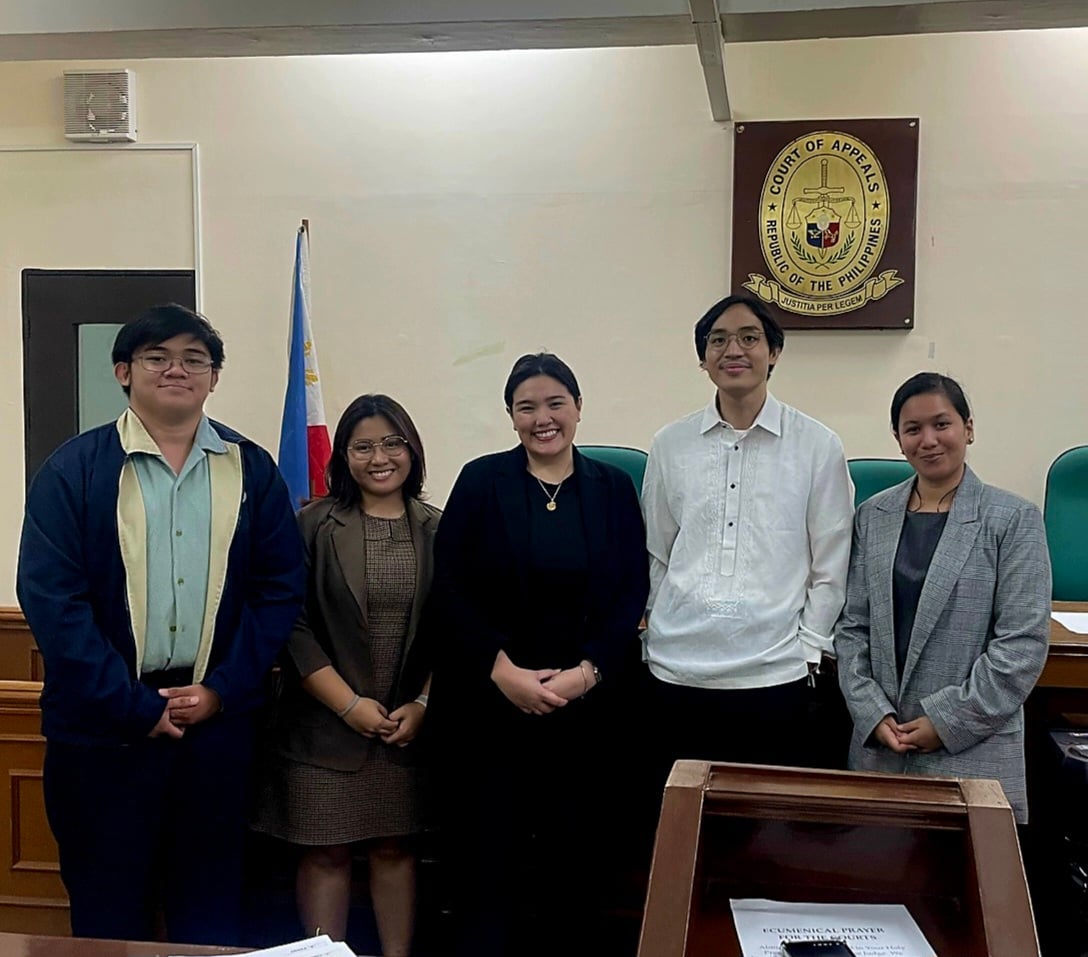
PARALEGAL. Myles Albasin appears for the first time in court barely two months after the acquittal in her case. Myles and the team of La Viña and Zarate (LVZ) law firm attended a Court of Appeals (CA) hearing in Cagayan de Oro City Nov. 2025. Myles now works as a paralegal at the firm. (Photo by Atty. Carlos Isagani Zarate)
Behind them were families, friends and human rights defenders who kept campaigning for their release through the years.
That solidarity mattered. It meant they were never reduced to a case number or a statistic. People outside were still remembering them. Still speaking their names; still knocking on the prison door.
Now, a year after the Mabinay Six walked free, they have returned to their individual lives. But the years they shared remain part of them.
“Our acquittal may have led us back to our individual lives,” Myles says, “but the shared experience will always echo in the daily tasks we face outside the walls of the jail that held us for almost a decade.”
Perhaps that is what remembering the acquittal means in a country once again looking back at the declaration of martial law 54 years ago.
It is not simply that six (6) people were freed. It is that seven (7) years of imprisonment failed to make them disappear.
Myles is studying law now. She is rebuilding her life. She is still trying to find where she can serve most effectively. And she is still learning how to live with everything that happened.
The prison doors opened a year ago. But freedom did not close the book.
Because accountability does not end at the prison gate. Neither does the struggle for justice.
The lessons of martial law remain precisely because the abuses it produced were not merely about one dictator or one generation. They are reminders of what can happen when power is allowed to operate without accountability—and of what ordinary people can endure when the machinery of the state turns against them.
Myles and the Mabinay Six are part of that continuing history.
Their story is also a warning: remembering martial law is not enough if the same patterns of impunity can still find new victims.
“Social change does not happen overnight,” Myles says. “It doesn’t happen behind our screens. It will never happen if we don’t fight for it ourselves. And it will never happen if we fight for it individually.”
Then she adds the lesson seven years in prison taught her: “This is why we should never be afraid to join organizations that are pro-people and pro-poor.”
A year after the prison doors opened, Myles is free—but the questions that put her there remain.
Fifty-four years after martial law, that is perhaps the harder lesson to confront: justice cannot simply mean freeing those who were wrongfully imprisoned.
It must also mean making sure that power is never again allowed to imprison, silence or abuse people with impunity.
For Myles, freedom is not the end of the story. It is the reason to keep telling it. The struggle that began in the darkness of a Mabinay night is not over. (davaotoday.com)