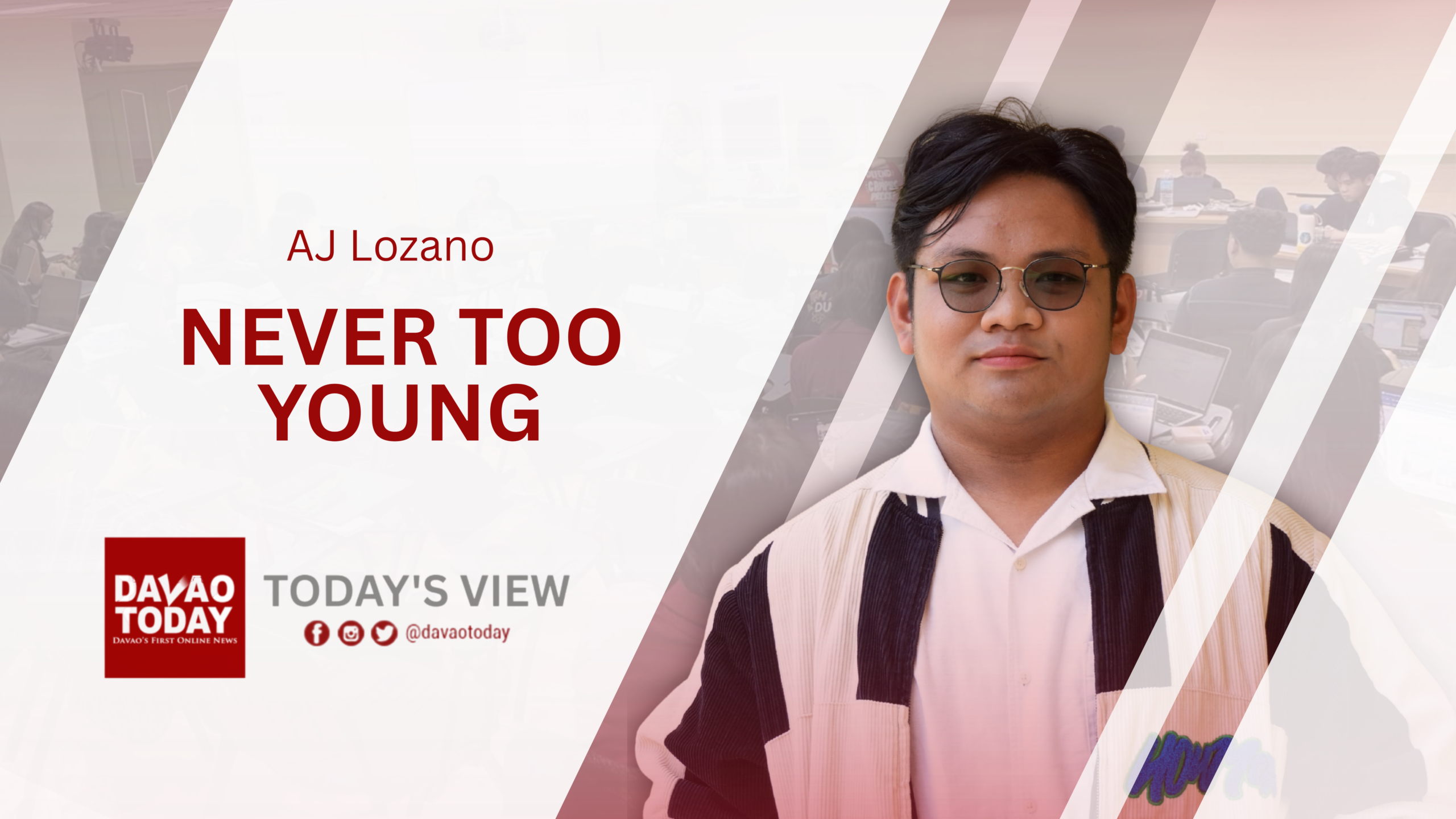
“Papunta ka pa lang, pabalik na kami.” Most of us heard this growing up, usually right after asking a question that mattered. “Never Too Young” offers a view of the world as young people actually experience it: the pressures, the contradictions, the late-night spirals, and the loud, messy, honest feelings that get dismissed as “just a phase.”
We’ll dig into the issues shaping young lives, from mental health and school to social media and to the world we’re set to inherit. And also lean on the pop culture that helps us make sense of it all: the songs on repeat, the shows we binge, the trends we love and love to roast.
Expect raw thoughts, questions, and a healthy skepticism of rules that exist only because “that’s how life has always been.” We aren’t a problem to be managed or a future to be postponed. This is our open mic.
*********
Youth take it to the streets
It has become almost mundane to hear stories of students going to class on an empty stomach, borrowing money just to eat, walking long distances to save on transportation, or juggling work and academics simply to make ends meet.
These are such harsh realities that the youth face today. For the most part, we were not given a choice, but we were rather pushed by circumstance.
Over the last few days, thousands of students and young people from various sectors have taken their clamor to the streets as we push for higher state subsidies for education, fight for people’s rights and struggle for a future we rightfully deserve.
Despite different perspectives in our participation in the people’s struggle, it begs the question: Why does the youth always seem to find itself in the struggle of the Filipino people?
We, as youth, are oftentimes dubbed as the ones who will inherit the future and on the flipside we are also those who will face the brunt of the long-term consequences of what society will become in the future.
The youth showing up in the struggle is not entirely new. Bonifacio’s fervor and Rizal’s idealism inspired a generation of young blood taking up the role as catalysts of change.
Decades later, the revolutionary youth of Kabataang Makabayan. unfazed by the socioeconomic and political unrest, led the First Quarter Storm that challenged the Marcos dictatorship of the ‘70s and ‘80s.
This revolutionary spirit continues to live on today.
Yet the youth’s pursuit of social change is met head-on by state repression.
In 2024, the Supreme Court ruled that red-tagging and other forms of state attacks are recognized as serious threats to the rights to life, liberty, and security.
In spite of this, youth leaders continue to face trumped-up charges, terrorism allegations, red-tagging, surveillance, and other forms of harassment and intimidation. These attacks reveal how the reactionary state responds when people assert their power to challenge existing social conditions.
But when we reflect upon the question imposed earlier. The youth has always found itself in the people’s struggle because we recognize the need for social justice. We fight for sufficient funding for schools. We fight for higher state subsidies for basic social services. We call for higher wages. We hold government officials accountable.
Our country’s social conditions justify why the youth inevitably finds itself challenging the status quo.
To be honest, I also was nervous the first time I held a placard on a picket line. My hands shook the first time my voice echoed through the megaphone. I wondered whether I was convincing enough to encourage people to join the fight and whether I was prepared for whatever might come after the protest ended.
Even now, standing on the frontlines of a protest means facing cameras pointed toward us, wondering who is documenting our faces, taking notes of our names, and becoming increasingly aware of unfamiliar individuals monitoring a gathering that should be an exercise of democratic participation.
As the late Lean Alejandro once said, “In the line of fire is the place of honor.” Being in the line of fire is never the absence of fear. To stand in the line of fire is to combat fear with a force much stronger— hope.
Hope that is built collectively in our classrooms, our communities, our workplaces, our organizations, and in the streets. The kind of hope that emerges when we recognize that our individual struggles are connected to those of others.
And perhaps that is why young people keep returning to the streets.
We are not simply marching out of our classes because we want to be heard. We walk out because there are things greater than us that should no longer be considered normal.
There should be nothing mundane about a student going hungry just to stay in school. Nothing ordinary about young people being forced to choose between education and survival.
And perhaps that is our most enduring role as the youth: not to accept the world as something unfinished, but to proactively become part of making history. (davaotoday.com)
(AJ Lozano, 22, is a student-leader and writer-activist based in Davao City. He graduated with a degree in Applied Mathematics from University of the Philippines Mindanao. He currently serves as the 2nd Nominee of the UP Office of the Student Regent.)