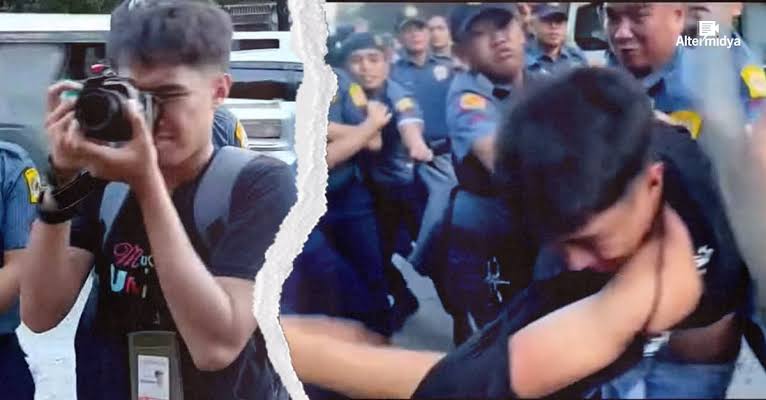
MANILA, Philippines —This year has seen several instances of police violence at protests, renewing concerns over the safety of media workers covering demonstrations.
The Commission on Human Rights said its National Capital Region Office conducted a quick response operation and initiated a motu proprio investigation into the alleged excessive force.
The CHR is gathering initial accounts from witnesses and protest organizers, requesting operational records from the Quezon City Police District, securing formal statements and medical records, and assisting affected individuals in filing complaints.
The commission is also separately investigating reports of harm involving student journalists during the protest.
On Oct. 19, Bulatlat reporter Aaron Ernest Cruz was covering the dispersal of farmers outside the Department of Agrarian Reform central office when Quezon City police officers allegedly surrounded and dragged him despite his identification as a journalist.
Video footage showed Cruz displaying his press ID and repeatedly shouting, “Taga-Media ako” (I am from the media), as officers restrained him.
According to the CHR, Cruz sustained bruises during an attempted arrest that his colleagues prevented. His shirt was torn, and he later received medical attention. He also reported that his bag went missing.
Robie Matias, a student journalist from Far Eastern University and correspondent for Tudla Productions, reported being injured after being caught in a standoff between police and protesters.
Altermidya Network also reported that an intern was pulled and nearly dragged away by police during the attempted dispersal.
The involvement of student journalists underscores the risks faced not only by professional reporters but also by campus and community media workers who document public-interest issues.
A pattern of alleged harassment
Media organizations said the incident was not isolated.
“This is not the first time the Philippine National Police (PNP) has resorted to violence in dealing with members of the media,” the National Union of Journalists of the Philippines said in its Oct. 19 statement.
The NUJP cited incidents during the Sept. 21, 2025, anti-corruption protests, when journalists reported being assaulted, obstructed and exposed to tear gas while covering police operations.
In another incident on July 22, 2026, police attempted to arrest photojournalists Bullit Marquez and Rene Dilan while they were covering a protest in Pasay City.
For media organizations, the issue extends beyond the injuries allegedly sustained by Cruz. The safety of journalists covering protests is tied to the public’s ability to access information about police conduct, the exercise of civil liberties and the grievances of affected communities.
Safeguards versus accountability
The allegations come despite existing rules prohibiting police violence against journalists.
In October 2025, the National Police Commission (NAPOLCOM) and the Presidential Task Force on Media Security (PTFoMS) entered into an agreement establishing mechanisms to address complaints involving police misconduct against media workers.
The NUJP said the agreement explicitly prohibits the use of force against journalists.
NAPOLCOM Resolution No. 2025-0472 also approved the PNP’s rule on media relations, safety of journalists and media practitioners, and enhancing freedom of expression and access to public information.
Section 7(3) prohibits the use of force against journalists under any circumstance, including during the dispersal of demonstrations and the detention or arrest of protesters.
The CHR reiterated these protections in its Oct. 22 statement.
Meanwhile, the PTFoMS coordinated with NAPOLCOM to investigate the incident.
NAPOLCOM deployed investigators to establish the circumstances surrounding the alleged harassment and determine whether accountability measures are warranted.
The QCPD, for its part, maintained that its personnel exercised maximum tolerance during the confrontation. Police said officers were deployed to maintain public order and dismantled the protesters’ temporary structure after dialogue. The police also reported that several officers sustained injuries during the incident.
The competing accounts underscore the need for an independent investigation that examines both the police operation and the treatment of journalists documenting it.
“We demand that these safeguards be applied in Cruz’s case, that the officers involved be held accountable, and that the PNP ensure journalists can cover protests without fear of violence or obstruction,” the union said.
The International Federation of Journalists also condemned the alleged violence against Cruz and Matias, describing the incident as part of a broader pattern of police brutality against journalists in the Philippines.
The CHR stressed that maintaining public order must remain consistent with the rights to freedom of expression, peaceful assembly and press freedom. It said allegations of excessive force must be independently investigated and those found responsible held accountable.
As investigations proceed, the case raises a central question for authorities: Whether existing protections for journalists will be enforced in practice, particularly when reporters document confrontations involving law enforcement. (davaotoday.com)