
CEBU CITY, Philippines—The children they hope to protect may never know their names, but survivor leaders Barbie, Trixie and Patricia want their experiences to help make the internet and their communities safer for the next generation.
All three are part of the Philippine Survivor Network (PSN), a network of adult survivors of child sexual abuse and exploitation who now help lead efforts to prevent online sexual abuse and exploitation of children (OSAEC).
Their surnames are withheld and identifying details limited to protect their privacy and safety they as they take part in advocacy work.
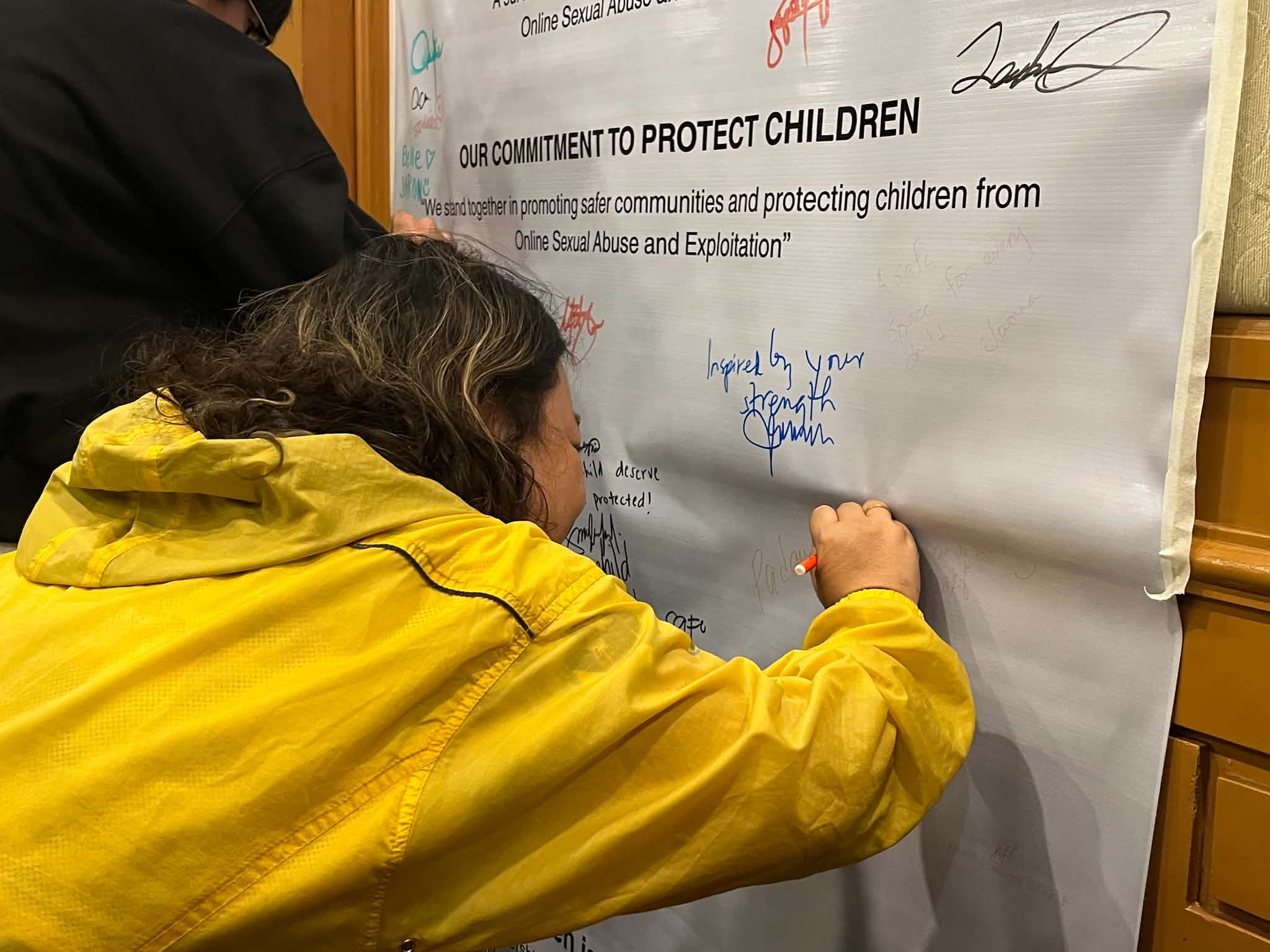
On Oct. 21, they gathered community volunteers in Cebu City for an orientation on Hope U Protect, a campaign that seeks to turn public awareness into concrete action to protect children.
“Every moment of inaction gives abuse a chance to continue, but every action we can take brings a child closer to safety and hope,” Trixie said.
The campaign encourages volunteers to join child protection efforts, from helping children learn about safety and how to report abuse to engaging parents, families, schools and community organizations.
“Our experiences can become a source of strength, purpose, and hope. Every voice has the power to inspire change,” Barbie said.
From surviving to leading
Hope U Protect aims to make child protection a shared responsibility, with survivors helping shape the campaign and community members contributing their skills, time and resources.
Patricia said the initiative is intended to make the public more aware of the lives survivors can build after abuse and the roles they can play in protecting others.
Survivors who have received support may join PSN through its training module and eventually take on leadership roles.
Asked about programs that support survivors beyond the arrest or conviction of perpetrators, Patricia said organizations continue to work with survivors, although these efforts rarely draw the same public attention as law enforcement operation.
“There are a lot of initiatives; they just aren’t mainstream yet,” she said.
Patricia also said that existing child protection laws must translate into something children can feel in their daily lives.
“There’s no need to change [laws on OSAEC]. We just need to act, because there’s a lot of laws,” she said, referring to the need to properly implement existing policies.
Children do not necessarily need to know the specific law that protects them, she said; what matters is that they experience that protection when they need help.
The scale of online abuse
The campaign comes as the Philippines continues to grapple with online sexual abuse and exploitation involving children.
A UNICEF Philippines overview reported that 2 million children in the country experienced online sexual abuse and exploitation in 2021. It also found that disclosure and reporting remained low, with only 0% to 4% survivors reporting their experiences and only 0% to 3% knowing how to report to police or helplines.
OSAEC can involve online grooming, sexual extortion, the production or distribution of child sexual abuse or exploitation materials and livestreaming of abuse. It may also involve abuse that happens offline but is facilitated or extended through digital platforms.
Republic Act No. 11830, the Anti-OSAEC and Anti-CSAEM (Child Sexual Abuse or Exploitation Materials) Act, was enacted in 2022 to penalize these offenses and strengthen prevention and response mechanisms. The law also protects children’s privacy during investigations and court proceedings and prohibits media coverage that causes undue publicity and further suffering to a child.
For PSN, the challenge is not only to raise awareness of the law but to help communities recognize their role in preventing abuse and responding appropriately when a child needs protection.
Hope U Protect includes age-appropriate learning sessions for children, animated materials on reporting abuse, helpline awareness, parent-focused activities, and family development workshops. Its targets include reaching 100,000 schoolchildren with online safety education, engaging 1,000 parents, teachers, and other adults, and partnering with 50 churches and community centers.
It also aims to support five cities, including Cebu City and Cagayan de Oro, in monitoring local anti-OSAEC measures, and to support the passage of a local anti-OSAEC and anti-CSAEM ordinance in Taguig City by 2028.
Protection must include how survivors are treated
During the orientation’s open forum, participants raised questions about how survivors are treated when they report abuse and what happens after a case reaches the justice system.
Barbie said one area needing improvement is how authorities and other stakeholders handle survivors, particularly when interviewing children about sensitive experiences. Some stakeholders may not be sufficiently prepared to conduct interviews in ways that account for trauma and children’s vulnerability.
She also raised concerns about accountability when people tasked with protecting children are themselves accused of mistreating or violating their rights—comments that point to the need for responses that do more than investigate allegations: children must also be treated with dignity and shielded from further harm throughout the process.
Those concerns extend to media coverage, which can expose children and their families to renewed distress when reports include unnecessary personal details, graphic descriptions or unverified images.
A responsibility for journalists, too
During a separate training for journalists on Oct. 20, lawyer Maria Jane Paredes urged reporters to exercise judgment before publishing graphic descriptions of abuse or photos and videos supplied by authorities, such as press releases.
Journalists should consider whether a photo or video adds meaningful information to a report and whether the story can stand without it, she said. If reporters cannot verify whether an image was taken during the operation being described, that uncertainty should be treated as a warning against using the material.
Paredes also cautioned against reproducing graphic details, even when these come from a source interviewed by a reporter, because they may retraumatize survivors. The responsibility, she said, is not only legal but ethical: journalists and content creators should avoid becoming part of the bullying or public shaming of children and their families.
Editha Caduaya, a founder of a Davao-based media outlet, similarly urged journalists to use sensitive language, provide context and prioritize accuracy over speed when reporting on children. She cautioned against relying on generic labels or emotional descriptions that invite readers to judge a child or family without understanding the circumstances.
The guidance is consistent with Republic Act No. 11930, which protects children’s identities and prohibits undue publicity that may cause further suffering. It also prohibits statements that blame children for offenses committed against them.
Davao City strengthens local protection
In Davao City, local measures against OSAEC and CSAEM include a dedicated ordinance, training for child protection personnel and community education initiatives.
City Ordinance No. 0914-26, Series of 2026, prohibits OSAEC and CSAEM and institutionalizes programs for prevention, eradication and support for child victims. In August, the City Social Welfare and Development Office, in partnership with the International Justice Mission, conducted basic internet crimes against children training for 177 participants, covering trauma-informed mechanisms and victim confidentiality.
The city has also conducted cyber-safety and cyber-security seminars for barangay councils for the protection of children. In September, councilor Richlyn Justol-Baguilod proposed strengthening the Parent Effectiveness Service program to help families recognize online risks and protect children.
These initiatives provide a local example of efforts to connect laws with prevention, community awareness and frontline responses. Their effectiveness, however, depends on implementation and whether children and families can access help when abuse is suspected.
Making protection felt in communities
Hope U Protect was launched nationally on July 1, 2026, during the Manila Prayer Gathering, an ecumenical event attended by government representatives, civil society organizations, faith communities and child protection advocates.
The campaign’s larger goal is to help children recognize unsafe situations, make it easier for them to seek help, and ensure that the adults and institutions they turn to respond with care.
For Barbie, Trixie, Patricia and other survivor leaders, their past experiences do not have to define the limits of their lives. Through Hope U Protect, they are using their voices to help build communities where children are better protected and survivors help ease shape the response to abuse. (davaotoday.com)


