
DAVAO CITY, Philippines—Emma Ricaforte was recovering from cancer treatment when alleged representatives of the National Task Force to End Local Communist Armed Conflict (NTF-ELCAC) and the 10th Infantry Division (10ID) repeatedly pressed her to sign a document clearing her name of links to the New People’s Army (NPA).
Ricaforte, chairperson of the board of trustees of the Nonoy Librado Development Foundation, Inc. (NLDFI), said the visits and pressure strained her emotionally and psychologically while she recovered from surgery and chemotherapy. She served as NLDFI executive director for 13 years, working with plantation workers on labor standards, workers’ rights and union organizing.
“They would come to my house and ask me to sign a document to clear my name. They came bringing fruits and offered me P5000,” Ricaforte told Davao Today in Cebuano.
The visits ran from February to July 2026, following an earlier round in 2024.
When she was too weak to receive the visitors, her husband spoke with them.
“You really added to my psychological effects, stress,” she said. “You are not God. You don’t have the right to harass me.”
Her work took her to banana plantations in Compostela Valley, pineapple plantations in Polomolok and communities in Bukidnon and Misamis Oriental.
“We provide vocational training, labor standards, know-your-rights talks, and women orientations to the laborers,” she said.
She rejected the allegation that helping workers organize made her an NPA supporter.
“Is it wrong to go to Compostela Valley to help the workers in banana plantations? Is it wrong to go to the pineapple fields in Polomolok?” she asked. “Is it wrong to go to Bukidnon or Misamis Oriental, to help laborers organize unions so they understand their protection and rights in their work?”
She also reported condolence wreaths hung at her gate. Her home security camera captured the incident, but the military denied involvement. She still suspects it was connected to the harassment she has experienced.
Ricaforte reported the visits to the Commission on Human Rights (CHR), but said she received no updates on the promised investigation.
She is now staying in Davao City for refuge.
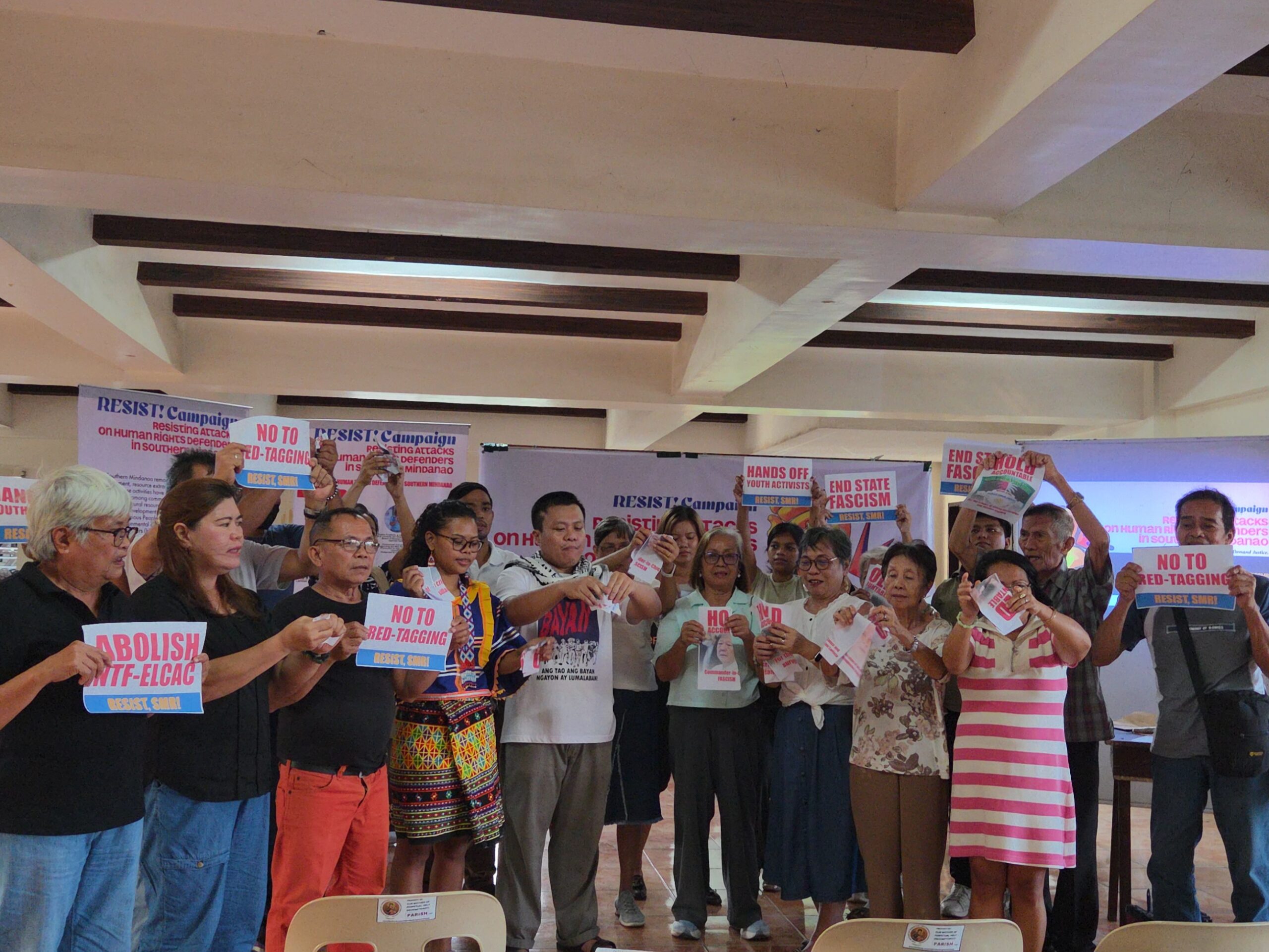
Her account was among testimonies shared by human rights defenders and progressive groups in Southern Mindanao at the Oct. 21 launch of Resisting Attacks on Human Rights Defenders in Southern Mindanao (RESIST! SMR). The campaign seeks to document violations and challenge red-tagging, surveillance, threats and harassment against activists and rights defenders.
Pressured to surrender
Kat Dalon of Sabokahan Unity of Lumad Women said military intelligence personnel repeatedly visited her and those of fellow activists, asking about their whereabouts and associates.
Relatives initially refused to welcome the visitors, but as visits grew more frequent, personnel brought food and money and attended family celebrations. Some relatives eventually pressured activists to surrender or disclose information, fearing for their own safety.
“Because of the pressure, we were forced to cut communication with our families,” Dalon said in Cebuano. “We can’t talk to them anymore because they would text and call us everyday to surrender because they’re also tired. At some point, even our parents would trust the military and give information about us.”
Dalon said activists asked the CHR to hold a discussion with the military, but the military declined.
Marklen Lariosa of Desaparecidos Philippines said his family faced similar pressure before his father, labor organizer William Lariosa, was allegedly forcibly disappeared in Bukidnon.
Lariosa said individuals identifying themselves as state agents and NTF-ELCAC representatives visited his family’s home in Davao de Oro in 2022, alleging his father had links to rebels and urging him to surrender. The family maintained that William was a labor organizer with the Kilusang Mayo Uno (KMU), not a rebel.
“It came to a point when they threatened us that if tatay (father) doesn’t surrender, the entire family would be implicated,” Marklen said.
William was reportedly taken by suspected military agents on April 10, 2024, in Barangay Butong, Quezon, Bukidnon. The CHR said a month later it was alarmed by his disappearance and had begun coordinating with the family and relevant agencies.
The family’s legal efforts have faced setbacks. Lower courts rejected earlier petitions seeking to compel authorities to account for William’s whereabouts.
In October 2025, the family elevated the case to the Supreme Court, which in a resolution dated July 8, 2026, directed military respondents, including the 48th Infantry Battalion and the 10ID, to submit comments on the petition.
“Until now, it has been more than two years that we’re still looking for him,” Marklen said.
‘Activism is not a crime’
Rauf Sissay of Bagong Alyansang Makabayan-Southern Mindanao Region (BAYAN-SMR) said the testimonies reflect a broader pattern of targeting people who organize communities, defend workers’ rights and oppose the exploitation of natural resources.
He said red-tagging is used to silence people who speak out against abuses or resist projects that threaten their communities.
“If you demand or talk about the realities of people on the ground, you’re immediately branded as a member of the NPA,” Sissay said in Cebuano.
Sissay said activists also face surveillance, threats and fabricated criminal complaints.
“Trumped-up cases are being filed against known progressive leaders and organizations that stand up for rights,” he said. “Charged with illegal possession of firearms or explosives, or even charged with murder despite not having killed anyone.”
He said the experiences create a chilling effect that forces people to abandon their advocacy out of fear, and questioned the continued military presence in rural and Indigenous communities despite declarations that the Davao region was insurgency-free as early as 2022.
“There is nothing wrong with what we are doing. Activism is not a crime. Defending our human rights is not terrorism,” he said. (davaotoday.com)

