Hunger Still Highest in Mindanao ? SWS Survey

davaotoday.com photo by Erwin FallerMedco?s Dureza says the SWS survey on hunger highlights the urgency of the government?s anti-poverty program. But Kadamay counters that unless the government stopped prioritizing foreign investments and business over the welfare of ordinary Filipinos, unless it stopped displacing families from their lands and unless it increased wages, rolled back oil prices and junked the E-VAT, poverty and hunger will persist.

Related item

Rise in hunger incident blamed on denial of wage relief

DAVAO CITY (mindanaotoday.com) ? Mindanao, the most abundant region in the country, which accounts for a third of the country?s food products and which produces key crops for export, has registered the highest incidence of hunger in the Philippines, according to the latest survey by the Social Weather Stations (SWS).

The survey, which also showed that hunger in the whole country registered a record increase, says 21 percent of respondent households in Mindanao experienced hunger, a slight decrease from the 21.7 percent registered in December 2005. The survey was done in the first quarter of this year and was released on Friday.

(more…)

Continue ReadingHunger Still Highest in Mindanao ? SWS Survey

Farmers Seek Ban on Aerial Spraying of Pesticides

Related story: In Many Davao Villages, Poison Pours from the Sky

DAVAO CITY — Coconut farmers from seven villages of Baguio and Calinan Districts are demanding the banning of aerial spraying of pesticides on banana plantations in their villages, blaming this method for the decrease in their yield.

Jun Alcomendras, a councilor in barangay Wangan, said at least 60 percent of the coconut farmers in the village have suffered economic loss after their crop rhino beetles attacked their coconut trees.

(more…)

Continue ReadingFarmers Seek Ban on Aerial Spraying of Pesticides

In Many Davao Villages, Poison Pours from the Sky

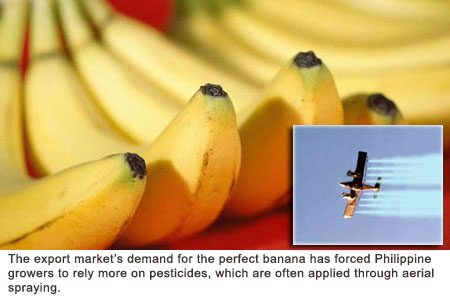
Environmentalists denounce the continued aerial spraying of pesticides in banana plantations in Davao City and Southern Mindanao. They note the havoc wrought by aerial pesticide use, among them diseases and an increasingly imbalanced ecosystem.

Photos from www.sarangani.gov.ph and www.cow-net.com

By Germelina A. Lacorte
davaotoday.com

DAVAO CITY — The air would smell of alquitran (tar) and the leaves of malunggay (horse radish tree) would turn into what looked like beans.

A woman from Panabo thus described what happened to her plants after the aerial spraying of a nearby banana plantation.

?I did not believe her at first,? said Josephine Quiamzon, vice-chairperson of the environmental group Panaghoy sa Kinaiyahan. ?Until I saw malunggay leaves turned into what looked like monggo seeds when they fell to the ground and wilted,? she said.

During the Earth Day celebrations last week, environmentalist groups here called on government to ban the aerial spraying of pesticides, which has become a common practice among banana plantations here, according to the environment group Interface Development Interventions Inc. (IDIS).

(more…)

Continue ReadingIn Many Davao Villages, Poison Pours from the Sky

?Haob na Odong? and the Rediscovery of Davao Cuisine

Or is there such a thing as Davao cuisine?

By Germelina A. Lacorte
davaotoday.com

DAVAO CITY ? Think of it as lasagna, only different. Its layers are made of beef, chicken gizzard, liver, spiced with lemon grass, ginger, onion, garlic, achuete, alugbati leaves, kesong puti (cheese), and odong, the poor man?s noodles.

Unlike lasagna, however, ?haob na odong? is wrapped in banana leaves and ?baked? in hot coal, like a bibingka. (Others fry it.)

?
Contrary to the popular view among visitors that Davao cuisine is limited to inihaw na panga (grilled tuna jaw) or Luz?s kinilaw (tuna salad),? there are some fare, though not yet popular, that Davao can call its own. ?Haob na odong? is one such dish; it uses a Davaoe?o method of cooking, which is to wrap the ingredients with banana leaves and ?bake? it by grilling, steaming or frying.

(more…)

Continue Reading?Haob na Odong? and the Rediscovery of Davao Cuisine