
A controversial bilateral trade agreement between the Philippines and Japan promises enormous economic opportunities for Filipinos, among them agricultural producers such as the banana workers and growers in the Davao regions. That, at least, is the Arroyo administration’s line. What they’re not telling the public is that, apart from the environmental hazards it poses, the agreement is a one-sided trade pact that benefits the Japanese more. The agreement, according to some economists, will also set a precedent that will further erode the Philippine economy. Davao Today’s Carlos H. Conde reports.
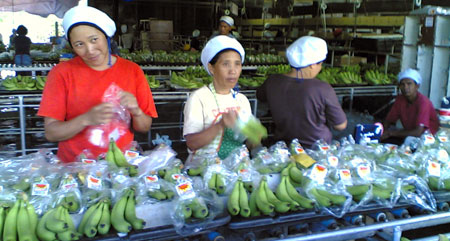
Will these workers in a banana packing plant in Compostela Valley benefit from JPEPA? Some economists don’t think so. As it is, many of these workers are overworked and underpaid. Several of them, in fact, have been fired by the company. (davaotoday.com photo by Barry Ohaylan)
Furor Over JPEPA: Will Davao’s Banana Workers Benefit From It?
MANILA — On paper, it’s a remarkable document: Manila and Tokyo will open up trade by lowering tariffs on more than 11,000 commodities from both countries. For an export-oriented, import-dependent country like the Philippines, it presents enormous opportunities.
And for a region like Davao that produces so much agricultural products for the Japanese market, such as bananas, the potentials are great.
Or so the governments of both countries want Filipinos to believe.
The document, called the Japan-Philippines Economic Partnership Agreement (JPEPA), is the first bilateral trade agreement Manila signed with another country since the end of World War II. Japan is the Philippines’s top trading partner and is also the source of much of its development aid. The Philippines, on the other hand, is Japan’s major source of mainly agricultural products, like bananas and pineapples, most of it from the Davao regions in Mindanao.
JPEPA is one of the many such agreements Japan has entered into lately, which are part of what is now a trend among developed countries — primarily Japan, the US and those in Europe — to negotiate bilateral trade pacts following the collapse of the Doha round of negotiations at the World Trade Organization.
Critics have always said that bilateral trade agreements are often negotiated in secrecy. This agreement, they allege, is no exception.
Signed in September by Philippine President Gloria Macapagal-Arroyo and then Japanese Prime Minister Junichiro Koizumi, practically nothing was heard about JPEPA ? until environmentalists came out last month to denounce it because, according to them, it will allow the entry to the Philippines of Japanese toxic wastes.
More Insidious Aspect
But the environmental and health hazards JPEPA poses is just one problem, critics say. They point out that a more insidious aspect of the agreement is that it will benefit the Japanese more than Filipinos.
JPEPA “is biased for Japanese imports,” said Jose Enrique Africa, an economist and head of research at Ibon Foundation, a Manila-based socio-economic research group.
While Manila agreed to immediately eliminate tariffs on key Japanese products — automobile and automotive parts, electrical and mechanical appliances for industrial use, and household appliances ? immediately after the signing of the agreement, Tokyo will not do the same for key Philippine products for export to Japan, such as fruit and fruit juices, Africa said.
“Japan refused to give immediate zero-tariffs to Philippine bananas and pegged the tariff rate at 10 percent to 20 percent,” Africa said. He added that Japan “only offers a removal of tariffs 11 years after the agreement comes into force and promising to lower tariffs every year until the eleventh year.”
Manila also failed to convince Tokyo to open the Japanese market for tuna, cods and herrings, which are major Japanese imports. “Japan will only start talks on tariff reductions for Philippine tuna five years after the JPEPA takes effect,” Africa said, referring to the agreement. Japan, he said, “is also not committed to removing quota restrictions and reducing tariffs” on such Philippine products as herrings, cod, sardines and mackerel.
Japan’s Benefit
Another criticism of JPEPA centers on the contention that it would benefit Japanese corporations operating in the Philippines, such as car manufacturers like Toyota, Honda, and Mitsubishi that dominate the local automotive industry. These companies, Africa said, would benefit from lower production cost because of reduced duties on imported raw materials and parts.
As for the supposed benefits to Filipino agricultural producers, Africa said this is misleading — most of the bananas from Davao, for example, are exported to Japan by Japanese companies such as Sumitomo. These companies and their contract growers or affiliates in Mindanao, he pointed out, will benefit from any lowered tariff of these bananas, not the farmers and plantation workers.
Africa estimated that the Philippines will lose nine billion pesos of tariff revenues a year under JPEPA.
Environmental Hazards
Then there’s the opposition to the agreement due to the environmental and health hazards it poses to Filipinos. According to environment groups, the agreement will turn the Philippines into a vast dumping ground of toxic wastes because the Philippines, by removing tariffs, would allow Japan to export here 141 items found by the Philippines Department of Environment and Natural Resources to be “environmentally sensitive products deemed potentially hazardous to health and the environment if not handled properly.” Among the items listed, according to the department, is incinerator ash, which is deemed highly toxic.
“This kind of legal toxic dumping is utterly unjust and its signing by the Philippine and Japanese governments is nothing short of criminal.” said Von Hernandez, the Filipino campaigns director of Greenpeace in Southeast Asia. “Where is the dignity in this lopsided agreement? We may be a poor country but we cannot be this desperate.”
Officials said the Philippines could benefit from JPEPA because Japan will accept more Filipino health workers, such as nurses and doctors. Overseas Filipino workers send home more than $10 billion annually, thus propping up one of the poorer economies of Southeat Asia.
Unfounded Fears
The Arroyo administration sought to dispel fears surrounding JPEPA. “This government will never allow, under any circumstances, the transport and entry of toxic wastes into Philippine soil,” said Ignacio Bunye, the president’s spokesman. “Fears of this kind are unfounded as both the Philippines and Japan are committed to respect each other’s sovereign rights and interests.”
Tokyo, meanwhile, tried to do the same. In a statement it issued two weeks ago, the Japanese embassy here said it would not export toxic wastes to any country “unless the government of such country approves such export.” It said the criticism to the agreement seemed to have sprung from “some misunderstanding.”
It said Tokyo respects the 1989 Basel Convention on the Transboundary Movement of Toxic and Hazardous Wastes, which Japan and the Philippines ratified.
Peter Favila, the Philippine trade secretary, said the inclusion of toxic wastes in the agreement “does not mean anything.”
“One of the items included is what we call hazardous toxic wastes. That’s part of all-in trade and it does not mean that we allow them to ship waste to us. It does not mean anything,” he told reporters two weeks ago.
He said the inclusion of toxic wastes was meant to prevent Japan from asking for more concessions on other Philippine products. “If we didn’t do it, we would be forced to offer another product,” Favila said. “It’s a negotiation strategy.”
A group of Philippine exporters, meanwhile, hailed the agreement as a breakthrough for Philippine products in the Japanese market and asked the Philippine Senate, which has been holding hearings on the agreement, to ratify it. The legislature of both countries need to approve the agreement before it can be implemented. One senator said the agreement “would go through the eye of the needle” at the Senate.
Improved GDP
A study by the Philippine Institute for Development Studies, which took part in the research that led to the formulation of the agreement, indicated that JPEPA would improve the country’s gross domestic product by as much as 3.3 percent “if potential foreign investment inflows and productivity gains” from the agreement would materialize.
The study pointed out that the elimination of tariffs on toxic wastes “does not imply free trade because countries have trade regulations or nontariff measures that are applied to restrict trade in these goods.”
Besides, it added, similar trade agreements between Japan and such countries as Singapore and Malaysia eliminated tariffs on toxic and hazardous wastes, such as ash, residues, pharmaceutical wastes, sewage sludge, clinical wastes, among others.
The more important issue, the institute said, “is how to strengthen our technical and regulatory capacity to manage hazardous wastes and effectively implement import controls.”
Poor Environmental Record
But to environmentalists, that’s just the problem. Unlike Malaysia and Singapore, the Philippines is a poor country with hardly any facilities to recycle waste, said Beau Baconguis, an anti-toxic waste campaigner for Greenpeace based in Manila. If Japan cannot recycle its own waste, she said, “how can we expect the Philippines to do better?”
Moreover, Baconguis said, the Philippines’s record on environmental compliance is rather poor. The country, she said, cannot even solve a simple problem such as the dumping into rivers and oceans of lead from batteries or chemicals extracted from electronic products imported from Japan and other developed countries.
Activists and environmentalists have been asking the Senate not to ratify the agreement. But Cielito Habito, an economist who was involved in the study that paved the way for the agreement, warned against “throwing out the baby with the bathwater.” In his column this week in the Philippine Daily Inquirer, he argued that while the agreement may have been negotiated in secrecy and undue haste, “many provisions in the JPEPA promise to benefit the Philippine economy, and provide much more jobs and livelihood to Filipinos.”
In the end, he said, “the issue really hinges on whether the Philippine government can be trusted to uphold and enforce our environmental laws and indeed our laws in general. And government’s track record, admittedly, does not merit that trust so far.”
But Africa, the economist, said the agreement has far-reaching implications for the Philippines. For one, it sets a precedent that other countries could use in future trade negotiations with Manila.
“It compromises and undermines the Philippines’s position in future trade negotiations with other countries, even within the World Trade Organization,” Africa said. “If Japan can get away with so much under this agreement, another country would be well within its right to demand similar concessions from us.” (Carlos H. Conde/davaotoday.com)