
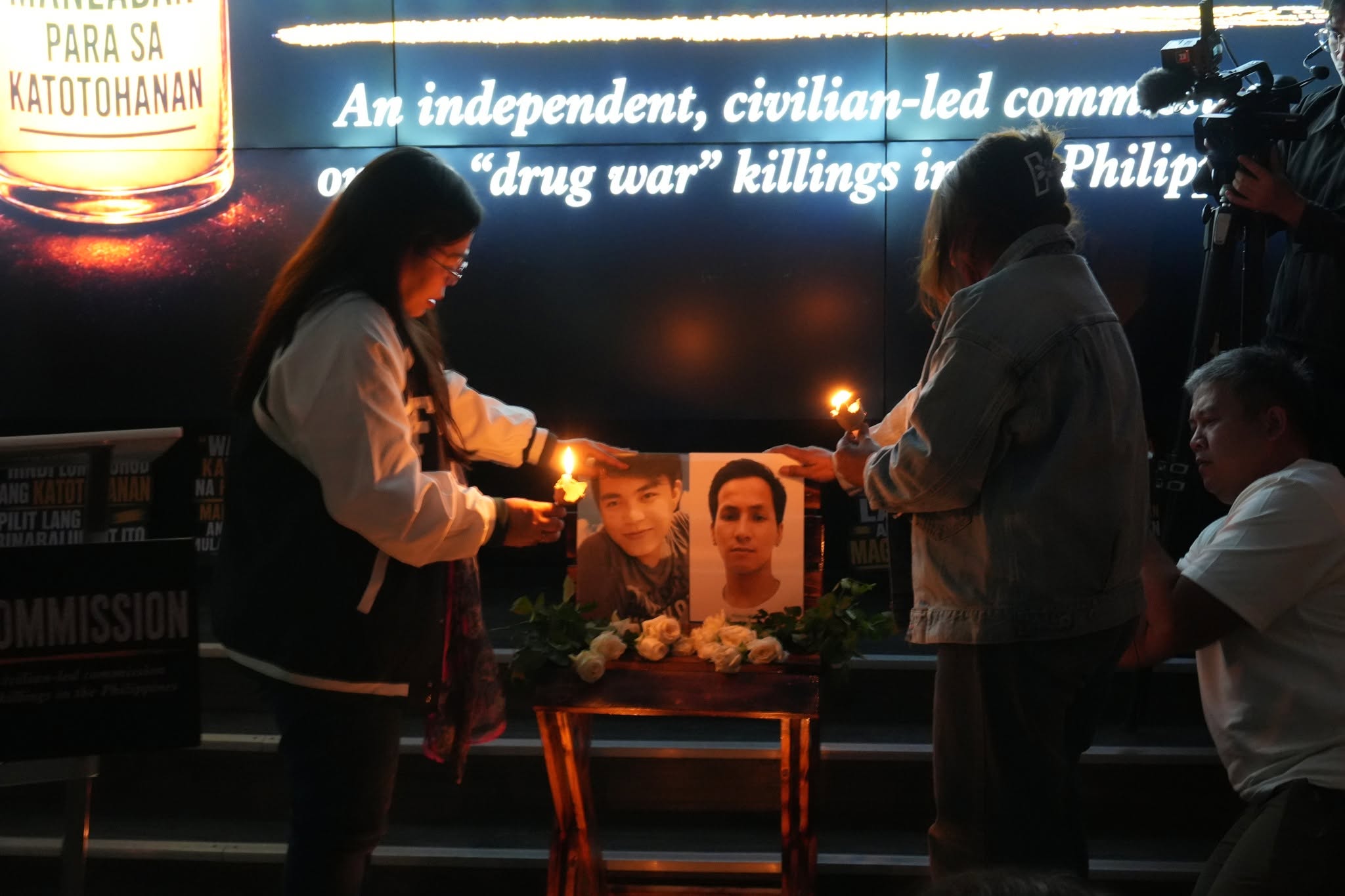
MANILA, Philippines — Nine years after Christopher Lazaro and Alberto Paragas were found dead in Bulacan, their families continue to question the police account of the incident, citing alleged misconduct, missing records and inconsistencies in the investigation.
During the Truth Commission’s sixth public truth-telling session on Nov. 6 at Adamson University, Christopher’s mother, Marissa Lazaro, raised the suspicion that the four friends found dead in Marilao and nearby Bocaue may have been divided between police units to meet separate quotas.
“Perhaps in Bocaue, one police unit needed to meet its quota, and here in Marilao they already had two,” Marissa said. She clarified that this was her suspicion, not evidence that quotas played a role in the killings.
Christopher, 20, and Alberto, 32, were among four friends found dead on Aug. 5, 2017. Police said they died following an attempted holdup.
Families question the police narrative
Marissa said Christopher had been arrested days before his death after being caught in a brawl, in which she maintained he was only an innocent bystander. She alleged that officers initially demanded 10,000 pesos for his release before reducing the amount to 5,000 pesos, which she paid.
After his death, she said she visited police stations for nearly a year to obtain records about the incident. She encountered delays and was initially given a logbook entry bearing a different name before eventually receiving a copy of the police report.
She also recalled being asked to sign a document at the funeral home that she understood as acknowledging the killing as a legitimate police operation. When an officer warned that she would eventually need their help, she challenged him.
“What help can you give my son? You already killed him. You can’t bring him back,” she recalled telling the officer.
Marissa also rejected the public labeling of her son as a drug offender, saying, “not all victims of the drug war are addicts.”
Alberto’s sister, Riza Quiamco, described her brother as a tricycle driver who took on motorcycle repair jobs to support his children. She said he left home on Aug. 5, 2017, to earn money for their needs but never returned.
At the funeral home, Quiamco said police asked her and Alberto’s partner to sign a document stating that events had happened as officers described. She refused.
“We were helpless; we had no way of fighting back,” she said.
Financial difficulties prevented the family from pursuing a case, she said.
“How could I fight? I had no money,” she said.
Forensic examination exposes gaps
Dr. Raquel Fortun, a forensic pathologist and member of the Truth Commission, examined the victims’ remains and reviewed their medical records.
Fortun found inconsistencies in Christopher’s death certificate and medico-legal report. While the documents recorded gunshot wounds to his head, her examination found no corresponding injury to his skull. Instead, she identified a fracture in the upper neck that could have been fatal.
“I don’t know where the mistake happened,” Fortun said.
She also questioned a report describing an autopsy, saying the body had only been superficially opened and its organs had not been examined. The report documented marks on Christopher’s wrists that Fortun said suggested he had been restrained.
In Alberto’s case, Fortun questioned whether an autopsy had been conducted at all, noting that she could not obtain a corresponding medical report. Her examination identified injuries involving his head, breastbone, ribs and finger.
Fortun classified both deaths as homicides. She criticized the limited number and poor angles of the crime-scene photographs, calling the case “clearly not a basic homicide investigation.”
Carlos Conde, a member of Truth Commission, said the findings highlighted serious problems in police work, particularly in the handling of bodies, crime scene processing and autopsies.
“We would like to highlight how serious the problems are in police work. It is clear how broken the system is when it comes to handling bodies, processing crime scenes, and conducting autopsies. The public needs to know about these problems so the government can take action and fix the system,” Conde said.
Conde noted that similar problems had surfaced in other cases presented before the commission, suggesting the shortcomings were not isolated to the deaths of Christopher and Alberto.
For Quiamco, accountability is necessary for families like hers to believe that justice is possible regardless of their financial standing. She said she wanted to see “there is justice for the poor, not only for the rich.”
Nine years after the killings, the families are still waiting for answers — seeking justice for Christopher and Alberto while struggling to understand not only why their loved ones were killed, but also why the system failed to give them the information they needed. (davaotoday.com)


