
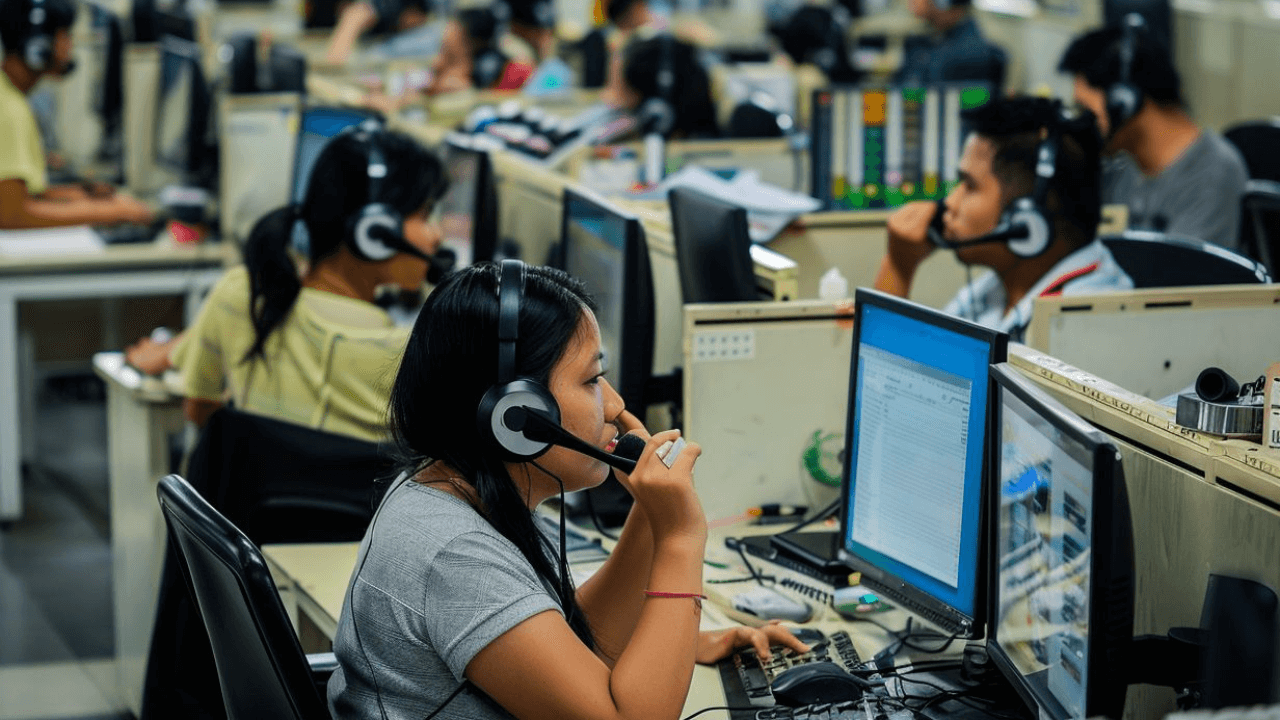
DAVAO CITY, Philippines—Artificial intelligence helps business process outsourcing (BPO) workers respond faster, improve grammar and manage heavy workloads. But amid low wages and demanding shifts, workers fear the technology may eventually replace them.
For Paul Catacutan Aquino, a Davao City-based BPO worker with more than three years in the industry, AI has become a practical aid. Working in email and chat accounts, he handles customer concerns involving subscriptions, billing, account issues and technical problems. He said AI tools help him construct responses, summarize information and suggest ways to address concerns.
“Anything that can make our work easier and more efficient is a big help,” Aquino told Davao Today.
But he also recognizes the uncertainty surrounding its growing use.
“If companies continue replacing more human tasks with AI, there is a possibility that many workers will be affected or lose their jobs,” he said.
His concern reflects a wider tension in the BPO industry, where companies are increasingly adopting AI to improve efficiency while workers face questions about job security and working conditions.
A February 2026 research brief by the International Labour Organization estimated that 12.7 million Filipino jobs, or more than one-fourth of total employment, are exposed to generative AI. A February 2025 study by the International Monetary Fund identified the BPO industry as having the highest proportion of jobs at risk of displacement due to AI among Philippine industries.
A tool for productivity, a risk to job security
ICT Davao Inc. sees AI adoption as an opportunity to improve productivity, provided workers are trained to use it properly.
During a briefing on Digital Frontiers 2026 and its hackathon, ICT Davao executive vice president Xavier Eric Manalastas said the organization wants companies, governments, educators and individuals to develop a proper framework for using AI.
Manalastas warned that employees using AI without company guidelines could expose sensitive organizational data, and stressed that workers should treat it as a tool rather than become dependent on it.
For the BPO sector, Manalastas argued AI does not necessarily mean job losses.
“AI will not take your job, you will have better jobs if you know how to use AI for your job,” he said.
He said workers should be trained to manage AI tools and become more productive instead of being laid off, and called on businesses to move beyond generative AI, which produces content from prompts, toward agentic AI systems that can carry out tasks based on instructions.
ICT Davao chairman Atty. Samuel Matunog likewise emphasized understanding how AI works, including its limitations, its tendency to generate inaccurate information and the risks of relying on platforms that may store data under foreign jurisdictions.
But for BPO Industry Employees Network (BIEN) Pilipinas, the promise of better jobs through reskilling does not reflect workers’ full experience.
John Kyle Enero, BIEN Pilipinas’ vice president for Visayas, said increasing AI integration has displaced workers, particularly in traditional voice and non-voice operations. He said the organization has documented AI integration plans that led to temporary layoffs through floating status, in which employees are kept on the payroll without work or pay.
Enero also raised concerns about AI-powered quality assurance systems that evaluate performance through rigid pass-or-fail procedures, which he said add pressure and could affect incentives.
“Job security is most at risk under AI,” Enero said.
He clarified the concern is not the technology itself, but how companies use it to justify cost-cutting at workers’ expense.
Reskilling is not a guarantee
For Aquino, learning to use AI is useful, but it does not remove the uncertainty. He said human assistance remains necessary because not all customer concerns can be automated, and AI-generated information is not always accurate.
“I think AI should be a tool that helps people not something that completely replaces human creativity and livelihood,” Aquino said.
Enero similarly argued reskilling alone cannot guarantee employment security. He said BPO workers are already accustomed to upskilling and training, but these do not translate into higher salaries — instead, workers may be expected to meet higher productivity targets without better compensation.
Enero similarly argued reskilling alone cannot guarantee employment security.
He said BPO workers are already accustomed to upskilling and training, but these do not translate into higher salaries — instead, workers may be expected to meet higher productivity targets without better compensation.
He called on the government to address employment practices that leave workers vulnerable, particularly mass floating status, and to consider the proposed No to Floating Status Bill, which the group said it lobbied for in October 2026.
He also cited a proposed resolution seeking an investigation into AI integration in BPO companies and workers’ participation in related management decisions.
Who benefits from the transition?
The push toward AI adoption is often framed as a way to make businesses more competitive and workers more productive. But productivity gains do not automatically mean higher wages, better conditions or greater job security.
Aquino said he hopes companies adopting AI will also provide better salaries, improved working conditions and opportunities to learn new skills, rather than simply replacing workers.
“Workers should still have a place in the future,” he said, pointing to the value of human communication, empathy, patience and problem-solving in BPO work.
Enero said workers will remain vulnerable unless safeguards are in place and companies are held accountable for how automation affects employment.
The challenge is not simply preparing workers for a future with AI. It is ensuring workers have a place in that future, and that technological progress does not become another justification for cutting jobs while employees shoulder the consequences. (davaotoday.com)


