
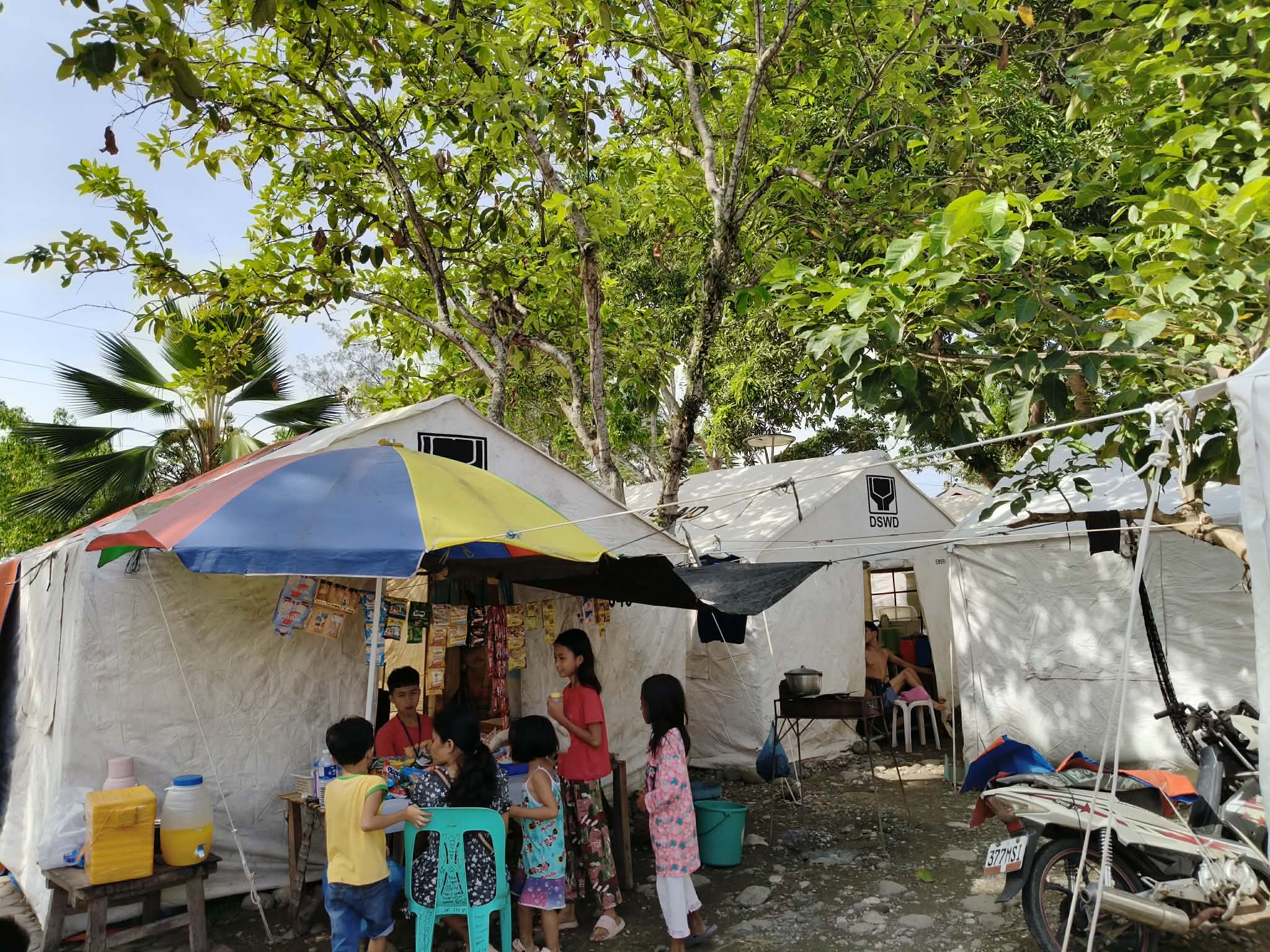
GLAN, Sarangani — Twenty one days after a magnitude 7.8 earthquake struck this tourism town in southern Philippines, government-issued tents line the public square as affected families grapple with the slow rehabilitation and prolonged recovery.
Families interviewed by Davao Today mostly came from the nearby Barangay Poblacion.
Despite cramped conditions, they said they could sleep soundly in makeshift tents, not in their houses.
They would rather stay in these tents than relive the trauma of shaking houses, falling objects and screaming children.
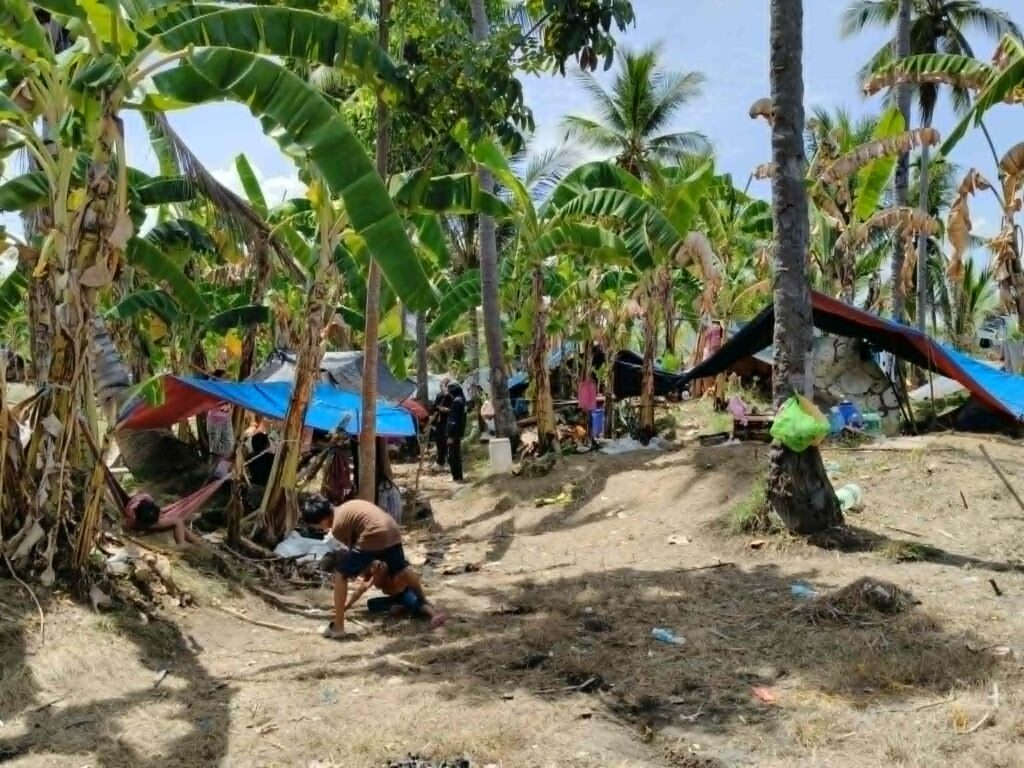
Several kilometers from Barangay Poblacion, another group of displaced families set up temporary shelters on higher ground along the road in Purok Islam, Upper Barangay Cablalan. They used open tents made of trapal, heavy-duty sheets commonly used in construction and emergency relief operations.
Residents fled coastal communities following a tsunami warning issued after the earthquake.
The tsunami warning has since been lifted, yet they remain in roadside tents. In a June 24 interview with Davao Today, they said they’d rather stay there than face cracked houses, the threat of big waves and aftershocks.
Despite being kilometers apart, the municipal plaza and Purok Islam represent two faces of displacement in Glan.
Uncertain and dangerous
Damage assessments show the devastation in Glan’s 31 barangays: 14,646 houses wrecked, of which 4,803 are destroyed and 9,843 damaged. For thousands of families, home has become uncertain and dangerous.
Nurbaysa Milasan, 38, mother of two in Purok Islam, faces this reality daily. With her husband, she checks their house each morning for what’s left and cleans for their children before fetching what they can use. By evening, they return to the roadside shelter where they have slept since the earthquake.
A portion of their kitchen collapsed, and cracks appeared in other parts of the home.
“We cannot stay there anymore because we have children. Every time there is a tremor, we run up to the hill again,” Milasan said.
She added that their evacuation followed the tsunami warning. “We were scared the sea might suddenly swell,” Milasan added.
Four days after the quake, these families took the initiative to erect their own temporary shelters. The barangay office lent them trapal sheets for tent roofing, though the makeshift coverings provide little protection from rain. Water seeps through during heavy showers.
They lack electricity, relying on shared solar lamps. Relief supplies so far have included rice, dried fish, noodles, coffee and tarpaulins, but Milasan said her family has not received cash assistance.
The residents relocated themselves to higher ground believing it would be safer than their coastal homes.
Getting relief as supplies allow
Sitio Tuka, Barangay Burias, also bears the quake’s toll. Fishing, the main livelihood for Glan’s coastal communities, has been disrupted as the sea pulled back and boats and gear were damaged.
“There has been no fishing,” a resident said, noting changes to fishing grounds after the quake.
Cracks on a hill near the community worry residents about potential landslides. Jamayka Japil said, “Even if life here (shelter) is hard, we stay here since we are scared to go home.”
Like residents in Purok Islam, these 28 families set up their own makeshift tents after some vloggers donated trapal (tarp) sheets several days after the quake happened. They set up 15 tents.
Relief is available only as supplies allow.
“What we need right now are food, water and building materials that will enable us to start again,” Japil said.
In Purok Islam, Vic Dante said, “Fishing is our main livelihood, but after the earthquake we lost everything.” Homes have tilted, and land beneath some houses has become uneven.
“There is now an unevenness in the land under our house,” Dante said. “We might be forced to demolish it.”
Waiting for dole-outs
At the municipal plaza, families sleep on cardboard and thin mats inside rows of white tents. Another night spent outside. Nearby, someone kneels over a plastic tub, wringing out clothes. Children dart between tents, shrieking and chasing each other. Under whatever shade they can find, groups gather to talk about what’s left of their homes and whether the cash assistance will actually come.
Rolferiosa, who has moved twice since the quake, described sleeping outdoors during heavy rains and fearing the tent could collapse in strong winds. She hopes for building materials to reconstruct a shelter beside her mother-in-law’s land.
“Even a small amount of lumber would help us rebuild,” she said.
They fled their homes on the night of June 8, slept along the roadside in Hilaya after the earthquake struck, then moved to the municipal plaza the next morning, where they’ve remained ever since.
Relief operations continue, but rehabilitation plans have not yet been finalized by Glan’s municipal government.
Patrick Yap, officer-in-charge of the Municipal Administrator’s Office, said the immediate focus is relief through the barangays while assessing needs. “Our approach is to return them to their normal way of life,” Yap said.
One option is to provide construction materials, though the municipality will consult PHILVOCS and the Mines and Geosciences Bureau (MGB) to ensure areas are safe for habitation before reconstruction begins.
“We will seek the advice of PHILVOCS and MGB,” Yap said. “If it is confirmed that the areas are safe for habitation, families may reconstruct in their communities.”
For now, those living in the plaza and Purok Islam say relief is not enough.
They continue to check damaged homes, wash clothes and wait for food, clean water, cash assistance and materials to rebuild. At night, children curl inside white tents at the plaza while families in Purok Islam close their trapal shelters a day outdoors.
Food and water have arrived in many communities, but rebuilding has not yet begun.
Hundreds of displaced Glan residents linger between the houses they left behind and the aid they hope will allow them to return home. (davaotoday.com)


