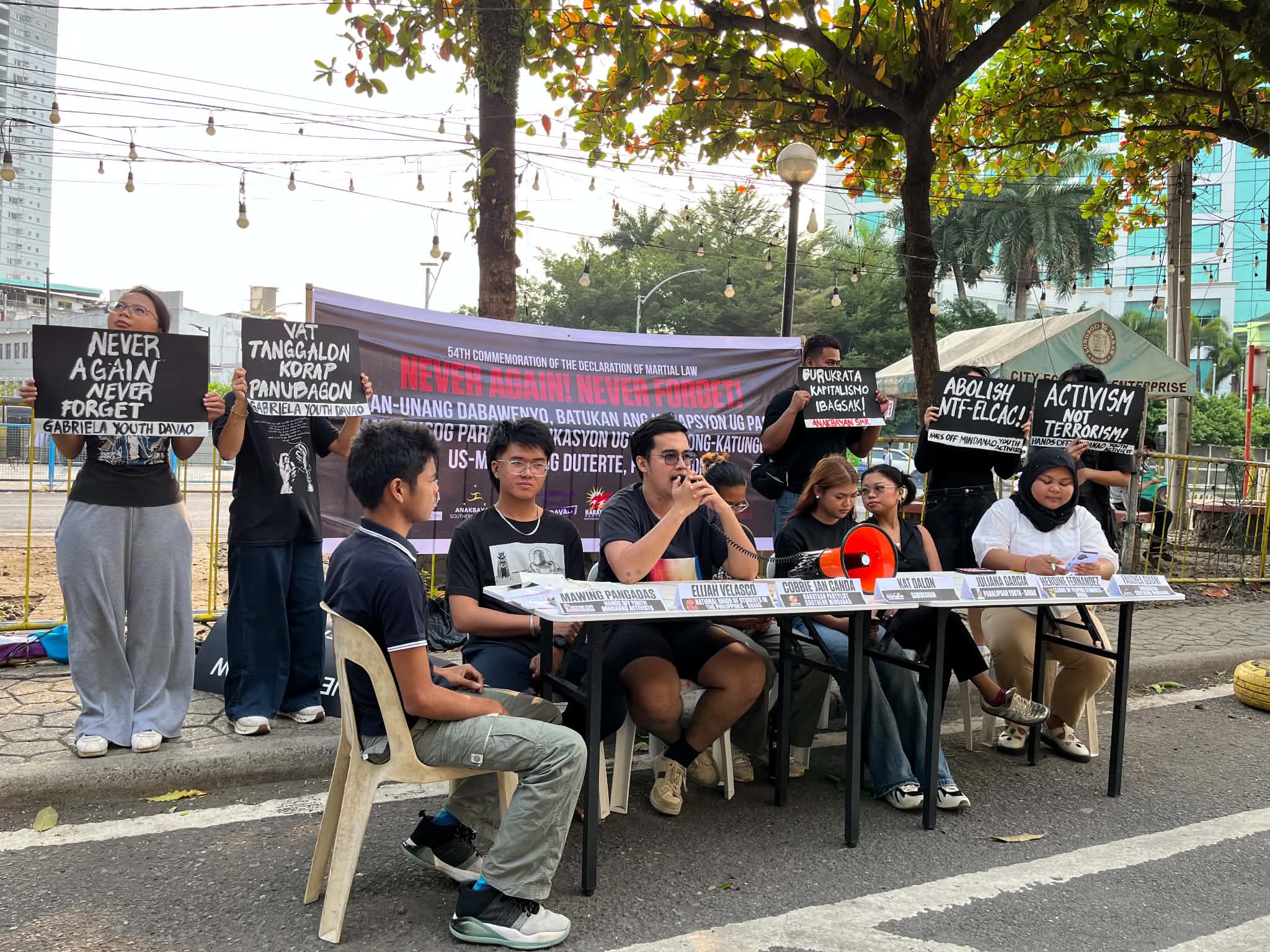
DAVAO CITY, Philippines—As the country commemorates the 54th anniversary of the declaration of martial law, militant youth organizations held a news conference at Freedom Park in downtown Davao City, Sept. 18.
Hands Off Mindanao Youth Activist Network and its affiliated organizations decried the continuing attacks on activists, repression of student rights, declining public investment in education, and lack of accountability in governance under President Ferdinand Marcos Jr.
Fifty-four years later, the atrocities sown during the dark years of martial law persist, carried out with different tactics but with the same disregard for basic human rights.
Mawing Pangadas, convener of Hands Off Youth Activists Network, said attacks against young activists in Davao continue through intimidation, harassment, and red-tagging.
Pangadas cited the incident when the Philippine National Police (PNP) in Cateel, Davao Oriental, posted an advisory on its official Facebook page on May 27, identifying students and activists in the Davao Region as “Active Wanted Persons.”
The post was later deleted, but student leaders and progressive groups called for accountability over the baseless labeling. (https://davaotoday.com/headline/up-student-leaders-activists-slam-wanted-persons-post/)
“This can’t be fixed with a mere apology, they need to be held accountable for what they did to these youth,” Pangadas said in Cebuano.
Pangadas, also a victim of “trumped-up charges” under Marcos Jr., accused the administration of using the National Task Force to End Local Communist Armed Conflict (NTF-ELCAC) to target young activists.
He said funds for NTF-ELCAC should instead be directed toward communities in need.
“Instead of listening to the youth and addressing their grievances, Marcos Jr. resorted to intimidating them. It seems Marcos Jr. is afraid of young people who are fighting for their cause,” he said.
In July 2022, Davao City police arrested Pangadas and his brother Ismael, after they attended a State of the Nation Address (SONA) protest in Freedom Park.
The brothers were apprehended while waiting for a jeepney after the protest, with police allegedly not presenting a warrant. (https://davaotoday.com/human-rights/after-sona-protest-vs-bbm-davao-police-arrests-ip-brothers-sans-warrant/)
In May 2023, a Tagum Regional Trial Court acquitted the Pangadas brothers and three teachers of human trafficking charges, ruling that the prosecution’s evidence was insufficient to establish their guilt beyond reasonable doubt. (https://davaotoday.com/human-rights/court-acquits-lumad-brothers-3-teachers-from-human-trafficking-charges/)
Campus press repression, education funding
For Elijah Velasco of the National Union of Students of the Philippines-Davao (NUSP-Davao), the problems confronting students go beyond funding. It includes restrictions on their rights to organize and protest.
“Protesting is an independent expression of dissent. It’s an exercise of student advocacy without interference from school administrations,” Velasco said in Cebuano.
He also raised concerns over restrictions on student organizations in some schools, barriers to student-council elections and the lack of adequate mental-health services.
Velasco cited the situation at Davao del Norte State College, where he said nearly 10,000 students are served by only three guidance counselors.
He added that student publications continue to face pressure, citing allegations of red-tagging against Ateneo de Davao University’s Atenews and the removal of the executive board of the University of Mindanao’s Primum following a political statement on EDSA.
“Just a reminder that being a journalist is not apolitical, it is not neutral. Silencing journalists are wrong, that is a form of repression,” Velasco added.
Cobbie Canda of Kabataan Party-list Southern Mindanao (KPL-SMR), questioned Marcos Jr.’s announcement in his 5th SONA that education is its administration’s top priority.
“If education is truly his number one priority, why are there budget cuts in the education sector?” Canda questioned.
Drought, militarization
The concerns extended beyond schools and into Indigenous communities and environmental issues.
Kat Dalon of Sabokahan Unity of Lumad Women said communities affected by severe heat and drought needed government assistance and subsidies, but instead faced increased militarization.
She alleged that military units are deployed in Indigenous communities, pressuring residents to surrender or seek clearance from authorities.
Dalon also raised the killing of Nenita Buscada in Malaybalay City, Bukidnon on June 15, which described as deliberate rather than collateral.
The Philippine Army acknowledged that soldiers from the 88th Infantry Battalion mistakenly shot Buscada, who was killed while gathering wood in Sitio Mahayag, Barangay St. Peter. Her husband was wounded in the incident. The battalion commander apologized to Buscada’s family.
“There is no reason for us not to continue. There is no reason to surrender., there is no reason to clear our names, because fighting is not a crime. Especially when we are repressed, especially when we are killed, especially when our rights are violated,” Dalon said in Cebuano.
Panalipdan Youth Davao representative Juliana Garcia also linked environmental concerns to government policy, particularly the expansion of the critical minerals industry.
Garcia criticized Executive Order No. 122 and raised concerns over the entry of foreign mining companies and the environmental and community impacts of large-scale mining.
“The Philippines is indeed rich, but the Filipino people continue to suffer because of corporations that even our government supports,” Garcia said in Tagalog.
She also linked the effects of extreme heat and climate change to government spending, saying funds should instead be directed toward climate adaptation and relief for affected communities.
Critical minerals and U.S. military presence
Meanwhile, League of Filipino Students-Davao (LFS-Davao) chairperson Heroine Fernandez criticized the Marcos Jr. administration’s push for the Philippines’ critical minerals industry under the Pax Silica initiative.
Fernandez acknowledged the administration’s argument that the initiative could generate jobs but questioned whether the economic benefits would outweigh its potential effects on communities and the environment.
“It is true that many jobs will open because of Pax Silica. But the question is, does the creation of these numerous jobs outweigh the impact it will have on us here in the Philippines?” Fernandez asked.
She also linked critical minerals to the global competition between the U.S. and China and the use of advanced technologies, including artificial intelligence and semiconductors, in military and surveillance applications.
The plans for a defense fuel support facility would deepen U.S. military involvement in the Philippines.
Link history, present realities
For Anakbayan Southern Mindanao Region representative Fauzhea Guiani, the commemoration is an opportunity to connect the history of Martial Law with present-day questions over government spending and public services.
Guiani questioned the government’s huge budget for confidential and intelligence funds while communities struggle with housing, wages, Transportation costs and rising prices of basic commodities.
“If it is possible to fund confidential and intelligence activities with such a large amount, why can’t our powerful leaders fund the public services that the Filipino people ought to benefit and enjoy?” Guiani said in Cebuano.
The youth groups said commemorating martial law should not only involve remembering abuses committed during the Marcos Sr. dictatorship but also defending democratic rights and holding government officials accountable for alleged abuses and failures under successive administrations. (davaotoday.com)