
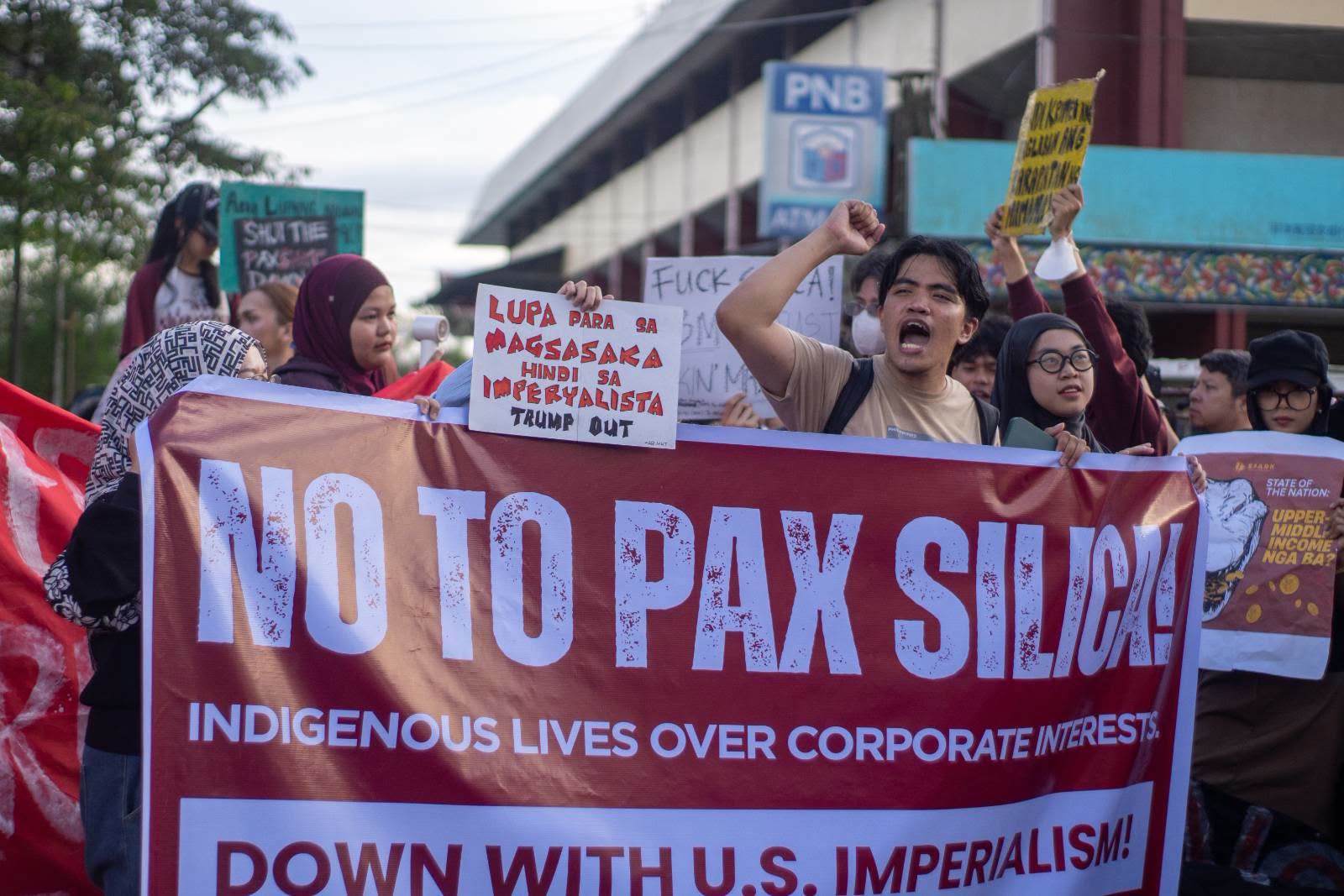
DAVAO CITY, Philippines—Although the proposed Pax Silica industrial hub is located in New Clark City, Tarlac, Gabriela Southern Mindanao Region warned that its implications could reach Mindanao’s resource-rich communities, particularly women, Indigenous peoples, farmers and workers.
Corazon Espinosa, 70, vice chair of the group, said the initiative could add to the burdens of already vulnerable communities, questioning who would benefit from the country’s participation and who would bear its consequences.
“We are here today at Freedom Park to express our opposition to Pax Silica. For us, this will not bring benefits to the people, especially women. It will only add to the burdens of mothers and women living in poor communities,” Espinosa told Davao Today in Cebuano.
She also warned that the initiative could affect Indigenous peoples, farmers and workers who depend on ancestral lands and agricultural resources for their livelihoods.
According to the Mindanao Development Authority (MinDA), around 90% of the country’s nickel ore production comes from Mindanao. The region also holds deposits of copper, gold, silica and rare-earth elements used in semiconductor manufacturing, batteries and other advanced technologies.
MinDA Assistant Secretary Romeo Montenegro previously said the region could supply production inputs for the initiative, although insufficient power infrastructure remains a challenge to establishing mineral-processing and value-adding industries in Mindanao.
Mining and the cost of supplying technology
Data from the Mines and Geosciences Bureau showed 19 mines with Mineral Production Sharing Agreements operating in the Davao Region alone as of Aug. 31, 2026, including four in Davao Oriental extracting copper and nickel laterite.
The Pujada Nickel Project in Mati City, Davao Oriental, has been associated with soil runoff and water turbidity that threaten the livelihoods of local fisherfolk. The project sits within the ancestral domain of the Mandaya Indigenous Peoples.
Espinosa questioned the allocation of 1,620 hectares for the proposed hub at New Clark City, as reported by the Bases Conversion and Development Authority (BCDA), when majority of farmers do not own the land they till.
Why Mindanao cannot be left out
“Some people think Mindanao has nothing to do with the establishment of Pax Silica. But we will still be affected. For example, if electricity prices increase, people in Mindanao will also feel the impact. Just because the project is located in Luzon does not mean we are unaffected,” Espinosa said.
She said Pax Silica has placed the country’s resources at peril amid the interests of two powers, the United States and China, in their race to dominate the global technology industry.
“They compete through their products, including artificial intelligence, mobile phones and other technologies. But the Philippines could be affected because our resources may be used for their own interests.”
The BCDA has clarified that the proposed Clark hub is intended primarily for advanced manufacturing, including semiconductor-related industries, rather than a massive artificial intelligence data center, and that mineral-processing activities in Mindanao are being planned separately under a dedicated minerals corridor.
Environmental advocates repeatedly questioned whether safeguards for communities and ecosystems would be prioritized should increased mineral extraction and industrial development push through.
Espinosa also questioned the government’s transparency and priorities in joining the initiative, saying the country’s natural resources risk being used without benefiting its people.
“Our government is pushing for Pax Silica. It seems it is readily granting permission for the project. We are calling on the president to prioritize the Filipino people first, not Pax Silica or Trump,” she said.
Gabriela vowed to continue conducting community education activities, particularly among women, to help them understand the implications of the initiative. (davaotoday.com)

