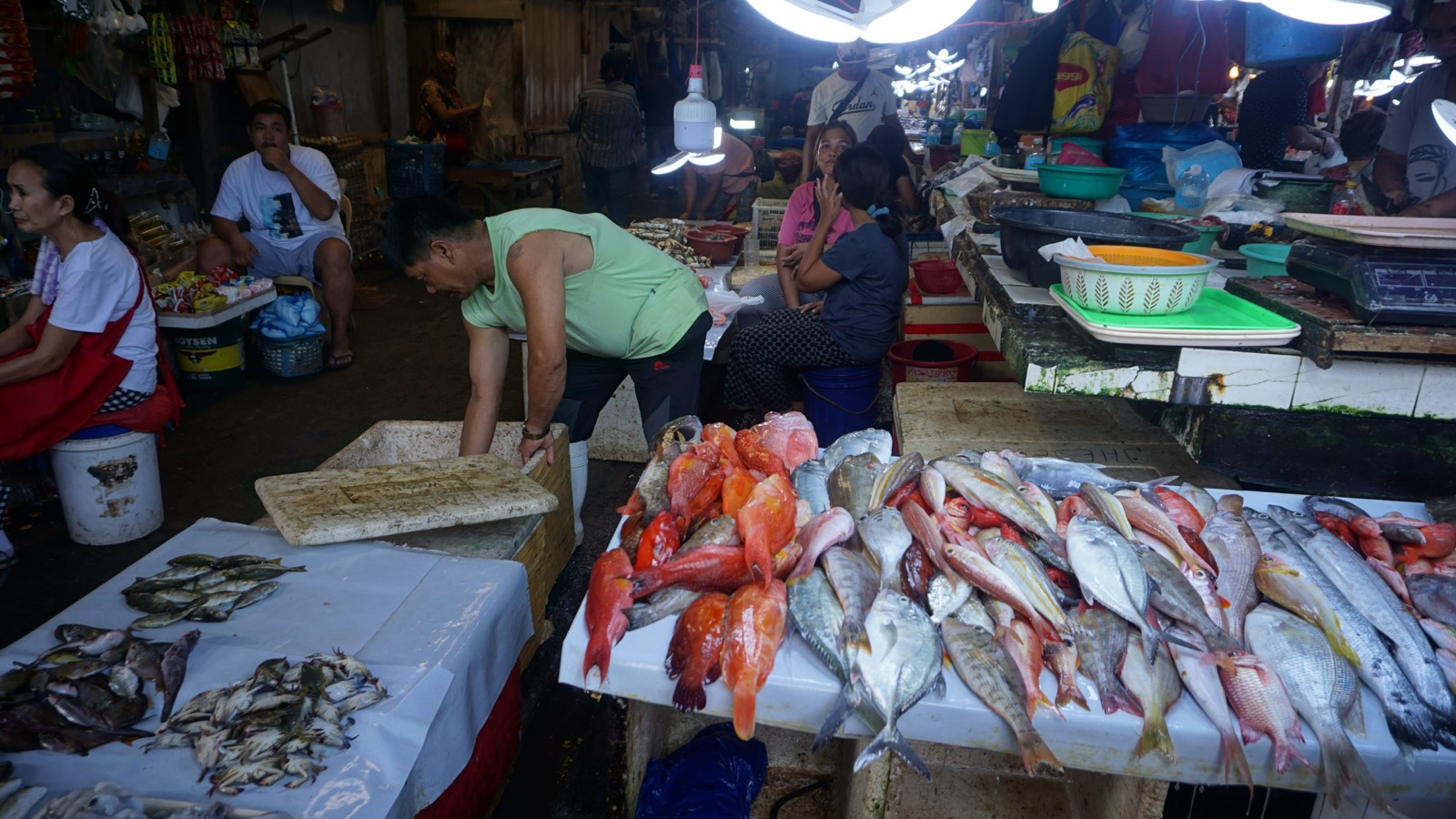
GENERAL SANTOS CITY, Philippines – For 40 years, Editha Payas has watched the tides of General Santos City’s public market rise and fall from her fish stall, a place she calls home.
Though the aging structure leaks and crumbles, her heart remains tied to its bustling aisles. When the city announced a redevelopment, Payas initially embraced the hope for repair.
“Actually, we are not against the redevelopment. I was happy that the market would be redeveloped,” Payas speaking in Visayan told Davao Today on June 29.
Yet that joy turned to doubt when she learned the project involved a 28-year partnership with Robinsons Land Corporation (Robinsons Land). As the plan shifts toward a modern, privatized complex, Payas now fears the very place she loves may soon have no room for the vendors who built its legacy.
P2.3 billion “Palengke Heneral”
In a press statement by Public-Private Partnership (PPP) Center, General Santos City and Robinsons signed a landmark agreement for the city’s first PPP in Mindanao under the new PPP Code.
The P2.3 billion project will transform the 50-year-old central public market into “Palengke Heneral,” a three-story commercial complex.
Under the 28-year concession, Robinsons Land will finance, build, and operate the facility, paying an annual lease before handing it back to the city. Signed by Mayor Lorelie Pacquiao and Robinsons CEO Maria Socorro Isabelle Aragon-GoBio, the deal aims to resolve decades of structural decay and improve sanitation.
In exchange for using the city’s land, Robinsons Land will pay an annual lease fee. Once the concession ends, the fully developed facility will be turned over to the city government.
However, the project faces scrutiny from vendor groups fearing rent hikes and displacement. While officials tout the development as a model for inclusive growth, the three-year construction timeline presents a critical challenge: modernizing essential infrastructure without displacing the low-income traders who depend on the market’s affordability.
Fifteen years on the drawing board
Plans to modernize the public market stretch back 15 years, originating under former Mayor Darlene Antonino-Custodio with a 2010 feasibility study.
Lawyer Leonard Flores of the City Economic Management and Cooperative Development Office (CEMCDO) cited the long delay in finding a partner.
“Imagine, for more than 15 years the city has dreamed of upgrading the public market,” Flores told Davao Today via online interview on July 1.
Initially, the city envisioned a simple two-story facelift. However, Robinsons’ unsolicited May 2023 proposal expanded the scope to a three-story mixed-use complex. After securing the Sangguniang Panlungsod approval with no competing bids, the city signed a 28-year concession agreement. Robinsons Land will finance and operate the facility, with construction set to last three years.
“Since they (Robinsons Land) were qualified, eventually we sought and received the approval of the City Council. That local legislation, by its overwhelming approval, gave us the imprimatur to award the contract,” Flores said.
No public hearings?
Vendors argue the controversy isn’t about rehabilitating the market, but the lack of consultation regarding the partnership itself. Payas recalled learning only at the council’s final reading that Robinsons Land would be the developer.
“When we got there, we only learned the market would be redeveloped… Only there did we find out that Robinsons was the one who would develop it,” Payas said.
She insists vendors were never asked for their input before major decisions advanced.
Flores defended the process, claiming consultations occurred through “pocket meetings” and public hearings.
“Nevertheless, the pros and cons had been thoroughly discussed in many ways,” Flores said.
But Rey Gargaritano of the General Santos City Market Vendors Association (GSCMVA) and spokesperson said Robinsons Land submitted its proposal in May 2023, and the city accepted it in September.
Gargaritano claimed no public hearings were held during this critical window.
Abdulhakim Saricala, the vendors association’s vice president, emphasized the difference between informing stakeholders after decisions are made versus seeking their participation beforehand.
“It should have been that before they spoke, they consulted us… They did not go to the grassroots. We are the ones who know the problems here,” Saricala speaking in Visayan told Davao Today.
Accessibility not aesthetics
Vendors argue the debate also centers on the market’s identity as an affordable hub for ordinary residents, not just its modernization.
Saricala warned that raising prices would hurt the poor.
“Most who go to the public market are ordinary people. The wealthy go to SM, Robinsons, KCC,” Saricala said.
He added, “If the vendors become poor, the customers will become poor too.”
Gargaritano emphasized their 30-year role supplying daily essentials to street vendors, restaurants and eateries.
“We in the vegetable section have been selling here for a long time, for almost 30 years. We sell vegetables, spices and grocery items,” Gargaritano said in Visayan.
Projected rise in rental rates
The most contentious issue for vendors is the projected rise in rental rates. Currently paying P15-25 daily, vendors fear new rates could hit P50 per square meter.
“If the rent for us is expensive, we will pass it on to the consumer. It’s a chain reaction,” he said.
Saricala echoed this, predicting rents could double or triple.
“If our rent is now 2,000, Robinson will charge us 4,000. If you are now renting for 10,000, Robinson will charge 20,000,” he said.
Flores argued the P50 ceiling was negotiated by the city and remains low for Region 12. He believes increased foot traffic from the mall will offset costs.
“They will not only rely on their loyal customers. The mall-goers could also become their customers,” he said.
But the vendors remain skeptical, fearing a mall environment cannot support traditional tapok-tapok (bulk small-quantity) sales or cheaper ipit (lower-grade) fish.
Payas questioned if such commerce fits a private complex. “Where can you see a mall where people sell in small piles?”
She added, “will Robinsons allow the sale of cheaper fish? It’s a mall.”
The core debate remains whether modernization preserves the market’s essential affordability or transforms it into an exclusive commercial hub.
Displacement
Saricala warns that the contract limits the city’s power over stall allocation, leaving final decisions to the developer.
“In the contract, it is stated that the LGU is merely recommendatory… Robinsons is the final authority,” Saricala said.
But Flores insisted the city retains oversight and that 1,700 stalls will be built for roughly 1,300 profiled vendors.
“The total number of stalls or spaces is more than the existing numbers of the vendors that were profiled,” he said.
But Saricala claims they were told only 1,200 stalls will be available, while 1,587 vendors are currently registered inside, excluding around 400 operating outside.
“They propose 1,200 can enter our new market. Compared to our current standing where most of the vendors here are 1,587. This does not yet include (the row vendors and those outside),” he said.
Saricala calculates that if outside vendors are included in the 1,200 limit, only about 800 spots would remain for current stallholders, forcing displacement.
The 1,200, they say, includes those entering from the surroundings. There are about 400 of them. And you add them to the 1,200. So how many are left for us? Only about 800. We have to distribute this among different sections. Some will definitely be displaced,” he said.
For Payas, Saricala and Gargaritano, modernization is not the issue; the aging market needs repair. Their fight centers on whether privatization will displace long-time vendors, spike costs, and erase the affordable public character that has made the market indispensable to the city for generations.(davaotoday.com)