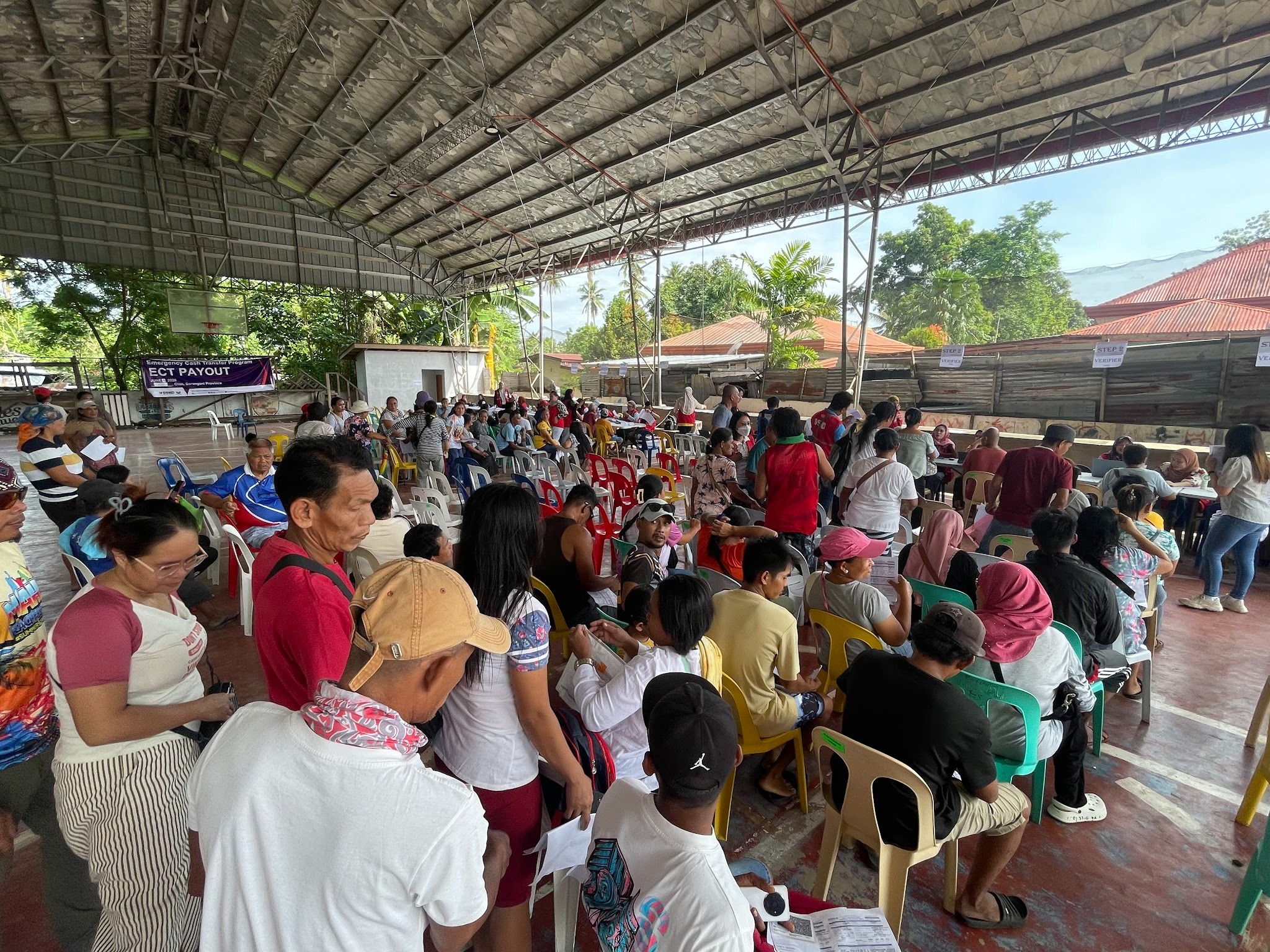
GLAN, Sarangani – Colorful motorcycles and tricycles line the perimeter of the Glan Padidu Gymnasium as residents from four barangays crowd inside, hoping to receive assistance through the Department of Social Welfare and Development’s (DSWD) Emergency Cash Transfer (ECT) program.
The process involves a few steps. Residents first present a valid identification card to verify their names on the master list submitted by their respective barangays. Once confirmed, DSWD personnel assess the extent of the damage to determine the amount of assistance each family will receive. For houses beyond repair, the families could get P10,350 ($184) while those whose houses could still be repaired get P5,175 ($92). Beneficiaries are then issued a payroll slip before proceeding to the cash-out station.
For some, the cash offers a chance to begin again. For others, it barely covers the cost of rebuilding more durable shelters that can withstand future earthquakes.
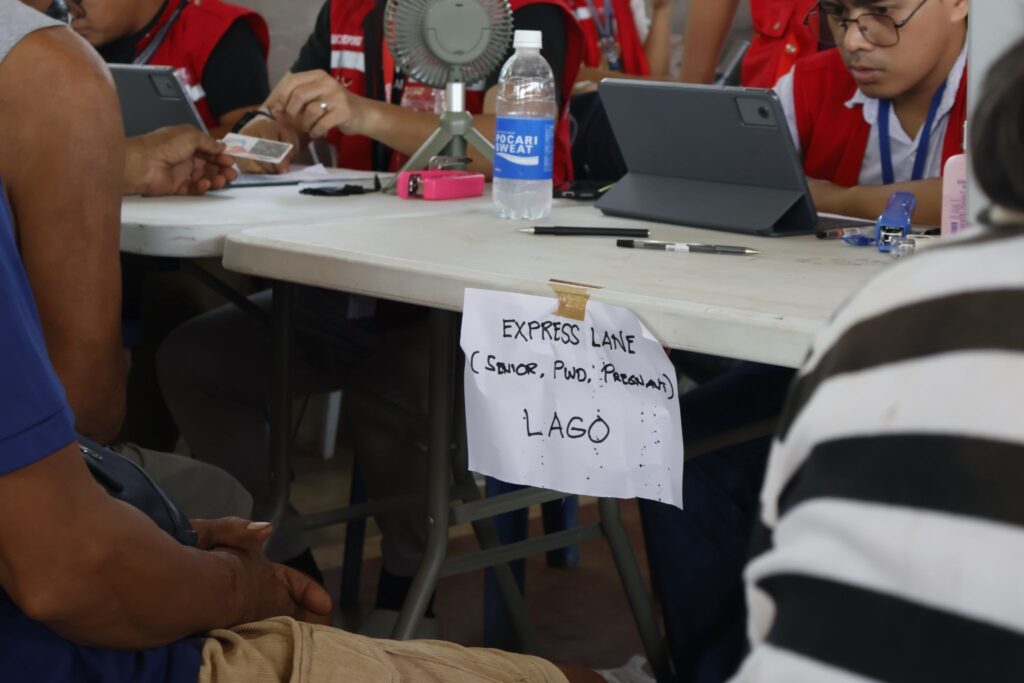
This is the reality for 67-year-old Rica Remigio of Barangay Lago, who claimed her cash assistance of P5,175 through the priority lane designated for senior citizens, persons with disabilities (PWD), and pregnant women.
Although her home has remained standing, the earthquake severely damaged the kitchen. Rebuilding it, she said, requires far more than a few thousand pesos.
“Dili gyud sakto [ang kwarta]. Naa lang untay mudonate bisag lansang nalang, kahoy, o bongbong.” (“The money really isn’t enough. I just wish someone would donate even nails, wood, or roofing materials.”)
Since the earthquake, Nanay Rica and her sick husband have not returned to living inside their home, fearing aftershocks.
“Naa rami sa terrace, sa among balay. Diha rami katulgan kay naa pud mi bana na masakiton. [Kung sa balay mi mag pondo], dili dayon mi makadagan kay naa man siyay hose sa ilong, dito gina-paagi ang iyang pagkaon.” (“We live on the terrace, at our house. We sleep there because my husband is sick. If we live inside the house, we can’t move quickly because he has a nasal tube, and that’s how he gets his food.”)
Disorder on the ground
On the other side of the gymnasium, another group of residents leaves empty-handed. Several women from a remote Barangay Tapon gathered in a circle, visibly disappointed after discovering they would not receive cash assistance that day because their barangay was not on the list.
What frustrated them most was the confusing information they received.
“Gitawagan mi sa barangay tapos giignan mi na dili madayon, pero gaina giignan mi na madayon. Unya, pag-abot namo diri kay wala diay ang Barangay Tapon sa listahan,” as the group explained. (Our Barangay informed us last night that the cash release was canceled, but this morning they told us it would push through. When we arrived here, we found out Barangay Tapon wasn’t even on the list.)
Unlike many beneficiaries who returned home with financial assistance, these women left carrying nothing but disappointment, knowing they had no good news to bring back to their families.
Officials’ response
Addressing the concerns of residents living beside the roads, Glan OIC-Municipal Administrator Patrick Yap said he and the mayor are working on strategies that go beyond relief distribution. Their goal is to gradually help displaced families regain normal living conditions instead of becoming dependent on relief assistance.
Given the municipality’s limited resources, Yap encouraged private donors to contribute construction materials to help families rebuild their homes.
“Sa pagkakaron, nagpasalamat ta kay Senators Robin, Cayetano, nga naghatag sila ug construction materials.” (“For now, we are thankful to Senators Robin and Cayetano for donating construction materials.”)
According to Yap, the municipality’s initial reconstruction efforts prioritize families currently staying at the Tent City evacuation located in front of the Municipal Hall.
“As of this time, mauna namo ning naa diri sa evacuation sa Tent City, mauna namo sila himo ang ilang balay. Dili gyud ingon na bongga ang balay, at least the government is helping them.” (“As of now, we’re prioritizing those staying in the Tent City evacuation center. We’ll build their houses first. They won’t be extravagant homes, but at least the government is helping them.”)
Meanwhile, DSWD Information Officer II Cesar Ian Manico explained that each barangay has a designated schedule for cash distribution, when asked about the Barangay Tapon blunder on cash payout schedule.
“Iniiwasan nato na gina announce [ang schedules] ahead of time kay syempre kay magkagubot. So tung mga most affected kay mao sila atong priority, pero tanan jud matagaan as long as sali siya sa totally and partially damages.” (We avoid announcing the schedules ahead of time because it would cause chaos. The most affected are our priority, but everyone will be given help as long as they fall under total or partial damages.)
He did not clarify how the miscommunication between the barangay and DSWD occurred. However, both the municipality and DSWD continue to coordinate closely with barangay officials in validating the master list of beneficiaries and updating them on their schedules for payout.
P56M assistance
Relief operations continue across Sarangani Province. As of June 23, DSWD and its partners had released P56.18 million worth of assistance, including food packs, modular tents, hygiene kits and cash aid.
According to Yap, the municipality has yet to finalize its long-term rehabilitation plan as aftershocks continue to endanger the area. They will further coordinate with Philippine Institute of Volcanology and Seismology (PHILVOCS) to determine appropriate recovery measures, including infrastructure rehabilitation.
“Kung atong basehan is ang geographical location sa Glan–no matter what, kung unsa pa kaligon [ang usa ka building], kung maagian ka ug crack, ma-crack pud imong building.” (“Given Glan’s geographical location, no matter how structurally strong a building is, if there is a rupture underneath, the building will crack as well.”)
For now, emergency cash and temporary actions continue to provide relief to affected communities. But as aftershocks persist and damaged homes remain standing, many families in Glan continue to wait for a long-term recovery plan that will allow them to finally return to a sustainable and stable life. – Dawn Maricar Bojos | UP Mindanao Intern (davaotoday.com)