
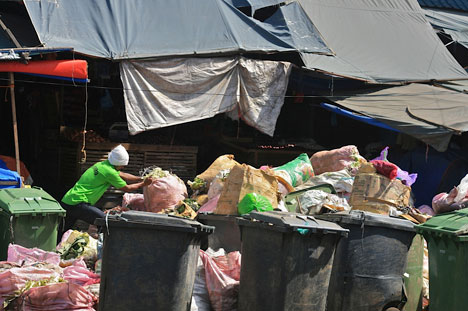
DAVAO CITY, Philippines – Lack of waste segregation and recycling facilities in barangays of Davao City have aggravated the city’s landfill which is now near overcapacity.
Of the city’s 182 barangays, only 53 have built a material recovery facility (MRF) while 116 maintain a materials recovery system (MRS). These facilities are meant to receive, sort, process, and store compostable and recyclable materials and segregate plastics that will be disposed of to the landfill.
These systems are also a requirement under Republic Act 9003 or the Ecological Solid Waste Management Act of 2000, City Ordinance No. 0361-10 (Davao City Ecological Solid Waste Management Ordinance of 2009), and its amendment City Ordinance No. 0987-22.
But Engineer Lakandiwa Orcullo, Acting Division Head of the Environmental Waste Management Division of CENRO point out
that the implementation in barangays is weak as some units maintain MRFs or MRS only “for compliance purposes.”
“Actually, ang uban man gud nga mga MRF ug MRS sa mga barangay for compliance ra ba. Kita nimo naay MRS nila diha walay gamit pero sayang ba wala nakita ang potential bitaw sa equipment facility then daghang mga barangay walay composting, (Actually, some of the MRF and MRS in the barangays are just for compliance. You see an MRS there, but they don’t use it at all. It’s such a waste, as you don’t see the potential of the equipment facility while many barangays don’t even have one)” Orcullo said.
He explained that because of this, mixed waste continues to be collected, even though the sanitary landfill’s MRF cannot accommodate or process the amount of waste for recycling and composting.
Orcullo said the city could reduce its garbage collection if biodegradable waste were excluded from daily pick-ups and instead processed at barangay facilities for recycling and composting.
Based on their analysis of the waste disposal in Davao, food waste makes up over 40%, with vegetable and fruit residues on top with 23.79% followed by food and kitchen waste with 18.48%.
Diapers, sanitary napkins, and tissues make up only 10.41% of the waste disposed of by Davao City residents. This is followed by yard waste (6.44%), sando bags (5.78%), food wrappers (2.55%), tin cans (2.52%), tetra packs and shampoo bottles (2.49%), shampoo sachets and metallic foils (2.08%), PET bottles (2.13%), assorted papers (2.08%), and colored bottles (1.39%), among others.
Atty. Mark Peñalver, executive director of the Interfacing Development Interventions for Sustainability (IDIS), shared the same observation, noting that strict segregation would reduce the volume of waste dumped at the landfill.
“There is a weak implementation of segregation under R.A. 9003 here in our city. We cannot see it being fully implemented by our barangays,” he said.
Orcullo further admitted that CENRO has limitations in ensuring barangay compliance, saying the responsibility falls on the Department of the Interior and Local Government (DILG) to penalize non-compliant barangays.
On August 6, 2025, the DILG urged LGUs to exceed the minimum waste diversion targets in their 10-Year Solid Waste Management Plans to reduce landfill use, cut tipping fees, and strengthen climate and disaster resilience.
This overwhelming amount of waste is straining Davao’s sanitary landfill, as 750 to 800 tons of garbage are collected daily by 153 dump trucks from 145 barangays. There is only one bulldozer functioning that pushes the growing volume of waste toward the far end of the site to make room for more.
To address this problem, the city government has allocated around P500 million for the establishment of a second sanitary landfill in Barangay Carmen, a nine-hectare property intended for expansion instead of opening a separate facility. The project is now 55 percent complete, but has not set a date for its operation.
While barangay governments face challenges in waste disposal, most of the city’s private schools have long banned single-use plastics on campus even before the SUP ordinance that was passed in 2021. These include Ateneo de Davao University, Assumption College of Davao, San Pedro College, and the University of Southeastern Philippines (USeP). (davaotoday.com)

