
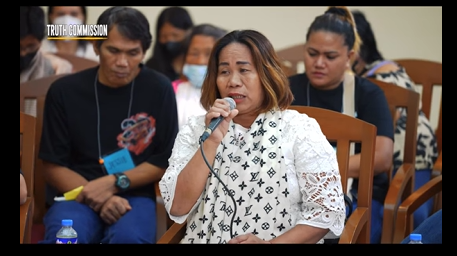
MANILA, Philippines—For 10 years, Mariza Hamoy has relived the eight-day search for her son after learning he was killed in an alleged drug buy-bust operation.
The incident occurred on the night of Aug. 15, 2016. Hamoy, a street sweeper in Payatas, was attending the wake of a coworker’s husband when her neighbors informed her that police had arrived and began shooting at people who attended a birthday party where her 17-year-old son Darwin was present.
Hamoy retold her story in the second session of the Philippine Truth Commission last August 29.
Neighbors said there was a ‘buy-bust” and that Darwin was wounded. They also heard police saying, “Tuluyan natin ito para malinis.” (Let’s finish this, to make it look clean).
Hamoy said she didn’t believe Darwin was involved in drugs. He was homeschooled in eighth grade and spent his time caring for his 5-year-old sibling and working as a laborer in the market.
She couldn’t find Darwin following the incident. Three days later, she went to the police station where she saw the spot report that described an unidentified male around 20 to 25 years old, about 5 feet 4 inches tall, slim and wearing a blue shirt and camouflage shorts. Hamoy said the description matched her son.
It took eight days for Hamoy to locate Darwin’s body, already embalmed at a funeral parlor in Kamuning. She was asked to pay for the funeral expenses but negotiated for an initial payment of P2,000. She also bought a new barong for her son, her final gesture for Darwin.
Long fight for justice
Hamoy said she and two relatives of other victims initially filed a complaint with the Ombudsman against the 16 police officers involved in the operation. But the Ombudsman ruled in 2018 that no testimonies on the incident were filed and dismissed the charges.
They also filed another case to the Philippine National Police, but the two other relatives withdrew, leaving Hamoy to pursue the case alone. That case was also dismissed recently.
She told the commission that she had endured the years of seeking justice for her son and expressed gratitude for the opportunity to share her story.
“I am the one who is hurt. This is my son. I carried her for nine months. As long as I’m alive, I will not give up,” Hamoy said.
Challenging the “nanlaban” narrative
Dean Raul Pangalangan, chairman of the Truth Commission, said there were gaps in police reports on the Aug. 16, 2016 incident, which typically follow official accounts that suspects resisted arrest.
He noted police transcripts described the operation as a buy-bust, but did not specifically identify Darwin.
Police forensic reports also raised questions from forensic pathologist Raquel Fortun during her presentation at the Truth Commission, where she questioned the documentation of Darwin’s injuries and the handling of evidence.
Darwin was initially listed as one of two unidentified victims in the police report. Later, the report stated that five men were killed while another person was injured in the incident.
Fortun also questioned the quality of the crime-scene documentation, pointing out that available photographs did not properly document the scene and that bodies were not shown in the crime-scene sketch.
She said the victims appeared to have been identified through relatives rather than through a systematic, professional identification process.
Darwin’s autopsy report indicated gunshot wounds to the trunk. The forensic review also found questions surrounding the trajectory of the wounds, with the examination describing injuries involving the chest, ribs, lungs and heart, as well as injuries to the lower extremity.
Fortun said the available records were not enough to conclusively reconstruct what happened to Darwin. She questioned whether the victims were immediately brought to hospitals for examination to avoid compromising evidence.
The Truth Commission was formed by Catholic leaders and human rights advocates in an effort to bring stories from families of victims of former President Rodrigo Duterte’s drug war to the public.
Duterte is now facing trial at the International Criminal Court (ICC) as his drug war is considered as “crimes against humanity” for its widespread killing of alleged drug offenders without due process.
The commission acknowledged that while the proceedings could help clarify the circumstances surrounding Darwin’s death and address the misconceptions, pursuing a criminal case would remain difficult without sufficient evidence.
But for Hamoy, she is grateful for the opportunity to tell the public what truly happened and what she felt in the past 10 years.
“I thought this is the way to get justice for my son,” she said. (davaotoday.com)


