
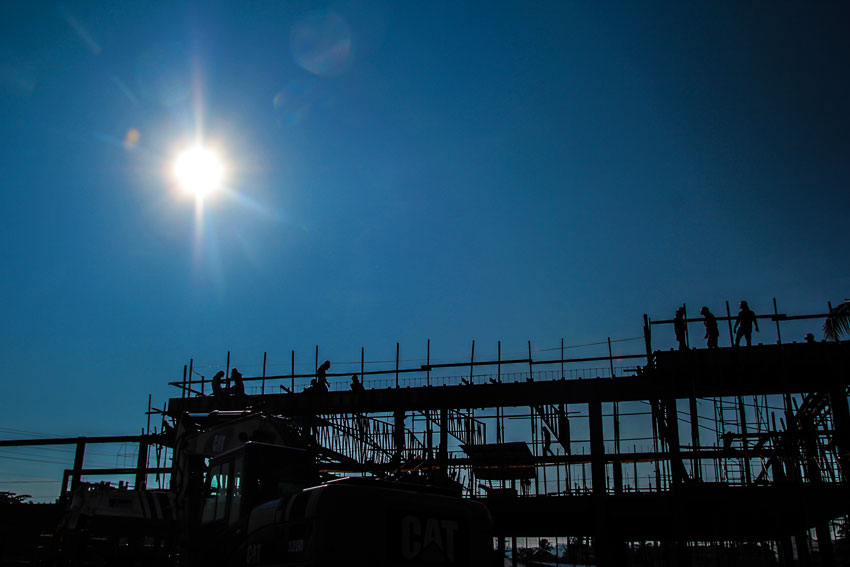
DAVAO CITY, Philippines—Street vendor Jay Elixir Rica, 40, expects sweltering weather to bring more customers for the juice he sells alongside siomai, fish balls and kwek-kwek.
Spending most of his working day under the sun means enduring heat he says is increasingly intolerable.
Rica sells street food across Kapitan Tomas Monteverde Sr. Central Elementary School at Poblacion District in Davao City. He starts selling at 8:30 a.m. and usually stops at 3:30 p.m., although he stays until around 4:30 p.m. to pack up.
He said the period between 10 a.m. and 3 p.m. would be the harshest time of the day.
“When there are no customers, I can take a break. But when it is busy and many people are buying, I cannot leave because I need to attend to them. When I feel that the heat has become too intense, I look for shade first. I also drink much more water now than I used to because it is really very hot,” Rica said in Cebuano.
Pedicab driver Jefferson Vismanos, 47, spends around 8 to 10 hours a day ferrying passengers around the city’s downtown area.
“The heat is really intense. It is difficult because you cannot escape it, and many people complain about how hot it is. So far, I have not felt sick because of the heat, but I have tried stopping for a while to rest and drink water,” Vismanos told Davao Today in Cebuano.
While the heat has not significantly affected his daily income, Vismanos worries about its potential consequences for his health.
“My concern is that I might suffer a heat stroke,” he said.
Rica also worries about heatstroke, although he has not experienced dizziness or other symptoms he associates with the weather. He has encountered information on protecting himself from heat-related illnesses on social media, while Vismanos has yet to find such guidance.
The accounts of Rica and Vismanos reflect the challenge facing people whose livelihoods keep them outdoors in intense heat.
Their concerns come as the Philippine Atmospheric, Geophysical and Astronomical Services Administration (PAGASA) warns that a strong to very strong El Niño is present in the tropical Pacific, could persist through the first quarter of 2027 and may continue to affect the region through the first half of the year.
The El Niño increases the likelihood of below-normal rainfall, dry spells and drought in some areas.
Health surveillance strengthened
Anticipating the effects of El Niño, the Davao City Health Office has begun strengthening surveillance for heat-related illnesses including dehydration, heat cramps, heat exhaustion and heatstroke.
Farah May Clamor, head of the City Epidemiology and Surveillance Unit, said preparations also covered the protection and conservation of water sources.
“We are also looking at how to conserve water and keep it clean, disease surveillance and outbreak preparedness. It is part of our public health advisories and preventive health advisories,” Clamor said in Cebuano.
Clamor identified waterborne diseases, food poisoning and dengue as other concerns.
She advised the public to prioritize safe drinking water, handwashing and sanitation, and to avoid leaving food exposed to heat. She also urged residents to keep their surroundings clean to reduce potential mosquito-breeding sites.
On Oct. 19, Dr. Honey Christine Dasmariñas, a medical officer at the Southern Philippines Medical Center (SPMC), also urged Davao residents to drink water regularly even when they are not thirsty.
“Once you feel the heat in your body, then you have to go to a cooler shade or cooler area,” she said, advising workers to carry drinking water and wear loose, breathable clothing. She also recommended scheduling outdoor activities during cooler periods, particularly early in the morning or after 4 p.m.
As of Oct. 19, SPMC did not record a significant increase in cases of heatstroke, dehydration or other heat-related illnesses.
Disaster risk Preparedness
Dr. Ritze Burgos, the City Health Office’s disaster risk reduction and management in health program medical coordinator, said the office would conduct daily heat-index monitoring as part of its preparedness measures.
Preparations also include public health promotion and ensuring the availability of medical supplies needed to maintain health services.
The City Disaster Risk Reduction and Management Office (CDRRMO) is also monitoring possible effects of El Niño beyond heat exposure.
“Our concern is also not limited to the impact on agricultural production and food security. We are also concerned about farm fires, forest fires and bush fires,” said Agnes Padinas, a CDRRMO geologist.
Rodrigo Bustillo, CDRRMO operations and warning division head, said there will be heat-index bulletins and coordination with city officials if high heat indices warranted limiting or suspending daytime activities.
“If the heat index is high, we will eliminate activities during daytime, from around 9 or 10 in the morning until 2 in the afternoon,” Bustillo said.
The city’s preparations also include monitoring water availability and ensuring that fire hydrants remain functional, Bustillo said.
“At present, we are not yet at the level where Water District has reported a critical shortage affecting domestic use. However, considering the current situation, we expect a possible reduction in our water sources,” he said. (davaotoday.com)

