
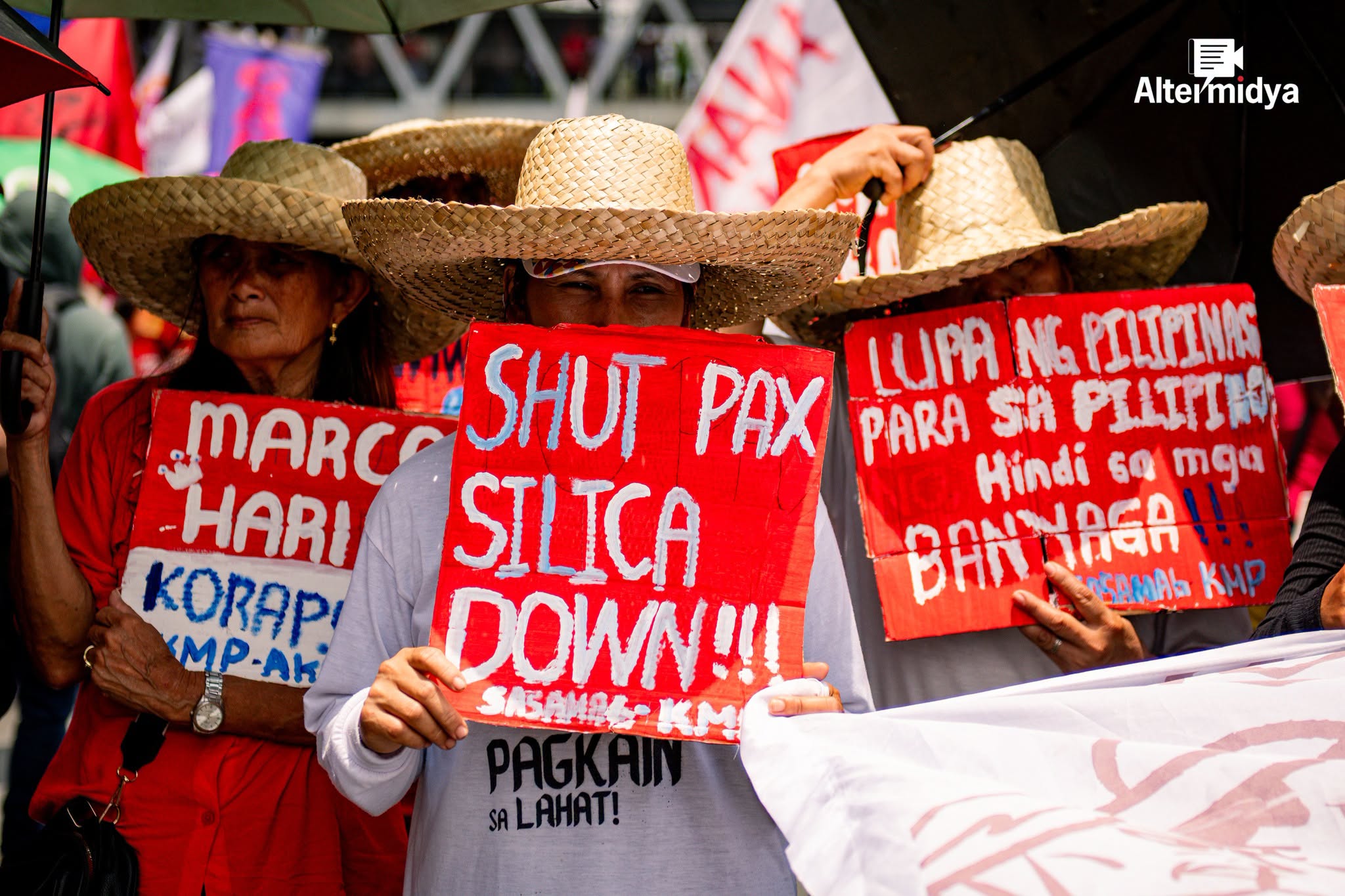
DAVAO CITY, Philippines—Groups warn that the Philippines will likely stay a raw materials and labor supplier rather than become a tech manufacturer—leaving Mindanao as a critical mineral source for global technology chains.
This concern emerged as a panel of environmental advocates, educators, and student leaders raised vital issues regarding the controversial U.S.-led Pax Silica Initiative, a semiconductor and artificial intelligence (AI) investments.
At a forum at Ateneo de Davao University on Aug. 29, the panelists questioned whether Pax Silica Initiative would benefit workers, indigenous communities and national sovereignty—or extract resources at their expense.
Lance Vicher of the Alliance of Nationalist and Genuine Labor Organizations (ANGLO-KMU), said the Philippines remains at the lower end of the global semiconductor supply chain, providing minerals and labor while foreign companies control technology, design, patents and intellectual property.
International trade rules, Vicher said, limit the country’s ability to develop technologies independently, leaving manufacturers dependent on foreign patents, licenses and royalty payments.
“Why is this of interest to the U.S.?… It’s important to discuss why the U.S. is pursuing this, because the materials used in electric vehicles are also used for war,” he said, speaking in Tagalog.
He identified Mindanao as a key target, noting that 95% of the country’s nickel originates there. “The millions of metric tons we export—almost giving it away for free— at the expense of ancestral lands of indigenous peoples, are being shipped to other countries. That’s almost like a sell-out or giveaway,” added Vicher.
The resource extraction tied to Pax Silica could extend beyond the proposed 1,619-hectare site in Clark, he said, pointing to Executive Order 122 which opens nine million hectares for mineral prospecting and accelerates mining permit processing and free, prior and informed consent (FPIC) protocols.
Technology, labor and the US-China rivalry
Vicher said Pax Silica, the Luzon Economic Corridor, and expanding military agreements with the U.S. form part of a broader strategy to strengthen Washington’s position against China.
The proposed Clark hub serves two strategic purposes: securing critical minerals from U.S.-aligned countries and establishing an alternative semiconductor base should conflict disrupt Taiwan’s dominant role in global chip manufacturing.
“If war breaks out, they say Taiwan will be blockaded. Since Taiwan is the world’s semiconductor manufacturer, they need an alternative, and the Philippines will be that,” he said.
Vicher warned that placing strategic facilities in the Philippines could make the country more vulnerable to conflicts involving the U.S. and China, particularly if infrastructure supporting U.S. interests is located on Philippine soil.
He also contrasted the country’s expanding military cooperation with the United States with ongoing shortages in public services and persistently low wages.
“U.S. funding is pouring into our military. Meanwhile, our schools are underfunded, our communities are being demolished, our hospitals are critically short on resources, and our workers are underpaid.”
Who controls the tech?
Danica Peralta of the Junior Social Workers Association of the Philippines (JSWAP) said opposition to Pax Silica is not about resisting technological advancement, but about who controls the technology and benefits from it.
She urged independent research and evidence-based scrutiny of government and investor claims rather than accepting projected job creation and economic gains at face value.
“We are not against AI advancement,” Peralta said. “But the Philippines should own it.”
Ron Dulhao, an electrical engineering student and a member of Ateneo Human Empowerment and Advocacy Response Team (HEART) of Ateneo de Davao University (ADDU), argued the country could develop its own technological capabilities if the government invested more in local industries, Filipino engineers and workers.
“If the government supported Filipino engineers… and capability to build Pax Silica through public-private collaboration, it could already happen,” Dulhao said.
Health, food security risks
Dr. Jean Lindo of Gabriela Southern Mindanao warned the initiative—a war apparatus of U.S. military-industrial complex—could create health risks for communities exposed to mining and industrial pollution, particularly where government health and regulatory systems remain inadequate.
“The problem isn’t just silica. All other minerals will have dangerous health effects on communities: cancer, fetal deformities, reproductive health problems,” Lindo said. She noted that rural health facilities lack capacity to address illnesses associated with industrial pollutants while environmental agencies struggle to effectively monitor pollution.
Aene Comiling of Metsa Foundation, which works with Indigenous and peasant women, highlighted how technology can be used to gather information about agricultural and Indigenous lands. She said AI-enabled machinery can collect land data while appearing to perform ordinary agricultural or construction work.
“The bulldozers, the tractors, the backhoes—you think they’re just leveling the land, but they’re extracting data. Mapping topography, identifying what minerals are there,” added Comiling.
She said control over such information could become another means of controlling land and resources, citing that data collection is essentially a method of dispossessing farmers and Indigenous peoples who primarily produce food.
Dr. Doris Montecastro, chair of the Environmental Science Department of ADDU, said environmental assessments struggle to account for losses that cannot be measured in financial terms.
“If crop fields disappear, food disappears—that can be given a monetary value. But cultural heritage, especially ancestral domains, have value too, the sanctity of it—but what price do you put on that?” Montecastro asked, speaking in Tagalog.
She also questioned whether existing environmental regulations and assessment processes are adequate for projects of the scale envisioned under Pax Silica.
A question of sovereignty
Heroine Fernandez, coordinator of the League of Filipino Students Davao (LFS-Davao), framed the initiative within the country’s longstanding political and economic relationship with the U.S.
“We are still a neo-colony of the United States, and Pax Silica is just another manifestation of U.S. imperialism,” Fernandez said. “When you displace a community, it’s not just people being removed—it’s the community, the identity,” Fernandez said. “Beyond technological perspectives, we must look at humanity and social science perspectives.”
Vicher said the alternative should not be the rejecting all foreign investment or technology, but rather a development policy that gives Filipinos greater control over industries, technology and resources. “We will allow foreign investment under three conditions: our industries must be nationalized, with state and worker control.”
He called for technology transfer and compliance with the Constitution’s 60-40 ownership rule, alongside national industrialization and genuine land reform.
For Vicher, the immediate task is opposing the initiative while pushing for an economy that can develop its own industries rather than remain dependent on foreign capital, technology and markets.
The Philippines is among 25 signatories to Pax Silica. Its proposed Clark Advanced Manufacturing Park would serve as an “AI-native investment acceleration hub” involving several US allies. (davaotoday.com)


