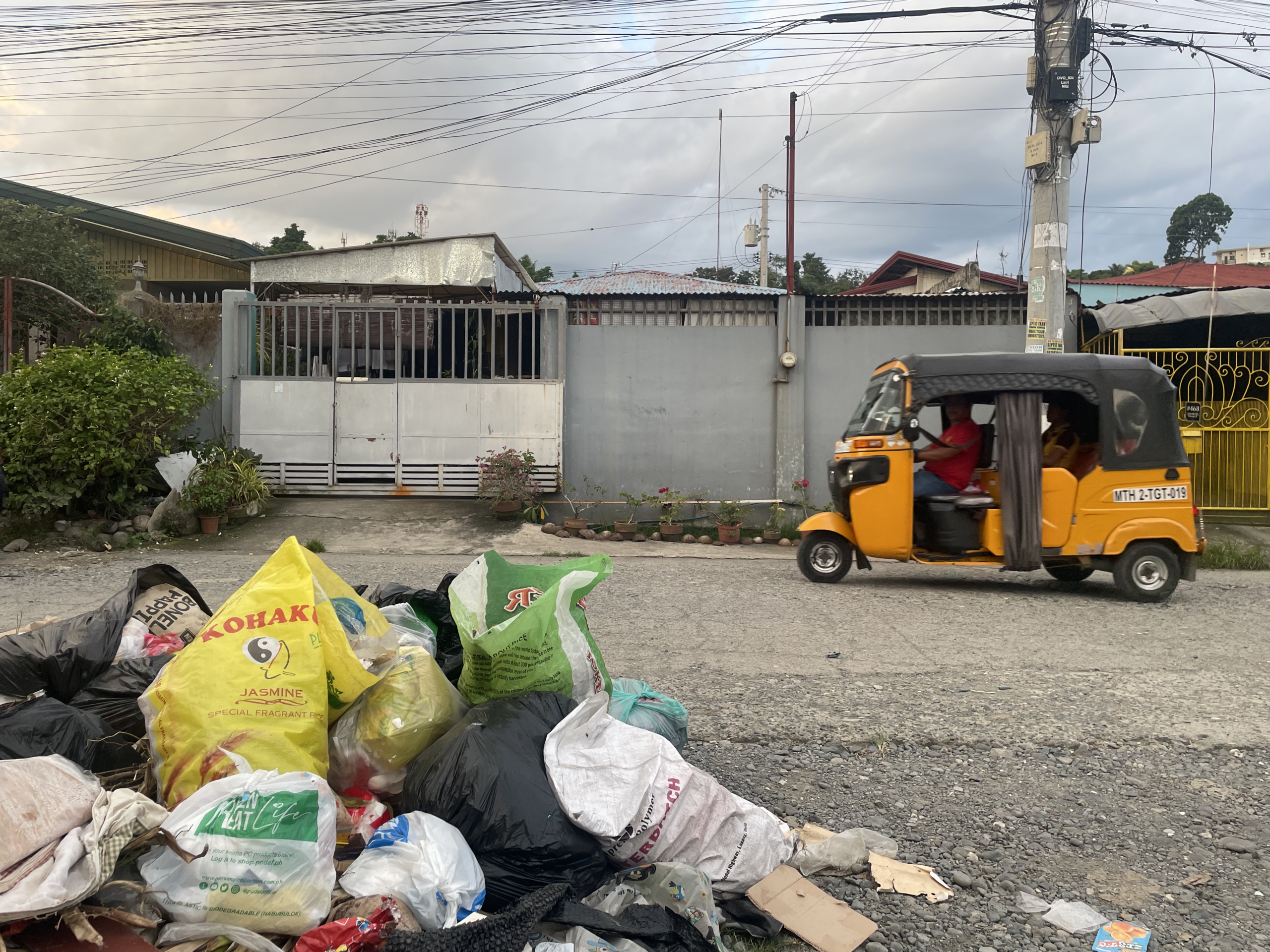
DAVAO CITY, Philippines – While most streets in the Juliville Subdivision in Barangay Tigatto appeared clean, inner sections of the neighborhood remain choked with trash three weeks after garbage collection halted due to a landfill closure.
Sacks of garbage line the gates of homes along Tambis Street, where a broken-down tricycle loaded with refuse sits parked outside one residence.
The backlog stems from the closure of the city’s sanitary landfill in New Carmen, Tugbok, on May 20 following a waste collapse.
The City Environment and Natural Resources Office (CENRO) initially asked residents to withhold trash as collection systems were disrupted.
“As much as possible, communities should not take out their trash yet because the collection system has become abnormal since the trash-slide,” said Leopoldo Baguio, a barangay councilor who heads the committee on environment and agriculture.
Although collection resumed in the second week of June, residents report inconsistent schedules. While some streets saw pickups, Tambis Street has remained uncollected since the closure.
Home remedies
“It reeks of the dead,” said Junjun Gonzaga, a resident of Tambis Street. He said a nearby dump truck often fills up before reaching his area.
Gonzaga and neighbors have resorted to home waste management, segregating plastics and cans. However, with CENRO often failing to collect yard waste, some residents burn dry leaves and branches in small amounts.
Violy Gelicame, an elderly resident caring for her husband with Alzheimer’s, expressed health concerns over the accumulating waste.
“I use black trash bags so it doesn’t smell, but the food waste is infested with worms and flies,” Gelicame said. “Thank God, we’re not getting sick because of it.”
A new landfill in Davao City, constructed to replace the overfilled New Carmen site, officially opened June 18 after receiving clearance from the Department of Environment and Natural Resources-Environmental Management Bureau (DENR-EMB) Region 11.
Despite the new facility’s opening and resumption of city-wide collections, garbage piles remained outside homes on Tambis Street as of June 19.
Trash was also visible along the main road of the adjacent Jade Valley Homes on June 18.
CENRO was unavailable for comment.
Rising city, rising dump
The waste crisis challenges Davao City’s reputation as one of the cleanest urban centers in Southeast Asia, a status it held in the 2024 Mid-Year Numbeo Pollution Index.
With a population exceeding 1.8 million, the city faces mounting pressure to manage waste generated by rapid urbanization and a surge in online shopping.
The New Carmen landfill was declared overfilled a decade ago, but a waste collapse last month forced its closure and accelerated the new site’s completion.
“This issue on waste accumulation shows that the current waste management system is not yet enough,” said Kristin Faye Olalo, an assistant professor at the University of the Philippines Mindanao and researcher on the city’s solid waste management.
Olalo emphasized the need to understand Davao City’s waste sources, noting that the rise in online shopping has increased residual waste that cannot be properly disposed of.
Olalo said there is a need for backup systems to prevent vulnerability during emergencies.
Mawing Pangadas, spokesperson for Panalipdan Youth-Davao, agreed that a new landfill alone is insufficient without a comprehensive waste management plan.
Green groups advocate for zero-waste solutions, including recycling and composting, opposing the city’s long-pushed waste-to-energy incineration program.
“(The city government) really hasn’t kept up. There should be a Zero Waste program, but we don’t have that,” Pangadas said.
Critics also point to issues with the Material Recovery Facilities (MRFs) established in 53 barangays, some of which were built merely to meet compliance standards.
As the city grapples with these systemic failures, residents in neighborhoods like Juliville continue to shoulder the burden of the reeking waste. /Marianne Guinoo,UP Mindanao Intern(davaotoday.com)