
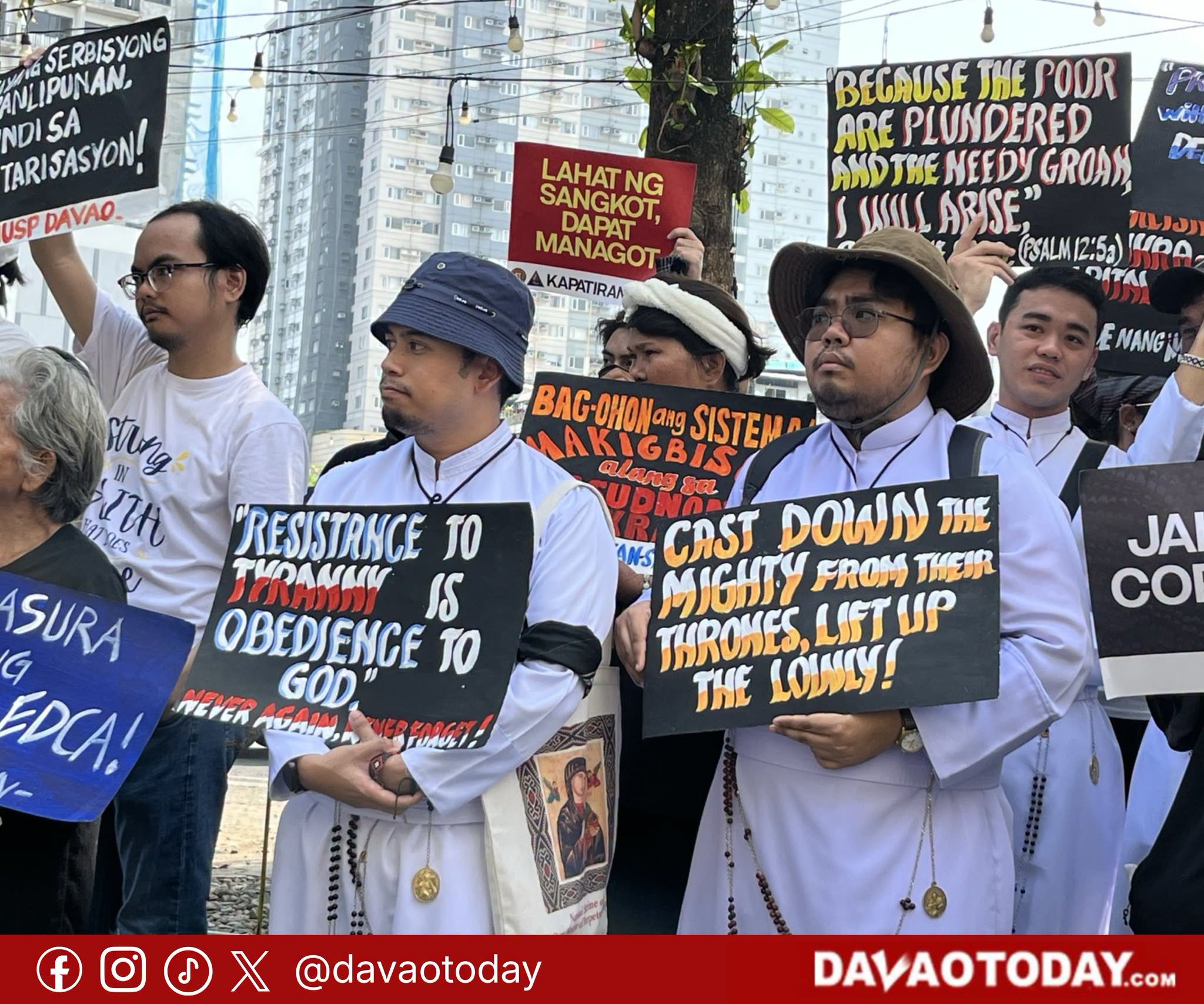
DAVAO CITY, Philippines—Survivors of the martial law and human rights advocates in Davao City criticized treating the dark years under the late President Ferdinand Marcos Sr. as plainly a historical commemoration.
They argued that 54 years under martial law, the struggle for justice remains elusive as abuses and impunity continue to persist under the administration of President Ferdinand Marcos Jr.
The Stand in Opposition to Plunder (STOP) Corruption Alliance, church groups, youth organizations, and human rights advocates marked the anniversary by honoring the victims of martial law-era atrocities and calling for accountability for abuses and corruption under the current administration.
Fe Salino, spokesperson of Samahan ng Ex-Detainees Laban sa Aresto at Detensyon-Southern Mindanao Region (SELDA-SMR), said martial law is not simply a date in the country’s history.
Salino was a political prisoner during martial law. She recounted her experiences living under a state that had immense power yet possessed little to no accountability.
“We know what it means to be imprisoned simply for speaking out, organizing, taking a stand and fighting for the people,” Salino told Davao Today in Cebuano.
She rejects the narrative that the Marcos Sr. regime was the country’s “golden years” as it disregards those who were arrested, tortured, killed or forcibly disappeared, simply for resisting the dictatorship.
“What ‘golden years’? For whom? Because for me, it’s a different story,” Salino said.
Amnesty International estimates put the number of people arrested or imprisoned during the martial law at about 70,000, those tortured at about 34,000 and those killed at 3,240.
Salino said Amnesty’s count includes people whose families continue to still seek justice. Her husband disappeared during martial law and was later confirmed killed.
The question of accountability came into sharper focus with the Supreme Court’s recent acquittal of former First Lady Imelda Marcos in a long-running graft case.
The Supreme Court’s decision, dated June 10 and uploaded on Sept. 9, reversed the Sandiganbayan’s 2018 conviction of Imelda on seven counts of graft. The Court found that the prosecution failed to prove her guilt beyond reasonable doubt.
Salino said the decision was painful for survivors who have spent decades seeking justice and reparations.
“As victims and survivors of martial law, we cannot help but feel the pain of this decision. Filipinos, us, have truly experienced the damage left behind by the dictatorship.”
From “Never Again” to present-day repression
Fr. Ely Cayao, chairperson of Karapatan Southern Mindanao, believes the repression faced today by people subjected to arbitrary arrests, red-tagging, surveillance and harassment warrant scrutiny and action than just commemorating the martial law.
“As we recall the human rights violations of the past, the people today continue to experience various forms of silencing and intimidation. Simply saying ‘never again’ is not enough. We must ask ourselves: how do we ensure that this does not happen again?” Cayao said in Cebuano.
Cayao cited the case of at least 14 activists whose names and photographs were posted on the official Facebook page of the Cateel Municipal Police Station in Davao Oriental in May, where they were labeled “active wanted persons.”
Police Major Michael Celecio, chief of the Cateel Municipal Police Station, has since apologized and acknowledged that the posting was an error, confirming that none of those named had pending arrest warrants.
Cayao also called for the resumption of the peace talks between the Philippine government and the National Democratic Front of the Philippines (NDFP).
“Peace is not merely the absence of guns. Peace is not merely the absence of war. True peace requires justice,” he said.
Br. Luke Gealogo of the Redemptorist Brothers, meanwhile, said the church’s role in remembering martial law is inseparable from standing with communities facing injustice.
Gealogo said church workers must continue confronting social structures that deny people their rights, as many church workers did during martial law.
“We must address not only the spirit but also the tangible needs of the people. Let us follow Jesus, and the example of those who came before us during the time of martial law. Let us serve the people,” he said in Tagalog.
Corruption still persists today
Former Bayan Muna party-list Rep. Carlos Isagani Zarate framed martial law’s impact not only in terms of political repression but also in the economic consequences of the regime.
“When Marcos Sr. was ousted, he had a debt of nearly $30 billion for the Filipino people to pay. This debt is the wealth plundered by his family and utilized by his cronies and other accomplices,” Zarate said in Cebuano.
The Philippines’ external debt had risen sharply during the Marcos Sr. years, reaching about $26 billion in 1984-1985, according to an International Monetary Fund historical study.
The protest’s anti-corruption message was also tied to the current controversy over government flood-control projects.
STOP Corruption Alliance spokesperson Elliot Dimasuhid said the commemoration also revives calls to hold accountable those involved in the flood-control scandal.
“Now, the call for accountability is directed at the lawmakers and contractors involved in the flood control issue. It is clear that the son of a dictator who has long been indebted to the people should not be allowed to remain in power,” Dimasuhid said in Cebuano.
Salino urged young Filipinos to listen to survivors, political prisoners and families of victims, remembering the dictatorship through the lens of those who suffered under it.
“Do not allow history to be rewritten so that the perpetrators become heroes and those who struggled become criminals,” Salino said. (davaotoday.com)


