
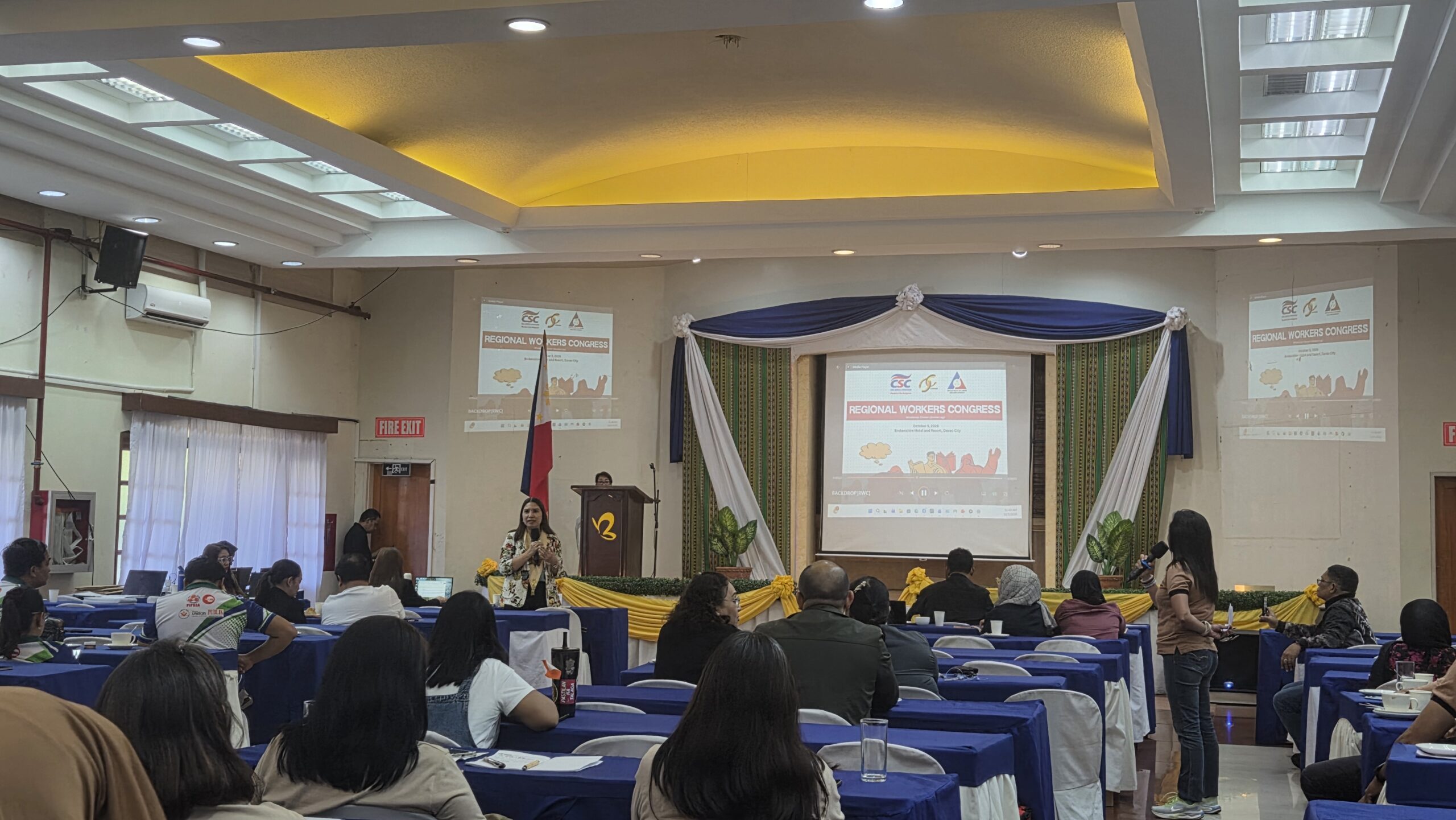
DAVAO CITY, Philippines—The Confederation for Unity, Recognition and Advancement of Government Employees (COURAGE) warned Monday that the declining of number of government workers’ unions could worsen as the space for collective advocacy narrows.
Jean Orsolino, international affairs officer of COURAGE, said labor-only contracting, red-tagging and government policies are among the major reasons union density in the public sector is declining relative to the number of government employees.
“A lot of unions are being identified as, not exactly left-leaning, but even just being progressive. So those are matters that probably attribute to the declining number of unions in the government sector today,” Orsolino said during the Regional Workers’ Congress-Mindanao Cluster Davao Leg held on Oct.5.
Government workers’ unions in Mindanao are losing ground as fewer employees participate in organizing efforts or union activities. Only a few unions remain active in speaking about issues affecting government workers, including salaries, benefits, job security and democratic rights.
The Civil Service Commission (CSC) reported 2,156 registered employee organizations nationwide, 74 of which were new registrations in 2025. The commission noted that 67 of these earned accreditation, allowing them to represent and negotiate for rank-and-file employees in their agencies.
Orsolino said the question is not only the number of registered organizations, but whether unions remain active enough to defend workers and whether inactive ones be encouraged to organize again.
“Only a few are organized and if there are a few organized unions and associations, [they are] inactive. They are just there to represent the government employees but not exactly to fight for the rights of the employees,” Orsolino said.
When unions are weak
Anabelle Dominguez, a senior accounting processor at Davao City Water District (DCWD) and president of the Nagkahiusang Mamumuo sa Davao City Water District (NAMADACWAD), has worked at the utility for nearly 25 years and served two consecutive terms as president.
After the Commission on Audit (COA) disallowed benefits previously provided to local water district employees, Dominguez’s union established replacement programs for members, including medical assistance, medical loans and financial aid upon retirement or resignation.
“Since management cannot provide them, our union is currently looking for ways to replace the benefits that COA removed,” Dominguez told Davao Today in Cebuano.
The union also gives workers a mechanism to raise concerns through a labor-management council, where union and management representatives meet to resolve issues. Dominguez said the same principle should apply before policies affecting employees are implemented.
“Not just from the management, they should also listen to representatives from the employees,” she said.
Lack of job security
Collective action can be more difficult for workers without permanent positions.
Rauf Sissay, representative of Bagong Alyansang Makabayan (BAYAN) Southern Mindanao Region, cited contractualization as another barrier to organizing.
Growing number of job order (JO) and contract-of-service (COS) workers leaves many government employees without the union and bargaining arrangements available to regular staff, Sissay said.
“Compared to previous times, the rate of unionization among government employees has decreased. This is because of the contractualization scheme implemented by the government,” Sissay said in Cebuano.
A 2025 joint circular from the CSC, COA and Department of Budget and Management (DBM) capped Jos and COS workers at agencies’ end-2025 baseline and directed agencies to review staffing needs, including the possible absorption of contractual workers into plantilla positions. The freeze order permits agencies only to renew existing contracts or fill vacancies, and excludes local government units and engineering and administrative overhead expenses personnel.
Gov’t Optimization Program
Sissay also called for a P36,000 monthly living wage for rank-and-file government employees and the repeal of the government’s optimization policy.
The Government Optimization Program is being implemented under Republic Act No. 12231, or the Government Optimization Act, signed into law in August 2025. The law allows government agencies to reorganize structures and abolish, consolidate or streamline functions and positions considered deemed redundant.
“We, in COURAGE, have always maintained our position that we are opposed to the government optimization program because this will only lead to retrenchment, termination of jobs [and] displacement of workers in the government sector,” Orsolino said.
COURAGE had submitted position papers opposing the measure and held lobbying, rallies and discussions before its enactment, she added.
Rebuilding workers’ collective voice
Despite the policy changes, Orsolino said rebuilding workers’ organizations remains crucial to ensuring a collective voice on decisions affecting their work and welfare.
The congress discussed the International Labour Organization (ILO) Convention 151 in the context of strengthening the institutional framework for public-sector unions.
Orsolino, who headed the preparatory committee for the Davao leg, said the gathering aimed to reconnect government unions and associations—including inactive groups—and develop a common platform on workers’ concerns.
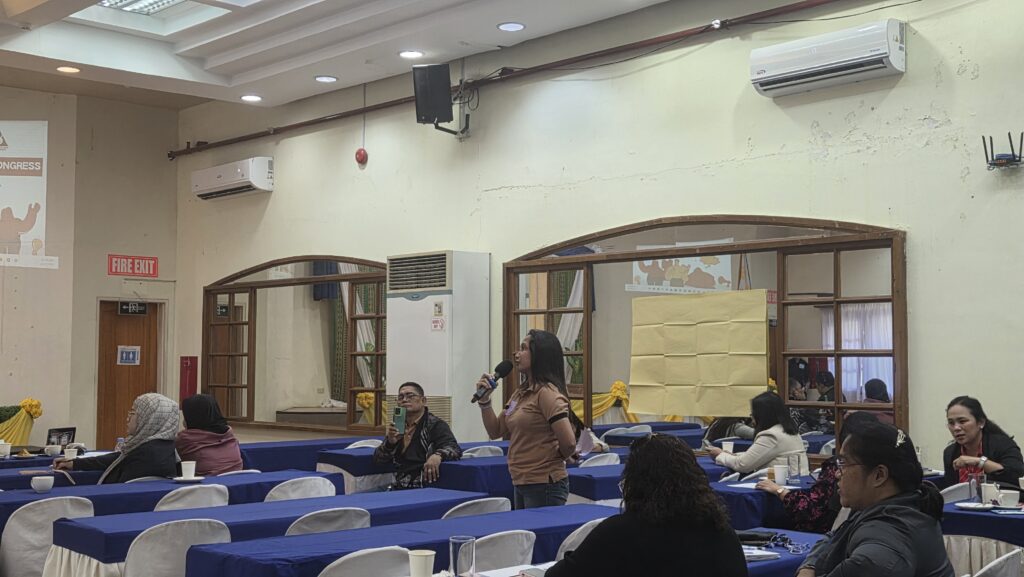
“We are hoping this congress will be a tool, will be a venue for government unions and associations to bond, to reach out, to strengthen our grounds,” she said.
The Davao leg brought together government workers and representatives from Davao Region, Soccsksargen, and the Bangsamoro Autonomous Region in Muslim Mindanao. Another leg is scheduled in Cagayan de Oro on Nov. 26. (davaotoday.com)


