
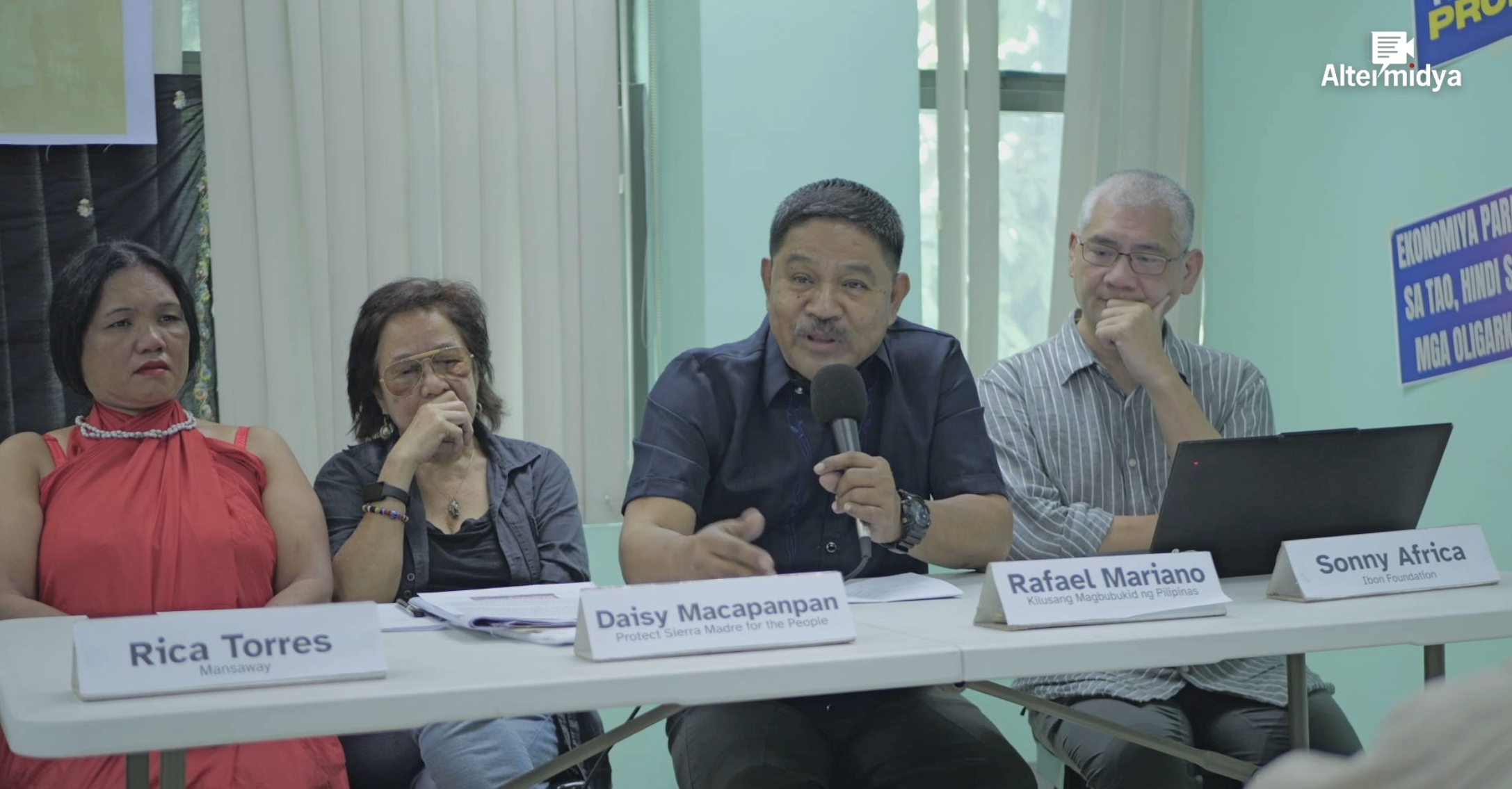
MANILA, Philippines — On the last day of the ASEAN Energy Business Forum on Oct. 6, civil society organizations (CSOs) held a counter news conference flagging the country’s energy plight—privatization, deregulation and renewable energy expansion.
While corporate leaders and government officials gathered at the Philippine International Convention Center for the energy forum, the CSOs comprising grassroots groups and environmental advocates discussed the effects of large-scale energy projects on agricultural and Indigenous communities, including reported environmental damage, disruptions to livelihoods, displacement and inadequate consultation.
Advocates demanded for greater public control over privatization in the energy sector that is causing high electricity rates and reforms to policies governing electricity generation and distribution and renewable energy development.
The groups criticized the Electric Power Industry Reform Act (EPIRA) because decades of privatization and market-oriented policies have failed to make electricity affordable for Filipinos.
Scourge of energy sector
Sonny Africa, executive director of IBON Foundation, questioned whether privatization and deregulation have achieved their intended benefits for consumers.
“If privatization, deregulation, and investor-driven reforms are the solution, why is electricity still so expensive for Filipinos?”
The success of an energy transition, Africa said, should be measured not only through investments and installed capacity but also through its effects on consumers and communities.
Engineer Julius Roa of Pro-People Engineers and Leaders (PROPEL) said about 70% of the Philippines’ power generation is controlled by five families, while the transmission sector remains under the private National Grid Corporation of the Philippines (NGCP).
Roa criticized the 25-year old EPIRA for failing to address the costly price of electricity despite the law’s goal of promoting reliable and affordable power.
Solar projects
Representatives from communities affected by renewable energy projects complained about large-scale solar developments that affected agricultural production, access roads and local livelihoods.
Marvin Resilva of Sitio Sangilo United Farmers Association in Gapan, Nueva Ecija said the construction of solar projects in his community has dried up some of his crops, like bananas and vegetables.
Resilva also said access to the community has been restricted because roads have been blocked.
Rica Torres, coordinator of Mansaway in Central Luzon, criticized the expansion of renewable energy projects such as the Olongapo Solar Project operated by Aboitiz Power Renewable Energy Corp. (APREC) affecting farmers and Aeta communities.
She alleged the project did not undergo the mandatory Free, Prior and Informed Consent (FPIC) process for areas belonging to Indigenous communities.
“There is no electricity and water in some AETA communities in the area,” Torres added.
Environmental risks, lack of consultation
Residents opposing a proposed wind energy project on Talim Island in Laguna fear environmental impacts from the project because of a lack of consultation.
Sean Rosales of Save Laguna Lake Movement said the proposed project involves VENA Energy—the largest independent renewable energy developer in the Asia-Pacific Region—and its subsidiary Island Wind Energy Corp. (IWEC). The project will entail the construction of 34 wind turbines in their community.
“The wind turbines are not yet being built in our area, [but] we already felt the effects like flooding and landslides from the clearing operations and earth-moving that was done by VENA Energy,” Rosales said.
He also alleged that their resistance is being met with militarization and other forms of pressure to quell opposition.
Marilou Dabon, representing Balimpuyo Farmers in Olongapo, criticized the Department of Environment and Natural Resources (DENR) over its handling of renewable energy projects in the area.
“We were hoping the DENR would be our ally… But it has become the spokesperson of Aboitiz,” Dabon said.
Power interruptions
Recurring power interruptions and the reliability of the country’s electricity supply were also raised at the news conference.
In recent months, the NGCP’s Visayas and Mindanao grid experienced red and yellow alerts over tight power supply and unavailability of several power plants.
Bishop Gerardo Alminaza of the Diocese of San Carlos called for stronger government regulation and greater accountability from private power companies.
“The poorest consumers are often the most vulnerable to power interruptions and rising electricity costs, while decisions made today will shape the energy system inherited by generations yet to come,”
Alminaza said in a statement read during the news conference.
Irma Espinosa, convener of the Panay Consumers Alliance, said nine of the region’s 47 power plants were not operational, 16 were operating below capacity and 22 had remained unused since 2021.
“Residents do not control when a plant experiences a forced outage or when a generator fails… But when the electricity supply is insufficient, consumers lose power and have to pay for high electricity rates,” Espinosa said.
Advocates called for changes to the country’s energy policies, including the repeal of EPIRA and the return of the electric power industry to public control.
They also called for the removal of value-added tax (VAT) from electricity and fuel bills, stricter compliance with public consultation and FPIC requirements before renewable energy projects are approved, and investigations into private power companies over unannounced outages and grid failures. (davaotoday.com)


